If I Planned Costa Rica Again, Here’s Exactly How I’d Do It
This post is part of my Central America series, following a three-week trip through Panama, Costa Rica, Nicaragua and El Salvador. I share what we did, how I handled transportation and planning, and what I’d do differently next time. You’ll find related guides in the Explore Central America section at the end.
A week in Costa Rica gave me many of the experiences I’d hoped for: volcano views in La Fortuna, hot springs after an active day, ziplining in Monteverde and a quiet finish on the Pacific coast. It also made me realize that choosing what to leave out is one of the biggest decisions you’ll make when planning a trip here.
The best Costa Rica itinerary depends on what you want to spend your days doing and how much time you’re willing to spend getting between places. A trip built around wildlife could look quite different from one focused on surfing, cloud forests or afternoons by the pool. Trying to include all of them can quickly turn a week of vacation into a series of transfers.
If I were planning my first visit again, I’d keep some of our route, give La Fortuna more time and be more deliberate about each additional stop. Here’s how I’d choose between the places we visited and the destinations on my return list, with route ideas for five days, one week, ten days or two weeks.
Planning a Costa Rica Itinerary at a Glance
My starting point: La Fortuna for volcano views, waterfalls, hanging bridges and hot springs. I’d give it at least three nights.
With one week: Combine La Fortuna and Monteverde for an active trip without adding another region.
With ten days: Add Pacific beach time in Guanacaste, or consider Manuel Antonio if wildlife is a bigger priority.
Before booking: Compare San José and Liberia against your full route, including the time needed to travel between bases.
What I’d do differently: Give fewer places more time. My recommendations combine firsthand experience in La Fortuna, Monteverde and Guanacaste with research for a return trip.
Flying Into San José or Liberia: Start With Your Route
One thing I appreciated about Costa Rica is how flexible it is to plan.
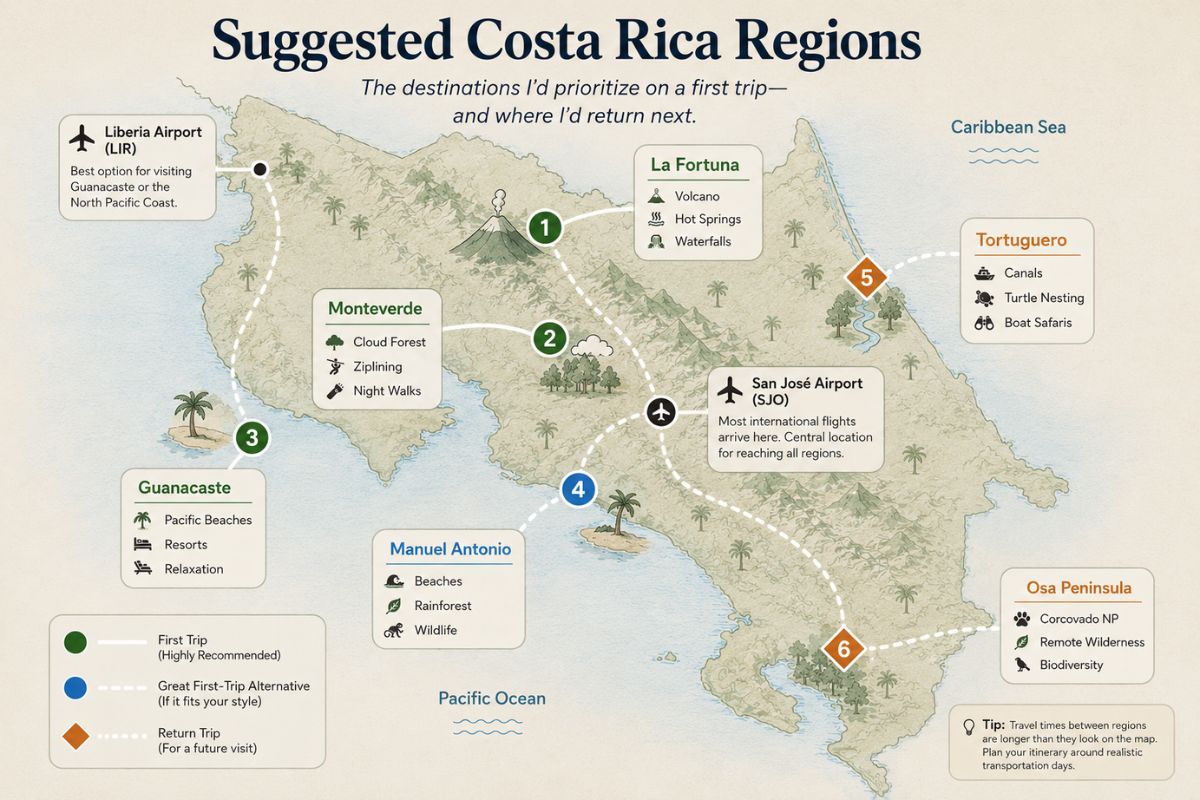
Most travelers fly into either San José (SJO) or Liberia (LIR) depending on where they’re spending their time. Since our trip focused on La Fortuna and Monteverde before ending along the Pacific coast, flying into San José made the most sense.
Getting between destinations takes longer than the map suggests, so I’d also recommend thinking carefully about your transportation before falling in love with a particular itinerary. Whether you rent a car or rely on shared shuttles like we did, building realistic travel days will make the trip much more enjoyable.

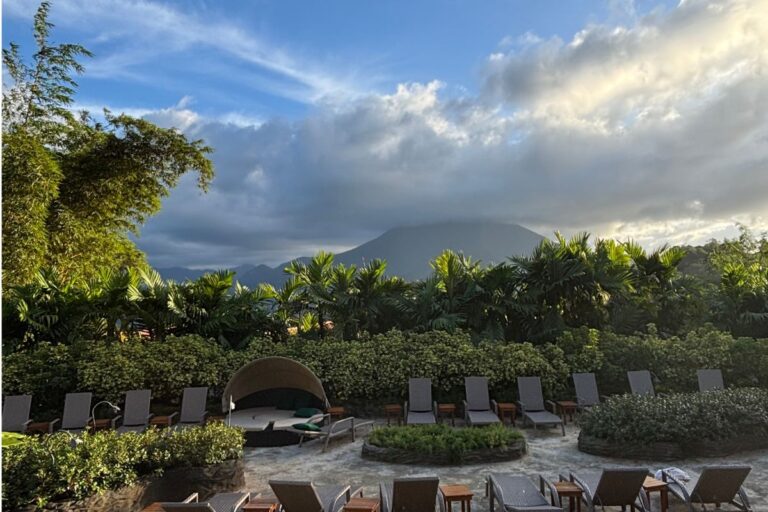
La Fortuna offers one of the best introductions to Costa Rica, combining volcano views, waterfalls, hot springs, wildlife, and adventure activities into one easy-to-explore destination.
La Fortuna: My First Choice for a First Costa Rica Trip
If I were choosing just one base for a first trip to Costa Rica, I’d pick La Fortuna. Between Arenal Volcano, waterfalls, hanging bridges, wildlife walks and hot springs, it gave me the variety I’d hoped for without needing to change hotels for every experience.
What worked especially well was being able to balance active days with quieter ones. You could spend a morning walking through the rainforest with a guide, then leave the afternoon for lunch and a soak in the thermal pools. Or dedicate a day to hiking and follow it with a slower start the next morning. There’s plenty to fill your time, but you don’t have to turn every day into a full excursion.
I’d spend at least three nights here, giving you two full days between arrival and departure. If you want to include several hikes, a day trip or more time at the hot springs, I’d consider a fourth night. We enjoyed our first evening soaking at The Springs Resort, but were too tired after the following day’s activities to return. Another night would have given us room to use that second-day admission.
For a trip focused on nature, I’d start with La Fortuna Waterfall and a guided walk at Mistico Hanging Bridges, two experiences I particularly enjoyed. Arenal Volcano National Park and the separate Arenal 1968 trails offer additional hiking options, while Río Celeste is another possibility if you’re willing to dedicate a day to traveling farther afield.
The main planning distinction is that staying in walkable downtown La Fortuna doesn’t put all these attractions within walking distance. I liked being able to reach restaurants on foot, but we still needed transportation for our excursions. I’d group activities thoughtfully and protect some downtime rather than assume everything nearby belongs in the same day.
Monteverde: Add Cloud Forests, Ziplining and Coffee Tours
Monteverde gave our trip a different atmosphere after La Fortuna. The cooler air and forest scenery made it feel like a worthwhile change of base, and some of my favorite memories came from how we chose to spend our time there.
I’d include Monteverde if its cloud forests and activities genuinely interest you, rather than adding it simply because it often appears alongside La Fortuna. Both places offer wildlife walks, hanging bridges and adventure activities, so you don’t need to repeat a similar experience at every stop. I’d decide what appeals most in each destination before filling the itinerary.
For me, ziplining was the experience I wasn’t going to skip. My friend preferred a coffee tour, and spending that afternoon separately meant neither of us had to compromise. We met again for dinner with new travel friends and plenty to talk about, which became as much a part of my memory of Monteverde as the activities themselves.
The night wildlife walk was another highlight. Having a guide helped us spot animals we would have struggled to find ourselves, but I was equally taken with the stars whenever we stepped out from beneath the canopy. Even as someone who doesn’t usually choose destinations primarily for wildlife, I was glad we made time for it.
I’d allow two or three nights, depending on how much you want to do. Two nights can work for a focused visit, while three would give you more room for a forest walk, ziplining or a coffee tour without squeezing everything between transfers. I’d also arrange transportation for the activities in advance or through your accommodation. We found getting around less straightforward than in La Fortuna, where Uber had been easier to find.
Guanacaste: End an Active Trip With Pacific Beach Days
After La Fortuna and Monteverde, I was ready for a day without an excursion booked. We’d spent much of the week walking, heading out on tours and moving between destinations, so finishing on the Pacific coast gave us a welcome chance to slow down.
We used a Hilton Free Night Reward for one night at the Waldorf Astoria Costa Rica Punta Cacique, overlooking Playa Penca. The point of that stay was to enjoy the hotel itself. We moved between the pools, admired the ocean views and watched the sunset without trying to fit another activity into the afternoon. For the kind of trip we’d planned, that was a satisfying finish.
If I were building a similar itinerary again, though, I’d aim for at least two nights on the coast. Our single night worked as a specific hotel stay, but it left little time to explore beyond the property. Two or three nights would give me more breathing room after the transfer and a full day to enjoy the beach or pool.
If the beach is your main reason for visiting Costa Rica, I’d reverse that balance and give Guanacaste a larger share of the trip. You don’t have to earn your beach days by completing a week of adventure first. A few outings mixed with unplanned afternoons might be exactly the vacation you want.
I’d be especially deliberate about accommodation here. Do you want to settle into a resort and have most meals there, or stay somewhere you can walk to restaurants and explore independently? As someone who doesn’t drive, that distinction would matter as much to me as the room or the view. I’d choose the coastal base first, then check whether the location and transportation options support the stay I’m imagining.
Manuel Antonio: Combine Beaches With Wildlife Watching
Manuel Antonio is high on my list for a return to Costa Rica because it brings together two things I’d like more time for: wildlife watching and the coast. I haven’t visited yet, but it’s where I’d start researching if I wanted beach time without making that part of the trip entirely about a resort stay.
For someone planning a first visit, the appeal is having rainforest walks and beach days within the same destination. If spotting monkeys, sloths and tropical birds is a priority, I’d look closely at the guided wildlife experiences available, while remembering that animal sightings are never guaranteed. I’d also leave time to enjoy the setting rather than treating the national park as another excursion to complete before moving on.
With around ten days, I’d consider Manuel Antonio as an alternative to Guanacaste, rather than trying to include both. The choice would come down to what I wanted from the coastal portion: time focused on a hotel and its surroundings, as we enjoyed in Guanacaste, or a stay built around the combination of rainforest, wildlife and beaches.
I’d provisionally allow three nights, then check transportation and accommodation before committing to the route. That would give me two full days to divide between exploring and relaxing, with less pressure to fit everything around arrival and departure. For me, that balance is what makes Manuel Antonio worth considering for the next trip.
The Osa Peninsula: Where I’d Plan a Trip Around Nature
The Osa Peninsula is the place I’d research for a return trip with a different focus from our first week. We moved between volcanoes, cloud forests and the Pacific coast, which gave us a varied introduction to Costa Rica. For another visit, I could imagine choosing one region and giving its forests and wildlife most of my time.
I haven’t visited Osa yet, but Corcovado National Park is a major part of what interests me. Guided forest walks, opportunities to look for wildlife and time exploring the surrounding area would shape the trip. I’d also research mangrove outings by boat or kayak to see how they might fit alongside the hiking.
That would still involve planning and organized activities. The difference is that I’d want to build my days around experiencing the region in more depth, with room to rest between outings, rather than moving on to another destination every few nights.
I’d treat Osa as a main destination, rather than an extra stop at the end of an already full itinerary. Before choosing accommodation, I’d compare access to the activities I wanted, transportation arrangements and what each property includes. For someone traveling without a car, those details would help determine both the budget and where it makes sense to stay.
On a shorter first trip, I’d be comfortable leaving Osa for another visit. For a return focused on nature, it could become the reason to book the trip in the first place.
Tortuguero: Explore the Rainforest by Boat
Tortuguero offers another way to build a wildlife-focused Costa Rica trip, particularly if exploring rainforest waterways appeals more than filling every day with hikes. The canals are what catch my attention: traveling slowly by boat, watching the banks and treetops, and giving a guide time to point out animals I’d probably overlook.
I haven’t visited Tortuguero, but I’d consider it for the experience of seeing the rainforest from the water. Monkeys, sloths, crocodiles and tropical birds are among the wildlife that draws visitors, although I’d approach any outing with curiosity rather than a checklist of animals I expected to see.
Sea turtle nesting is another reason people plan a visit. If that were my main motivation, I’d check the nesting season and guided viewing options before choosing dates. I wouldn’t assume that simply including Tortuguero would guarantee that experience.
For my own itinerary, Tortuguero would need to earn its place as a priority, rather than become another wildlife stop added to La Fortuna, Monteverde and Manuel Antonio. I’d compare the journey, available outings and accommodation packages to understand how much time and money I’d be committing.
It isn’t currently at the top of my return list, but the distinction matters when choosing your route. If quiet boat outings through the rainforest sound like a highlight of your vacation, Tortuguero may deserve more of your time than a destination you’re including simply because everyone recommends it.
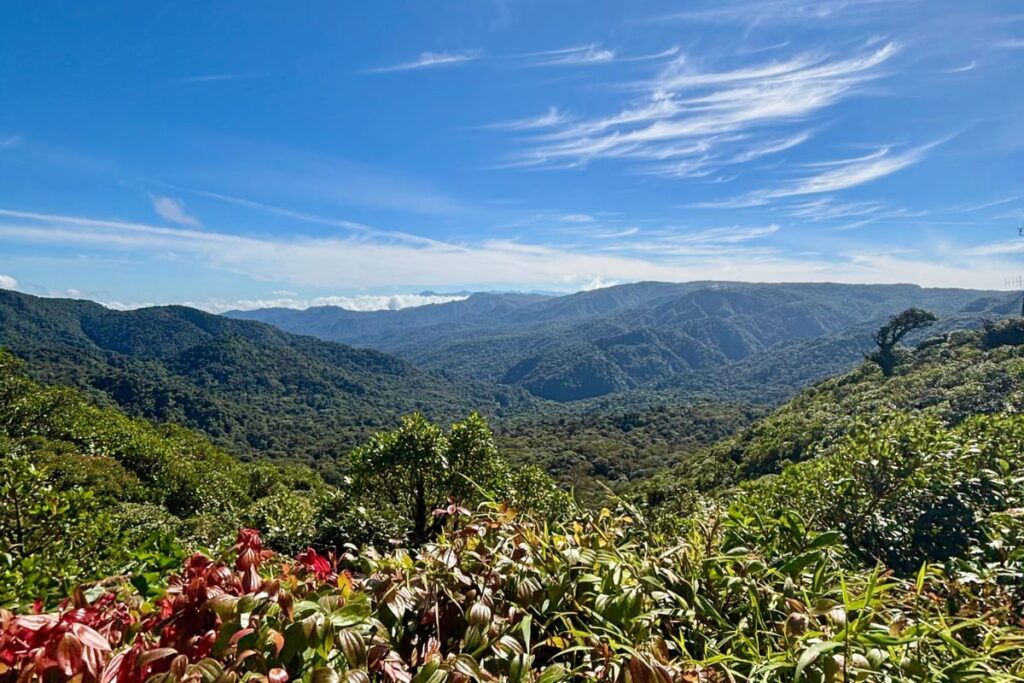
Costa Rica rewards travelers who slow down. Whether you have five days or two weeks, building your itinerary around fewer regions often leads to a more enjoyable trip than trying to see the entire country at once.
How Many Days in Costa Rica? Routes for 5 Days to 2 Weeks
5 Days: La Fortuna
Perfect if you’re short on time. Spend your days exploring waterfalls, hot springs, hanging bridges, wildlife, and Arenal Volcano without constantly changing hotels.
7 Days: La Fortuna + Monteverde
This is what I’d recommend for most first-time visitors. You’ll experience volcanoes, cloud forests, wildlife, and some of Costa Rica’s best adventure activities while keeping travel days manageable.
10 Days: My Recommended First Trip
I’d split my time between La Fortuna, Monteverde, and Guanacaste.
It gives you three of Costa Rica’s biggest contrasts: volcanoes, cloud forests, and the Pacific coast.
10 Days: Wildlife Alternative
If wildlife is your priority, I’d swap Guanacaste for Manuel Antonio. That itinerary offers a better balance of rainforest, beaches, and animal encounters while still giving you plenty of time in La Fortuna and Monteverde.
2 Weeks: Choose a Longer Route Without Rushing
If I were planning my next trip, I’d combine La Fortuna, Monteverde, Manuel Antonio, and the Osa Peninsula. If wildlife was the main goal, I’d also look at adding Tortuguero, even if it meant trimming time elsewhere.
Choose Your Costa Rica Stops Around What You Enjoy Most
Looking back, I’d keep much of what made our first week so enjoyable: La Fortuna’s hot springs and volcano views, Monteverde’s ziplining and night walk, and a quiet finish by the Pacific. What I’d change is how much breathing room I gave those experiences. Another night in La Fortuna would have been more valuable to me than squeezing in another destination.
Before choosing your stops, think about the days you’re most excited to have. If that’s a guided wildlife walk followed by an afternoon at the beach, let that shape the route. If you’re looking forward to hiking, ziplining and soaking in hot springs, give those places enough time without feeling obligated to include the coast as well.
Then look at what each additional base costs you in travel time. A destination can be worth visiting and still belong on a different trip. That’s how I’m thinking about places like the Osa Peninsula, where I’d want enough time to make nature the focus rather than fit it around everything else.
My first visit helped me understand what I’d happily repeat and what I’m curious to try next. For your own itinerary, I’d aim to choose places you’re excited to spend time in, with enough room to enjoy them once you arrive. That’s a better starting point than trying to fit every version of Costa Rica into one vacation.
Explore Central America
- My First Week in Costa Rica: Read the experiences behind the route I’d recommend now.
- Costa Rica Without a Car: Check how transportation could affect your choice of bases and number of stops.
- If I Went Back to Panama, Here’s How I’d Plan My Trip: Consider how Panama could fit alongside Costa Rica or become a trip of its own.
- Granada: Why It Was the Perfect Base for Exploring Nicaragua: Compare a more settled approach to exploring, with several experiences accessible from one base.