Using Points for Hotels Instead of Flights: My Egypt and Jordan Strategy
There are trips where points and miles completely shape the itinerary, and others where they simply make the trip you were already planning a little better. I tend to fall somewhere in between.
I’m not someone who plans a trip purely around maximizing a redemption, but I’m not entirely cash-based either. I try to balance cost, comfort, and flexibility based on the trip itself. When I’m traveling solo, I’m usually more flexible and willing to experiment. With family, comfort and simplicity matter more. And with friends, splitting costs can make nicer hotels or experiences more accessible.
That’s also why I’ve realized that a lot of points and miles advice doesn’t always translate perfectly to real-world travel. It’s much easier to chase the ideal redemption when you have flexible dates, flexible destinations, or the ability to build an entire trip around award availability.
Most of my trips don’t work that way. Sometimes the dates are fixed. Sometimes I already know exactly where I want to go. And sometimes the redemption that looks best on paper simply isn’t the best choice for the trip I’m actually taking.
Our Egypt and Jordan trip was a perfect example. Points played a major role in making the trip better but not necessarily in the ways I expected when I started planning it.
Why I Didn’t Use Points for Long-Haul Flights
When I first started planning this trip, I naturally looked at using points to fly all four of us to Cairo. It didn’t take long for the numbers to change my mind.
Even if I found economy awards in the 80,000–90,000-point round-trip range per person, multiplying that by four meant spending well over 300,000 points just getting everyone to Egypt and back. Business class could easily push that total toward half a million points or more.
Could I have used points for the flights? Probably. But I realized I didn’t want to burn such a large portion of my points balance just getting us to the destination, especially when those same points could improve multiple parts of the trip once we arrived.
So instead of trying to make points fund everything, I paid cash for our long-haul flights and saved my points for aspirational hotels and expensive regional flights where they could make a more noticeable difference.
For this particular trip, points weren’t most valuable getting us to Egypt. They were more valuable once we got there.

A felucca sailing along the Nile with Cairo’s skyline behind it, a reminder that once we arrived in Egypt, I wanted our points to improve the experience on the ground rather than simply get us there.
Why Hotels Became the Better Strategy
Hotels quickly became the area where points could create the biggest difference in the actual experience of the trip.
Egypt and Jordan also happened to have several properties that immediately landed on my hotel wish list: Marriott Mena House, where you can literally wake up beside the pyramids; Hilton Luxor Resort & Spa, sitting along the Nile with pools overlooking the West Bank; and Hilton Dead Sea Resort & Spa, where the resort stretches down toward the shoreline of the Dead Sea.
These weren’t hotels I chose simply because they belonged to programs where I had points. They were hotels I genuinely wanted to experience, but they were also the kinds of stays that became harder to justify when I multiplied the cash rate across multiple rooms and nights.
That’s where points changed the equation.
Instead of using a huge portion of my points balance just getting four people to Egypt, I could use those points to turn hotels that felt like splurges into realistic parts of the trip.
And for this particular trip, that felt much more rewarding.
The Credit Card Strategy Behind the Trip
Before this trip, I had mostly focused on earning flexible travel points rather than building a collection of hotel-specific credit cards.
The main exception was the Marriott Bonvoy Brilliant American Express Card, which I’d opened while planning an earlier Southeast Asia trip. Because I was booking flights and hotels for multiple people at the time, I was able to earn the welcome bonus naturally through expenses I was already going to have.
When I started planning Egypt and Jordan, I took a similar approach. Two of the hotels I most wanted to experience, the Hilton Luxor Resort & Spa and Hilton Dead Sea Resort & Spa, were Hilton properties, which made the Hilton Honors American Express Aspire Card particularly useful for this trip.
I was already planning to pay cash for our long-haul flights, so that spending helped me earn the welcome bonus without manufacturing additional expenses. Those points could then go toward the Hilton stays I’d already decided I wanted.
The cards also came with valuable hotel status benefits: Marriott Platinum Elite and Hilton Diamond status. On this trip, the benefit we felt most consistently was complimentary breakfast, which added up quickly when traveling as a family and made our already-nice hotel stays feel a little more luxurious.
And honestly, international hotel breakfast buffets remain one of my favorite underrated travel luxuries.
Where I Still Used Points for Flights
Even though using points for our long-haul flights didn’t make sense, shorter regional flights were a different story.
We needed flights between Cairo, Luxor, and Amman, and some of those relatively short routes were more expensive than I expected. Cairo to Luxor was still reasonably priced in cash, but Cairo to Amman was another story, especially when multiplying the cost across four people.
That’s where my flexible credit card points became useful. By transferring points to Air Canada Aeroplan, I was able to offset hundreds of dollars in airfare without draining the much larger points balance that would have been required for our long-haul flights.
For me, that was a much better use of points on this trip. I didn’t need points to pay for every flight. I needed them to step in where the cash prices stopped making sense.
And that really became the strategy for the entire trip: use points selectively where they could make the biggest difference, rather than trying to force every expense into a redemption.

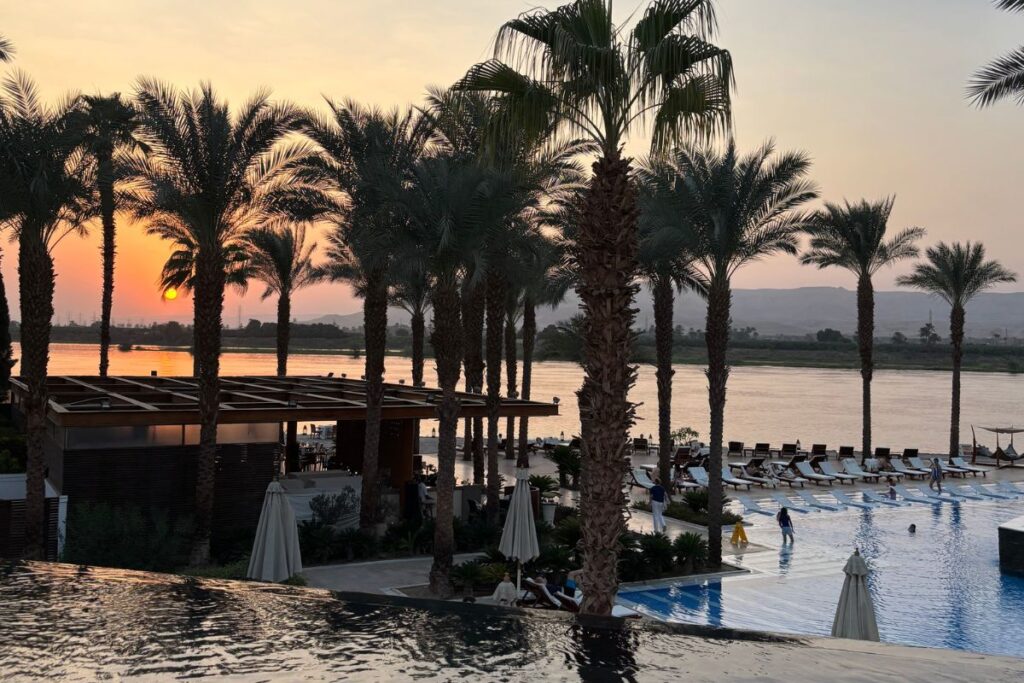
Sunset from the Hilton Dead Sea Resort & Spa, one of several stays that showed me hotel points could add more to this trip than simply covering a room for the night.
When the Strategy Worked Best
Some of our hotel decisions genuinely changed the experience of the trip, although not always for the same reason.
Our stays at the Le Méridien Cairo Airport were probably the best example of points solving a logistical problem while still giving us a hotel we genuinely enjoyed.
We stayed there twice: first after returning to Cairo from Luxor, and again after Jordan for one final night before our 4:45 AM flight home. By that second stay, something funny had happened: we were genuinely excited to be going back to the airport hotel.
That’s because the Le Méridien Cairo Airport doesn’t feel like a hotel you reluctantly book before an early flight. It’s directly connected to the airport by a pedestrian bridge, but inside it feels more like a full-service hotel, with a large outdoor pool, multiple restaurants and bars, and comfortable spaces to decompress between travel days.
After bouncing between cities, flights, guides, and long sightseeing days, returning somewhere familiar felt surprisingly good. And when that 4:45 AM departure arrived, we could simply walk across the bridge instead of arranging a middle-of-the-night transfer or worrying about Cairo traffic.
That’s where points and miles can be especially valuable. They don’t always need to create the flashiest itinerary; sometimes they make a difficult travel day significantly easier without sacrificing the experience.
The Hilton Luxor Resort & Spa, on the other hand, was exactly the kind of property I wanted points to help us experience.
The resort sits directly along the Nile, with pools overlooking the river and the West Bank beyond it. In the mornings, we could watch hot air balloons floating in the distance, while the pool and riverfront grounds offered exactly the kind of escape you want after hours exploring temples and tombs in the Luxor heat.
The atmosphere was quiet and retreat-like, the breakfast was excellent, and the staff made the stay especially memorable. The property felt like part of experiencing Luxor rather than simply somewhere to sleep between sightseeing days.
Ironically, our biggest mistake was not giving ourselves enough time to enjoy it.
Even now, the Hilton Luxor Resort & Spa remains one of my favorite hotel stays anywhere and one of the best examples from this trip of points genuinely making the experience better.
When Great Hotels Weren’t Enough
This trip also taught me that booking an aspirational hotel and actually giving yourself time to enjoy it are two very different things.
The clearest example was the Marriott Mena House, one of those hotels that immediately lands on the wish list when planning a trip to Egypt. Set beside the Giza Plateau, the property has landscaped grounds, a resort-style pool, and most importantly, pyramid views that make it very clear where you are the moment you step outside. Breakfast with the Great Pyramid in the background makes the hotel feel like part of the destination itself.
And the Mena House absolutely lived up to that. I’d stay there again without hesitation. I’d just stay differently.
We arrived late, had dinner at the hotel, went to bed before an early sightseeing day, and checked out after visiting the pyramids and Grand Egyptian Museum. We got the views and the convenience of starting our day right beside Giza, but barely had time to enjoy the property we’d been so excited to book.
The Mena House was completely the right hotel. We just didn’t give ourselves enough time to experience it.
The InterContinental Cairo Semiramis was a different kind of great choice. Instead of waking up beside the pyramids, we were along the Nile in central Cairo, with river and city views, multiple restaurants, a pool, and a location that worked much better for our Cairo sightseeing.
It was polished and incredibly convenient. We even paid for breakfast access because having a substantial meal downstairs before meeting our guide made our packed mornings easier. I’d make that hotel choice again, too.
What I’d change is how we experienced everything outside of it. By the end of Cairo, we’d eaten almost every breakfast inside luxury hotels rather than exploring local cafés or neighborhood restaurants. We’d seen nearly every major landmark we’d planned to visit while still feeling like we’d barely experienced everyday Cairo.
That’s a realization I explore more in We Saw Everything in Cairo, But Barely Experienced Cairo, but it also changed how I thought about our points strategy.
The points worked. The hotels worked. Our itinerary was the part that needed adjusting.
Mena House gave us an unforgettable pyramid setting, while the InterContinental gave us comfort and convenience in the city. But comfort and immersion aren’t always the same thing. Sometimes the best hotel is absolutely worth booking; you just need an itinerary that gives you time to enjoy the hotel and step outside of it.
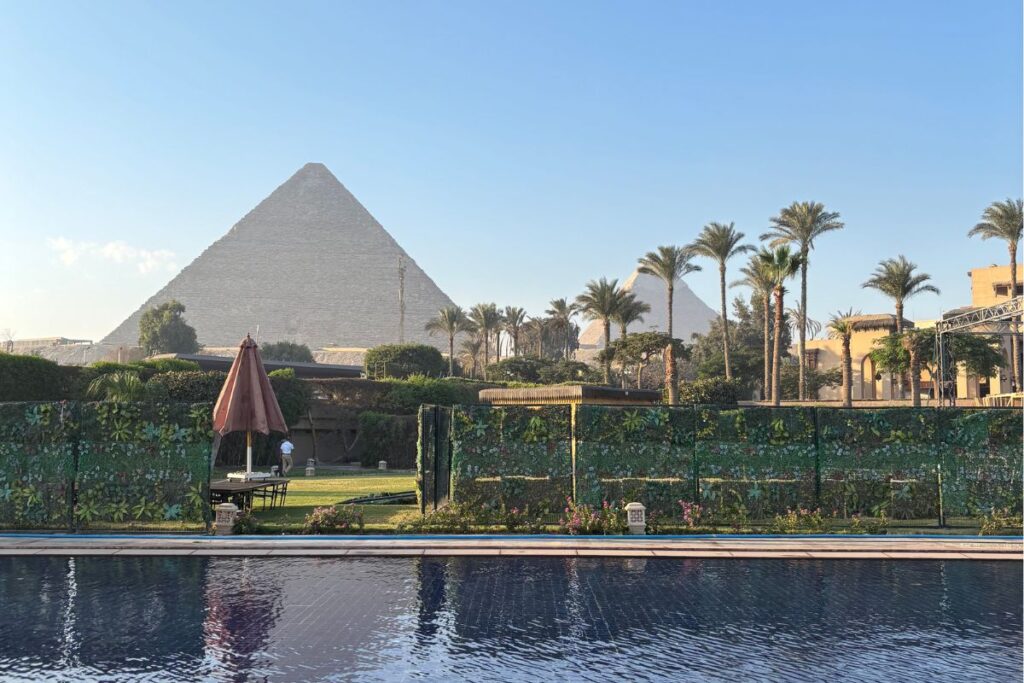
The Great Pyramid from Marriott Mena House, exactly the kind of hotel experience points made possible on this trip and one we should have given ourselves more time to enjoy.
The Biggest Lesson I Took Away
One thing this trip made especially clear was how tiring constant hotel changes can become. We moved hotels multiple times in Cairo because each change made sense for our sightseeing or transportation plans, but collectively, all that packing, unpacking, checking in, checking out, and coordinating transfers made us feel like we were constantly in transit.
That experience also changed how I think about using points. I don’t need every redemption to be mathematically perfect. I’d rather use points intentionally, whether that’s booking a hotel I wouldn’t normally justify paying cash for, making a difficult travel day easier, or simply offsetting enough of the trip that I can spend more elsewhere.
Ultimately, the best use of points is the one that makes the trip you’re already taking better, not more complicated. Sometimes maximizing the experience means maximizing a redemption. And sometimes it means recognizing the value of simply staying still.
Final Note
This trip ultimately came together through a mix of cash, flexible points, hotel points, and a strategy that changed depending on what made the most sense for each part of the itinerary.
If you want to see how it all played out beyond the points and miles, you can follow the full Egypt and Jordan journey here:
Read the full series:
- Cairo: We Saw Everything in Cairo, But Barely Experienced It
- Luxor: Luxor Needed More Downtime Than We Gave It
- Jordan: Petra Was Worth It—But We Planned It Wrong
Ready to Learn More? If you’re interested in building your own points strategy, you may also enjoy:
- The Middle Ground Between Cash Travel and Travel Hacking — my philosophy for using points without chasing every deal.
- Are You Building, Earning, or Burning Points? — the framework I use to decide when to earn, save, or spend points.
- Could the Chase Sapphire Preferred Be the Best Way to Start Earning Travel Points Right Now? — a beginner-friendly look at why one strong welcome bonus can be such a useful entry point into points and miles.
- Ready to Level Up? Why the Capital One Venture X Might Be Your Next Travel Card — how I think about upgrading beyond your first travel card and why the Venture X can be a strong next step for frequent travelers.
Work With Me
Trips like this don’t usually come together by deciding where you want to go and then hoping you already have the right points available.
I didn’t.
Months before I started making the major bookings for Egypt and Jordan, I was already thinking about the points I’d need, which hotel programs could be useful, what expenses I had coming up, and where cash would make more sense than points. That advance strategy is what eventually allowed me to book the hotels I wanted, offset expensive regional flights, and still avoid draining my entire points balance on four long-haul tickets.
If you’re planning a trip of your own, I can help you build that strategy before it’s time to book. That might mean figuring out which points and miles you should be earning now, identifying the hotel and airline programs that fit your actual trip, deciding where cash makes more sense, or putting everything together into a larger itinerary and points plan.
The goal isn’t to collect points just to have them. It’s to have the right points available when you’re finally ready to use them.
You can learn more about my trip-planning and points strategy services on my Work With Me page.