Luxor Needed More Downtime Than We Gave It
This post is part of my Egypt & Jordan series, following our family trip from Cairo’s pyramids and museums to Luxor’s temples, the Dead Sea, and Petra. Throughout the series, I share how we planned the trip, where we stayed, how we used points and travel credits, and what I’d do differently next time, including where I wish we’d slowed down. You’ll find more guides in the Continue Exploring Egypt & Jordan section at the end.
Luxor was one of the places I was most excited to visit in Egypt. We’d considered taking the overnight train from Cairo, which is a popular way to make the journey, but ultimately decided flying made more sense for us. The flight itself is only about an hour, and with just two and a half days in Luxor, I wanted to spend as much of that time there as possible.
And after visiting both cities, I’ll say this: if you enjoyed Cairo, I think you’ll love Luxor. Cairo gave us the pyramids, museums, and our first introduction to ancient Egypt, but Luxor made so much of that history feel tangible. Instead of seeing artifacts behind museum glass, we were walking through enormous temple complexes, descending into tombs covered in color, and seeing the names of pharaohs we’d been learning about everywhere we turned.
I genuinely think Luxor needs to be part of a first trip to Egypt. It feels completely different from Cairo, and not just because of the ancient sites. The Nile divides the city between the temples of the East Bank and the tombs and monuments of the West Bank, while the pace outside those sites feels noticeably calmer.
Unfortunately, we didn’t exactly plan our itinerary to take advantage of that calmer pace.
We arrived ready to see everything, and with a schedule that gave us very little time to do anything else. Add in the heat, early mornings, and full sightseeing days, and it didn’t take long to realize that Luxor was going to be one of the most memorable parts of our trip and one of the places we’d planned far too tightly.
Our Luxor Trip at a Glance
- Our time: About two and a half days, flying from Cairo to maximize our time in Luxor.
- What we covered: Karnak, Luxor Temple, Luxor Museum, the Valley of the Kings and Queens, Hatshepsut’s temple, and the Colossi of Memnon.
- Standout experiences: Luxor Temple illuminated after dark, the colorful ceilings inside KV9, and a sunrise hot air balloon ride over the West Bank.
- What worked: A private West Bank guide who handled transportation and helped connect the history across the sites.
- What I’d change: More time overall, with early sightseeing, proper afternoon breaks at the Hilton, and fewer activities stacked into each day.
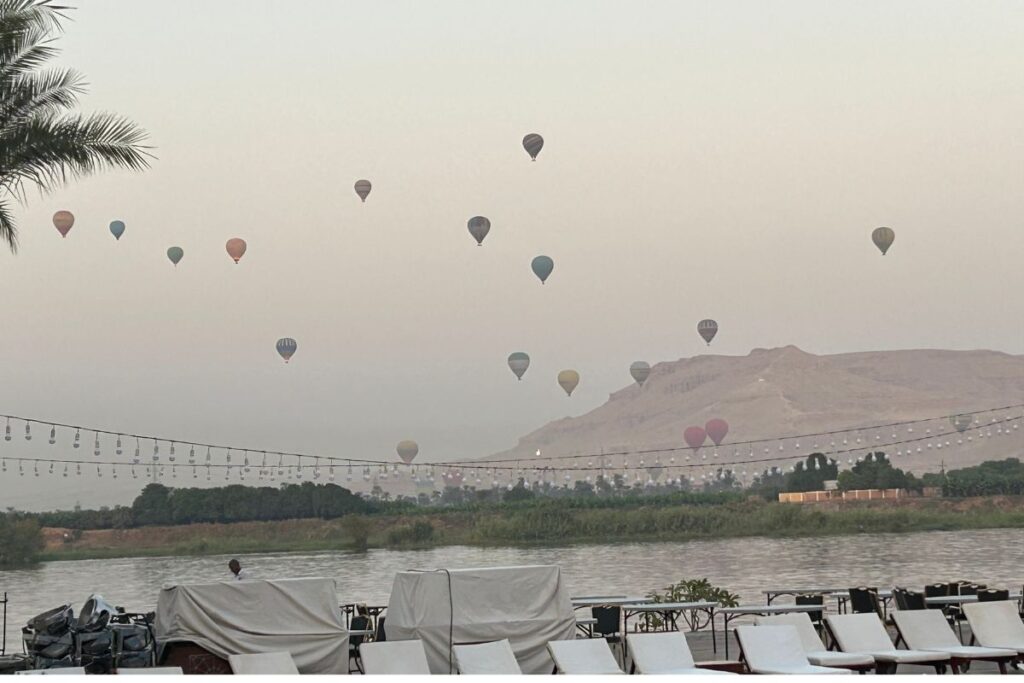
Morning views from the Hilton Luxor Resort & Spa, with hot air balloons floating over the Nile and West Bank, a pretty convincing argument for building more hotel time into a Luxor itinerary.
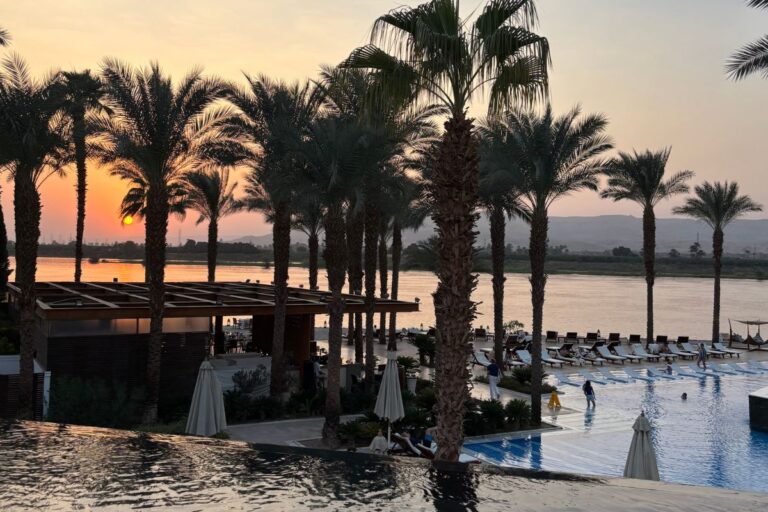
Hilton Luxor Resort & Spa
Choosing the Hilton Luxor Resort & Spa felt like a no-brainer. When I was researching where to stay in Luxor, it seemed to be one of the hotels that came up again and again, and after staying there, I understand why.
I’ll start with the one caveat: the rooms are a little older and aren’t exactly chic or modern. But that’s also not what makes this hotel special. The property itself is beautiful and peaceful, the team was absolutely wonderful, and its location directly along the Nile was easily my favorite part.
We arrived early, and although we didn’t receive a room upgrade with my Hilton Diamond status, the staff welcomed us and let us have breakfast while our room was being prepared. Breakfast ended up being one of our favorites of the entire trip.
Then there are the grounds. The pools overlook the Nile, there are plenty of places to sit outside, and one morning we even watched hot air balloons floating in the distance. This is the kind of hotel that’s meant to be enjoyed, not somewhere you should leave at 8 AM and return to exhausted at the end of the day.
And that’s exactly where we went wrong.
Egypt was hot in general, and Cairo certainly wasn’t cool, but Luxor felt more intense. It wasn’t even necessarily the temperature, it was the strength of the sun bearing down on you while walking through enormous archaeological sites with relatively little shade. By the middle of the afternoon, slowing down didn’t just sound nice; it sounded necessary.
If I planned this trip again, I’d structure my days completely differently: sightseeing in the morning, escape the strongest afternoon sun back at the hotel, spend a few hours by the pool, and head out again in the early evening.
The Hilton is perfectly suited for that kind of trip.
We just didn’t plan ours that way.
Explore Hilton Luxor Resort & Spa and check current rates →
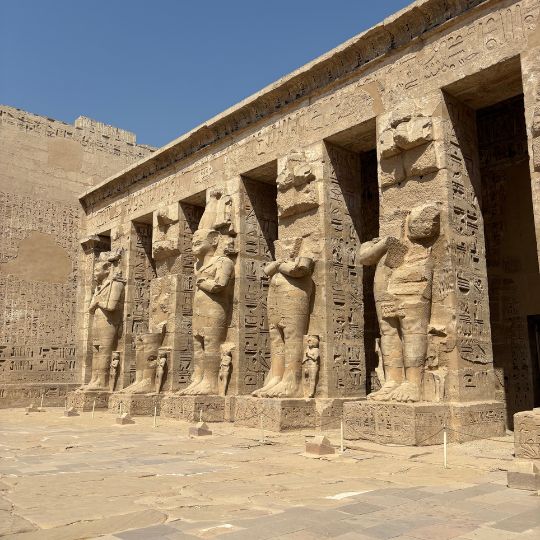
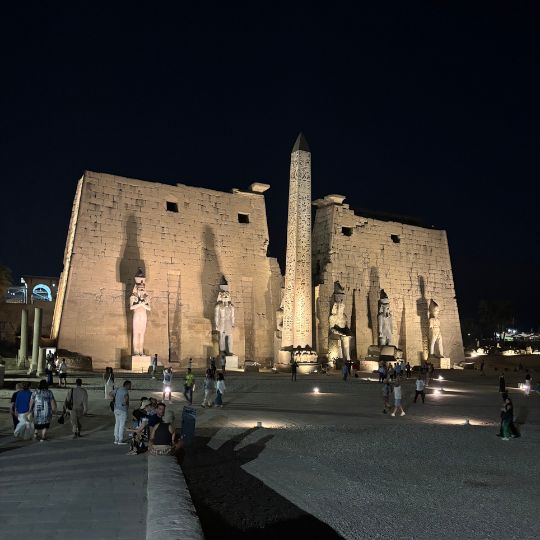
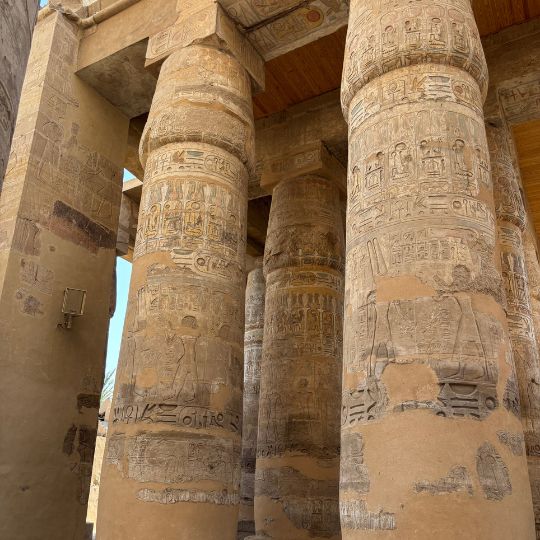
From Karnak’s massive columns in the afternoon to Luxor Temple illuminated after dark, our first day showed us just how differently these ancient sites can feel depending on when you visit.
Karnak Temple, Luxor Museum, and Luxor Temple
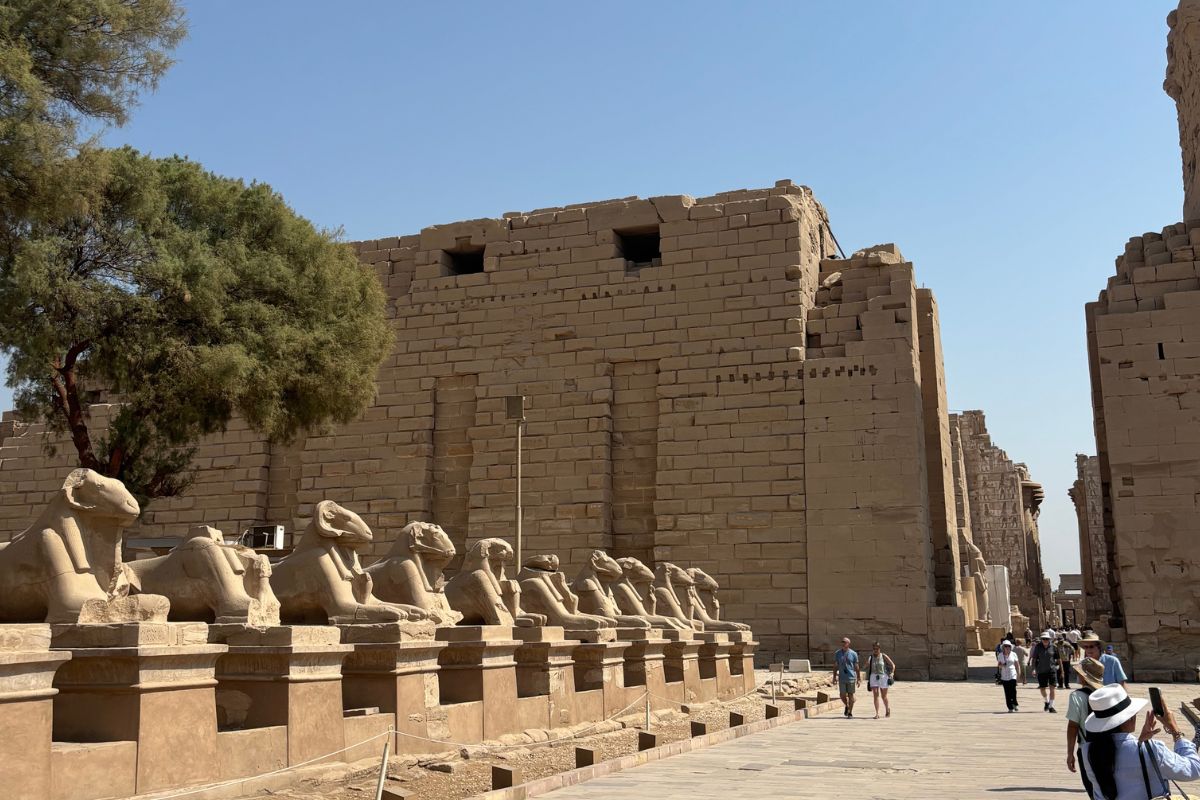
We started at Karnak Temple, and massive almost doesn’t feel like a big enough word for it.
Karnak wasn’t built as one temple at one moment in history. It developed over more than 2,000 years, with generations of pharaohs adding temples, pylons, obelisks, statues, and other monuments to what became ancient Egypt’s largest religious complex. Much of what visitors see today centers around the enormous Temple of Amun-Ra.
You move through enormous gateways and courtyards, past rows of ram-headed sphinxes, and eventually into the Great Hypostyle Hall, where 134 massive columns make the scale difficult to comprehend until you’re standing among them.
This was also where all those pharaoh names we’d been hearing in Cairo started showing up again. Hatshepsut, Thutmose III, Seti I, Ramesses II, different rulers left their mark on Karnak over centuries.
Apparently the Cairo portion of the trip really had just been studying for the Luxor pop quiz.
Unfortunately, we chose to take that pop quiz under the afternoon sun.
It was hot. Really hot.
And it wasn’t necessarily the temperature itself. There’s a lot of exposed space at Karnak, and the intense Luxor sun had us thinking about finding shade when I would have rather been taking my time.
If I planned Luxor again, I’d visit Karnak as early as I could reasonably get myself—or my group—out the door. It currently opens at 6 AM, and I’d much rather sacrifice a little sleep to explore before the sun becomes so intense. I’d give Karnak plenty of time, then deliberately leave the afternoon free to return to the hotel, have lunch, swim, or do absolutely nothing before heading out again in the evening.
Which, accidentally, is exactly how we experienced Luxor Temple.
Explore guided visits to Karnak and Luxor Temple →
Luxor Temple at Night
Between the two temples, we stopped at the Luxor Museum. It’s relatively small, and while I enjoyed it, I wouldn’t prioritize it over Luxor’s major archaeological sites if you’re short on time. After the enormous museums we’d already visited in Cairo, its more focused collection felt much more manageable.
Then we continued to Luxor Temple, and the timing couldn’t have been better.
Luxor Temple and Karnak aren’t completely separate pieces of history. The two complexes were connected by the Avenue of Sphinxes, a ceremonial route stretching roughly 2.7 kilometers between them.
But visiting the two temples couldn’t have felt more different.
By the time we reached Luxor Temple, the sun was down. The temperature had dropped, the temple was illuminated, and suddenly we weren’t searching for shade or thinking about how hot we were.
We could actually slow down.
The columns, carvings, and enormous figures of Ramesses II looked completely different under the lights, and the atmosphere made this one of my favorite experiences in Luxor.
After experiencing both in the same day, my recommendation is simple: visit Karnak as early as you can and Luxor Temple after dark.
You’ll avoid the worst of the heat while getting two completely different experiences of ancient Luxor.
I wouldn’t skip either one.
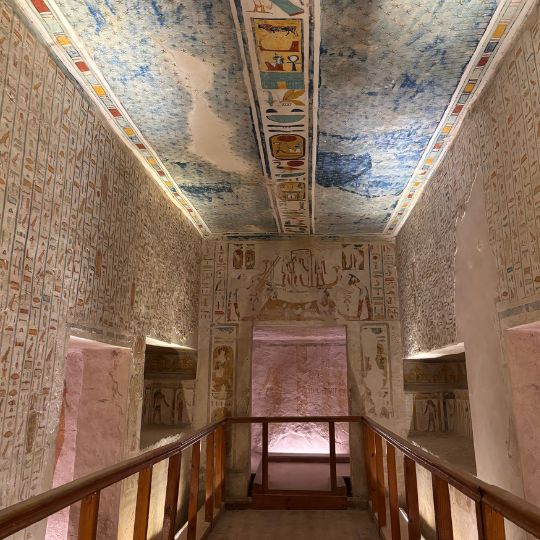
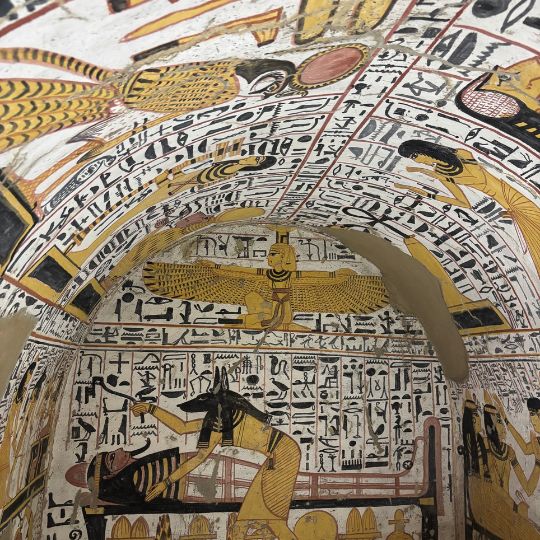
Step inside Luxor’s West Bank tombs and the desert landscape gives way to remarkably preserved color, hieroglyphics, and scenes created thousands of years ago.
Valley of the Kings, Valley of the Queens, and West Bank Sites
Our first day in Luxor we’d explored on our own, but for our second day, we decided to book a private guide for the West Bank.
When I was planning the trip, I wasn’t entirely sure how easy it would be to get between all of the sites we wanted to visit. The West Bank covers a fairly large area, and the Valley of the Kings, Valley of the Queens, Temple of Hatshepsut, and other archaeological sites aren’t all clustered together within easy walking distance. Having transportation handled for the day took that logistical piece completely off our plate.
But the guide ended up being valuable for another reason too: the context.
Before we entered each tomb, he would explain who it belonged to, what we were about to see, and some of the history behind the paintings and inscriptions. Once we were inside, we weren’t simply walking through another beautifully decorated tomb, we had some idea of what we were actually looking at.
And there is a lot to understand on Luxor’s West Bank.
The geography itself is part of the story. Ancient Egyptians associated the west, where the sun sets, with death and the afterlife. While Karnak and Luxor Temple sit on the East Bank, many of ancient Thebes’ great tombs and mortuary temples were built across the Nile on the West Bank.
Valley of the Kings
The Valley of the Kings was the burial place of many of Egypt’s New Kingdom pharaohs, particularly rulers from the 18th, 19th, and 20th Dynasties. More than 60 tombs have been discovered here, carved into an isolated desert valley rather than built as highly visible pyramids.
You won’t find the treasures these tombs once held, many were looted in antiquity, while surviving objects are now in museums, but the tombs themselves are the reason to visit.
You descend through passageways covered in hieroglyphics, painted figures, and scenes created thousands of years ago to help guide the pharaoh into the afterlife. After seeing so many artifacts behind glass in Cairo, walking through the spaces they were actually created for felt completely different.
Your standard admission gives you access to a selection of open tombs, while some require separate tickets. We decided to add the Tomb of Ramesses V and VI (KV9), and I’m very glad we did.
The tomb was originally begun for Ramesses V and later enlarged and used by Ramesses VI. Its corridors are remarkably well preserved, but the ceilings were what stood out most to me. They’re covered in elaborate astronomical scenes and funerary texts depicting the sun’s journey through the underworld and eventual rebirth.
It was easily the most visually striking tomb we entered.
If you’re going to pay extra for one tomb, KV9 is one I’d absolutely consider.
Valley of the Queens
From there, we continued to the Valley of the Queens, which felt noticeably quieter than the Valley of the Kings.
Despite the name, this wasn’t exclusively a burial place for queens. Queens, princes, princesses, and other members of the royal family were buried here as part of the enormous funerary landscape surrounding ancient Thebes.
The experience also felt calmer. There were fewer people moving through the tombs, and after the busier Valley of the Kings, I appreciated having a little more space to actually look at the painted walls and ceilings.
And that’s one of the things that surprised me most about Luxor: the color.
From the outside, you’re surrounded by a dry, rocky desert landscape. Then you step underground and suddenly you’re standing inside chambers covered in blues, yellows, reds, figures, hieroglyphics, and incredibly detailed scenes that have survived for thousands of years.
After everything we’d already seen in Egypt, being inside the tombs made the history feel tangible in a completely different way.
Compare private West Bank tours with the Valley of the Kings and Hatshepsut’s Temple →
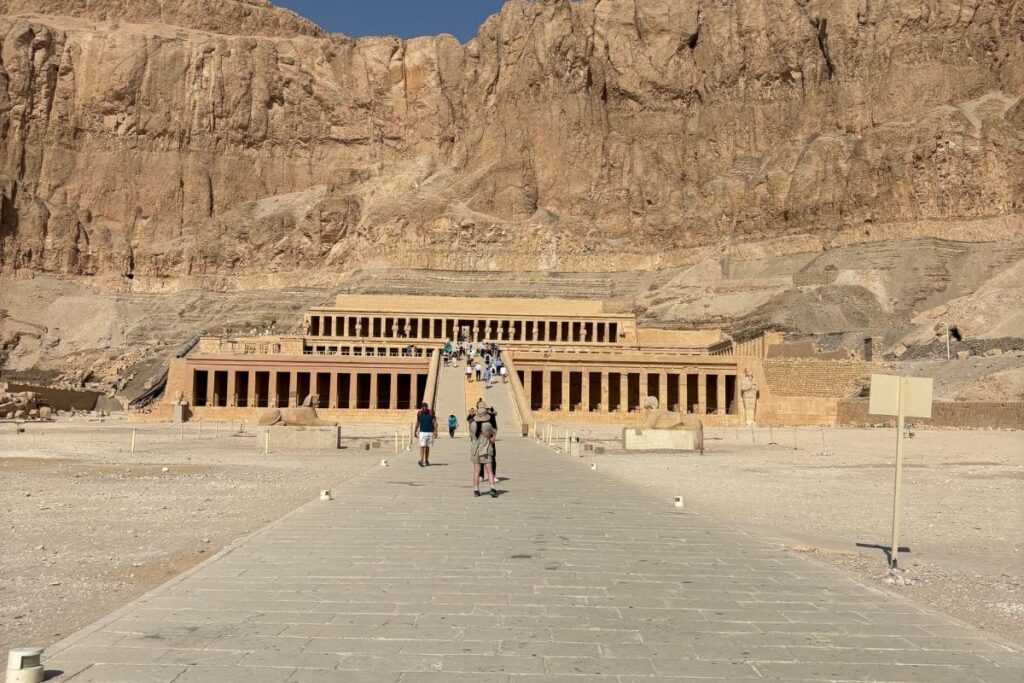
The Temple of Hatshepsut rises almost seamlessly into the cliffs of Deir el-Bahari, one of the most distinctive sights on Luxor’s West Bank.
Temple of Hatshepsut
The Temple of Hatshepsut at Deir el-Bahari is one of the most visually striking sites in Luxor. Built into the base of towering desert cliffs, its three terraces rise toward the rock face in clean geometric layers that somehow look almost modern despite being thousands of years old.
But the person behind it is just as interesting as the architecture.
Hatshepsut was one of ancient Egypt’s few female pharaohs. She initially served as regent for her young stepson, Thutmose III, before eventually declaring herself pharaoh and ruling for roughly two decades. She became a prolific builder, leaving her mark at places we’d already visited, including Karnak—and her mortuary temple here became one of her greatest architectural legacies.
That was another thing I appreciated about having a guide in Luxor. The sites started connecting to one another. Names we’d heard in museums in Cairo were appearing at Karnak, inside tombs, and now here. Instead of each stop feeling like an isolated attraction, Luxor started to feel like one enormous history lesson spread across both sides of the Nile.
The temple itself wasn’t Hatshepsut’s tomb. This was her mortuary temple, where rituals and offerings were made for her after death. Her probable original tomb, KV20, is actually on the other side of the cliffs in the Valley of the Kings, another connection I never would have understood just from looking at a map.
We also made a quick stop at the Colossi of Memnon, two enormous seated statues of Amenhotep III that once stood at the entrance to his much larger mortuary temple. Today the statues dominate the landscape while much of the temple that surrounded them is gone, although archaeological and restoration work continues at the site.
By this point in the day, though, we were done.
We were hot, sun-drained, and very ready to get back to the hotel. We’d also really liked our guide—he was funny, charismatic, incredibly knowledgeable, and made a huge difference on a day when we were moving through site after site.
But then came something we’d already encountered in Cairo: the “local shopping stop.”
I completely understand that these stops are part of the guided-tour ecosystem, and they can be fun if you’re actually interested in shopping. But after a long day of tombs, temples, walking, and intense sun, we weren’t.
And that’s something I’d handle differently next time. It’s okay to be upfront with your guide. If you’re tired and would rather skip the shopping stop and head back to your hotel, just say so. You don’t need to feel guilty about protecting a little downtime on an already packed sightseeing day.
In our case, that pool along the Nile was sounding much more appealing than another shop.
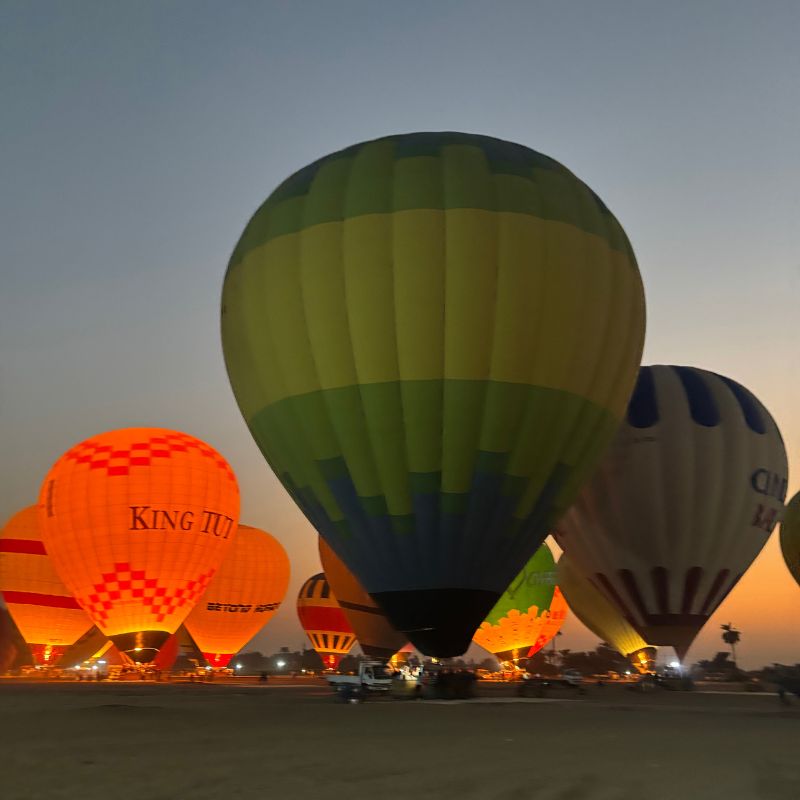
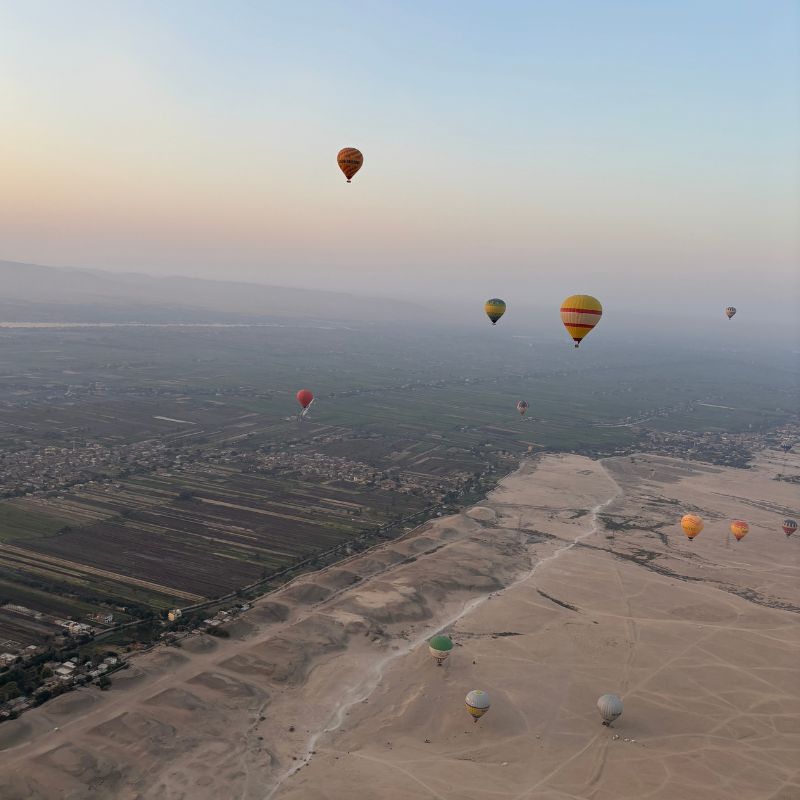
From watching the balloons inflate before sunrise to floating above Luxor’s West Bank, this was easily one of the most memorable mornings of our entire Egypt trip.
Hot Air Balloon Over Luxor
If there was one thing I knew I wanted to do in Luxor before we even arrived, it was take a hot air balloon ride over the West Bank.
This was a true bucket-list experience for me, and also our first time ever in a hot air balloon. We tried to convince my mom to come with us, but she was a firm no. There was apparently no amount of “but imagine the views!” that was going to get her into a basket floating hundreds of feet above the ground.
So while she stayed behind, we had a very early start. Pickup was around 5:30 AM, and before long we were standing in a field watching enormous balloons slowly inflate around us in the dark.
That alone was part of the experience.
Then suddenly we were in the basket, lifting off as the sun began to rise over Luxor.
And gorgeous is really the only word I have for it.
Below us, the West Bank stretched out in completely different directions: green agricultural fields along the Nile, the dry desert beyond them, temples and archaeological sites we’d been exploring from the ground, and dozens of other balloons floating through the morning sky.
But one of the things that surprised me most was how incredibly smooth it felt.
If the part making you nervous is wondering whether a hot air balloon ride feels bumpy, unstable, or like some kind of amusement-park ride, our experience was nothing like that. There was almost no sensation of movement at all. You’re simply floating.
Even the landing—which I’d expected to be the part where I’d suddenly remember we were standing in a basket underneath a giant balloon—barely registered. Maybe we were too mesmerized by everything around us, but I don’t remember feeling much of anything when we touched back down.
My biggest reaction to landing was honestly just disappointment.
I wasn’t ready for it to be over.
I wanted more time in the air. More landmarks to float over. More views. Just…more.
Now, if your hesitation is a genuine fear of heights like my mom’s, I can’t promise that waking up before sunrise and climbing into a balloon basket is suddenly going to sound appealing. She made the right call for her. But if you’re interested and it’s the physical sensation of the ride making you nervous, I wouldn’t let that stop you based on our experience.
And perhaps the best part? Your bucket-list adventure is over before most of Luxor has really started its day.
We were back at the hotel in time for breakfast, already having watched the sun rise while floating over the West Bank.
For all the things I’d change about how we planned our time in Luxor, this isn’t one of them.
I’d do it again in a heartbeat.
Actually, I’d just want a longer flight.
Explore sunrise hot air balloon rides over Luxor →
What I’d Do Differently on My Next Trip to Luxor
If there’s one thing I’d change about our time in Luxor, I’d give it more time. We only had about two and a half days, and technically, it worked. We saw the temples we wanted to see, explored the tombs of the West Bank, wandered through Luxor after dark, and checked a hot air balloon ride off my bucket list. But there’s a difference between having enough time to see a destination and having enough time to experience it, and Luxor deserved more.
That’s almost funny considering how much more compact Luxor felt compared with Cairo. Getting around was more manageable, with major sites on either side of the Nile, and we didn’t feel the same overwhelming scale we’d experienced in the capital. Yet of the two, Luxor is the place I’d hands down return to and give myself even more time.
I wouldn’t cut Karnak, the Valley of the Kings, Hatshepsut’s temple, Luxor Temple, or that hot air balloon ride. I’d simply stop stacking them so tightly together. I’d visit the major archaeological sites early, return to the hotel when the afternoon sun was strongest, and spend a few hours by the pool or along the Nile before heading out again in the evening.
I’d also leave room for a long lunch, a felucca ride, or an afternoon doing absolutely nothing without feeling like I should be somewhere else. We didn’t need less Luxor; we needed more time in Luxor to do less. That’s probably the biggest compliment I can give it: Cairo introduced me to ancient Egypt, but Luxor made me want to come back.
Continue Exploring Egypt & Jordan
- Where to Stay in Luxor: East Bank vs. West Bank + Hotels I’d Consider — Find a base for temple visits, evenings in town, and the downtime I wish we’d protected.
- How I’d Plan My Dream Egypt Trip After Doing It Too Fast — Where I’d slow down, what I’d add, and how I’d adapt the trip to the time available.
- Our Cairo Travel Experience — What our packed days in Cairo taught me before we continued south to Luxor.
- Petra and the Dead Sea: Our Short Jordan Itinerary — Another unforgettable stop where fitting everything in wasn’t quite the same as having enough time.