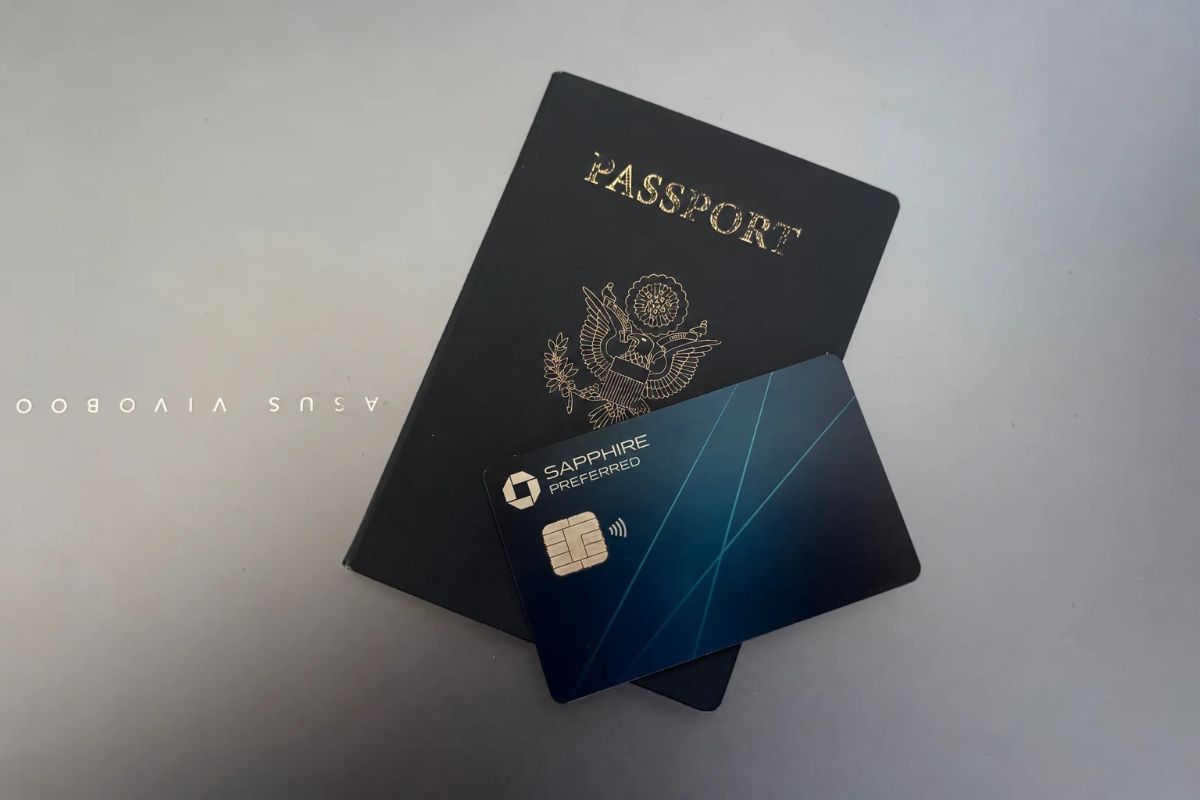
Is Chase Sapphire Preferred a Good First Travel Card?
Disclosure: This post contains referral links. If you choose to apply through one of my links, I may receive points at no additional cost to you.
I’ve used Chase Ultimate Rewards points to help book my family’s Premium Economy flights to Spain, but I’ve also questioned whether the card that earned them still belonged in my wallet. My spending habits had changed, I was reaching for other cards, and I wasn’t sure the Chase Sapphire Preferred justified another annual fee.
When Chase refreshed the card without increasing its $95 fee, it prompted me to reconsider a different question: Would I recommend it to someone starting with travel points? My own collection of cards had become more complicated, but a beginner wouldn’t necessarily have the same overlap.
The 100,000-point welcome offer drew plenty of attention at the time. Offers change, though, and a large bonus only helps if you can meet the spending requirement with purchases you already planned and pay the balance in full. You can check the current offer and application terms here.
For someone who wants to learn how to turn everyday spending into travel, Sapphire Preferred is a card I’d consider. Here’s how I’d evaluate the annual fee, earning opportunities, and transfer partners, with examples of what those points have made possible for my family and what I wish I’d understood earlier.
Chase Sapphire Preferred at a Glance
Who I’d consider it for: Travelers starting with points who want flexible airline and hotel transfer options.
Annual fee: $95. The up-to-$100 annual Chase Travel hotel credit can offset it when the booking fits your plans and the price is competitive.
How you earn: 5x through Chase Travel, 3x in several everyday categories, and 2x on other eligible travel.
Before applying: Meet the welcome-offer spending requirement with planned purchases you can pay off in full. Offers and eligibility vary.
My biggest lesson: Keep points flexible until you’re ready to book. Transfers to airline and hotel programs generally can’t be reversed.
The Welcome Bonus: Start with Spending You Already Have Planned
Before focusing on the size of a welcome offer, there’s a more important question to ask: Can you meet the spending requirement with money you were already planning to spend?
If a card requires $5,000 in purchases during the first few months, the goal isn’t to find an extra $5,000 to spend. It’s to redirect expenses that were already coming.
When I earned one of my earliest welcome bonuses, I had just moved into a new home and needed to buy furniture. After years of post-college IKEA furniture, I was ready for a “real” couch and dining table and unfortunately, real furniture costs real money. The spending was happening either way; the credit card simply changed what I received in return.
The same strategy can work when you have a larger expense on the horizon, a family vacation, new appliances, home renovations, wedding expenses, or even several smaller purchases that add up. That’s why I often think the best time to open a new card has less to do with the card itself and more to do with what’s already coming up in your life.
And don’t assume you’ve completely missed out just because you see a 75,000-point offer after hearing about a previous 100,000-point promotion. The welcome bonus isn’t the only points you’ll earn.
Say you already have $5,000 in airfare or hotel spending coming up for a trip. If booking that travel through Chase Travel makes sense and the card is earning 5x on those purchases, that’s potentially another 25,000 points from spending you were already going to do.
A 75,000-point welcome offer plus 25,000 points earned from planned travel? You’re at 100,000 points anyway.
That’s where points and miles start becoming interesting. You’re not spending more money just to earn rewards. You’re being more intentional about what you earn from money you were already going to spend.
Is Sapphire Preferred Worth Its $95 Annual Fee?
Before I recommend a travel card to someone, I want to know whether they’ll get enough value from it to justify keeping it after the excitement of the welcome bonus is gone.
For the Chase Sapphire Preferred, the annual fee is $95, so my starting point is pretty simple: Can I reasonably recover that $95 each year from benefits I would actually use?
That last part matters. Credit card companies can give me a long list of benefits and assign a dollar value to every one of them, but I don’t count a perk at full value just because it exists. If I wouldn’t have spent that money without the card, I’m not going to pretend the card saved me that amount.
Start With the Easiest $95 to Recover
One of the benefits that makes the math easier for me is the annual Chase Travel hotel credit. Cardmembers can receive up to $100 back each year on eligible hotel bookings made through Chase Travel.
If you’re already going to stay in a hotel and booking through Chase Travel makes sense for that particular stay, that one benefit can potentially offset the entire $95 annual fee.
That’s where my math stops.
I don’t need to add up every DoorDash credit or streaming benefit and convince myself I’m getting hundreds of dollars in theoretical value. If I can reasonably recover the annual fee from something I was going to buy anyway, everything else can be treated as an extra.
And if you’re reading a travel blog while considering a travel credit card, I’m going to take a wild guess that you’ll spend at least $100 on a hotel sometime this year.
The Other Perks Are Extras—If You’ll Use Them
The Chase Sapphire Preferred also comes with benefits like Apple TV+, DoorDash DashPass and credits, and a Global Entry/TSA PreCheck application fee credit.
Some of those may be genuinely valuable to you. Others may be worth absolutely nothing. And that’s okay.
Was I excited to discover that I could watch the new season of Ted Lasso thanks to my card? I sure was. Would I have paid for Apple TV+ every month on my own? Probably not.
That’s the distinction I make when I’m calculating what a card is actually worth to me. A benefit I enjoy isn’t necessarily money the card saved me.
I would never tell someone a $10 monthly credit is worth $120 a year if they have to change their spending habits every month just to use it. That’s how a card that looks incredible on paper can become much less impressive in real life.
Then I Look at How I’ll Actually Earn Points
Once I know I can reasonably justify keeping the card, then I care about how easily I can earn points from the spending I’m already doing.
That’s another reason the refreshed Chase Sapphire Preferred has my attention. It currently earns 5x on travel booked through Chase Travel and 3x on dining, gas and EV charging, online groceries, select streaming services, and eligible vacation home rentals through brands like Airbnb and Vrbo. Travel booked outside the portal generally earns 2x.
Those aren’t obscure categories I have to work particularly hard to use. I eat at restaurants. I buy gas. I travel. Chances are, if you’re considering this card, you do at least some of those things too.
The new vacation rental category is especially interesting to me. Hotels get a lot of attention in the points world because of hotel loyalty programs and transfer partners, but sometimes an Airbnb or Vrbo simply makes more sense, especially when I’m traveling with family and we want more space. Being able to book directly with eligible vacation-rental platforms and still earn 3x gives me another way to earn a meaningful number of transferable points from travel I was already planning.
And remember the welcome-bonus example from earlier: the points you earn don’t stop when the bonus posts. A card becomes much more useful long term when its earning categories overlap with expenses that are already part of your life.
But earning rates still aren’t enough for me to recommend a travel card.
The real reason I think the Chase Sapphire Preferred can be such a good starting point is what happens after you’ve earned those points.
Why I Value Chase Points Before Choosing an Airline
The real strength of the Chase Sapphire Preferred is that the points you earn aren’t tied to a single airline or hotel program.
Chase Ultimate Rewards points can be transferred to a variety of airline and hotel partners, giving you flexibility while you figure out where you actually want to go and how you want to get there.
You don’t have to earn Virgin Atlantic points hoping you’ll eventually fly Virgin Atlantic, or Flying Blue miles before you know whether Air France or KLM will make sense for your trip. You can leave your points with Chase until you have a specific redemption in mind, then transfer them to the program that works best.
That’s an important distinction for someone just getting started. You don’t need to predict your travel plans years in advance or commit yourself to learning a dozen loyalty programs on day one. You can earn first and figure out the best use later.
That’s exactly how the following examples came together.
Using Chase Points for Virgin Atlantic Economy and Premium Economy
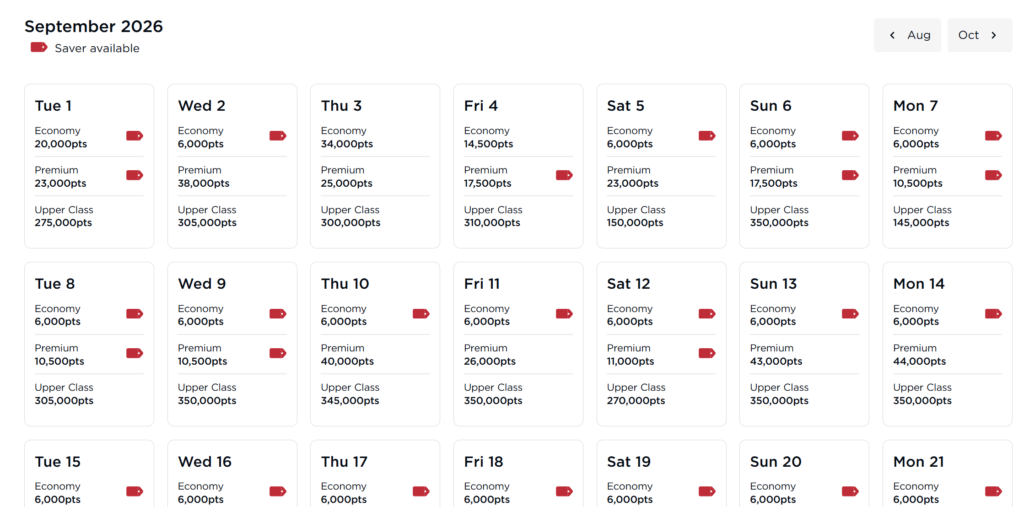
JFK>LHR September 2026 Reward Seat Calendar
Virgin Atlantic is one of my favorite examples of what transferable points can actually do.
Looking at the award calendar for a September trip from New York to London, I’ve seen Economy awards as low as 6,000 points one-way and Premium Economy around 10,500 points, plus taxes and fees.
We’re not talking Upper Class here. Those redemptions can require significantly more points—and much higher fees. For someone just learning how to use points, Economy and Premium Economy are often the much more interesting part of the calendar.
At those rates, a family of four could theoretically fly roundtrip in Economy for around 48,000 Virgin Atlantic points, while a solo traveler could fly roundtrip in Premium Economy for around 21,000 points, before taxes and fees.
And sometimes you can stretch your Chase points even further. Chase periodically offers transfer bonuses to partners like Virgin Atlantic, meaning fewer Chase points may be needed for the same award.
I wouldn’t transfer points just because a bonus exists, though. I wait until I have a trip and an award I’m actually ready to book.
That’s the part of points and miles I find much more useful than chasing a perfect redemption. You’re probably still going to pay something in taxes and fees, and that’s okay. The better question is: What would this trip have cost me without the points?
For many travelers, points don’t need to create an entirely new trip. They can simply help you spend less out of pocket—or travel a little more comfortably.
But I’ve Already Been To London
That’s fair. The point isn’t necessarily London. The point is getting yourself to Europe.
One of the most useful things I’ve learned with points is to be flexible about where I cross the Atlantic. If London has great award availability but Paris doesn’t, I can fly to London and continue from there by train or a short flight.
That doesn’t mean letting points choose your entire vacation. I still decide where I want to go. I’m just willing to be flexible about how I get there.
Sometimes the best redemption isn’t a flight directly to your final destination. It’s the flight that gets you close enough to make the rest of the trip work.
How I Used Chase Points for My Family’s Premium Economy Flights to Spain
My family’s flights to Spain cost 80,000 Flying Blue miles and about $400 in taxes and fees per person, with Premium Economy on the transatlantic flights. For four of us, that meant 320,000 miles and roughly $1,600 out of pocket. But the booking started with miles intended for a completely different trip.
I’d previously transferred Chase points to Flying Blue, the loyalty program of Air France and KLM, to book Business Class flights to Munich for Christmas Market season. When those plans fell through, I canceled the tickets, paid the redeposit fees, and received the miles back along with most of the taxes and fees. I now had nearly 250,000 miles sitting in Flying Blue.
An award cancellation doesn’t reverse the original points transfer. Those miles couldn’t return to Chase, even though the trip wasn’t happening. I’d transferred for a specific booking, but changed plans still left me with a substantial airline balance to use.
When we later started planning Spain, Flying Blue was one of the first programs I checked. We booked the four tickets across three accounts: mine, my dad’s, and my sister’s, with the largest share of the miles coming from my account. The remaining miles came from their balances.
Using those miles also took something off my mental checklist. I help coordinate our family’s points, so putting my dad’s and sister’s balances toward an actual trip meant fewer unused miles to track and less concern about expiration. Finding a useful redemption mattered more to me than leaving those balances untouched while earning points somewhere else.
Initially, I thought we might fly to Paris and book separate transportation to Spain. Instead, I found connecting awards that covered the journey to Madrid and home from Barcelona:
- Outbound: JFK → Paris → Madrid
- Return: Barcelona → Paris → JFK
- Cabin: Premium Economy on the transatlantic flights
- Cost per person: 80,000 Flying Blue miles plus approximately $400
We could arrive in Madrid and leave from Barcelona without returning to our starting city or arranging separate tickets through Paris. Those were the prices I found for our dates, rather than rates I’d expect everyone to find.
Would I have paid cash for four Premium Economy tickets? Probably not. The miles made a more comfortable family trip achievable, even with a meaningful amount still due in taxes and fees.
The experience also changed how I approached the booking. Before transferring, Chase points gave me a choice of programs. After canceling Munich, my starting question became: Could the Flying Blue miles we already had get us where we wanted to go? For Spain, they could.
Who I’d Recommend Sapphire Preferred To
A month ago, I was preparing to cancel this card. Today, I’m writing an article about why I think it can be a genuinely strong place to start with travel points, and why it can continue to make sense even after you’ve learned the basics.
Not because it’s the best card for everyone, and not because a big welcome offer automatically makes a card worth opening.
I’d recommend it because the $95 annual fee can be relatively easy to justify, the everyday earning categories are useful, and—most importantly—you earn transferable points that give you options when you’re ready to travel.
But I’d still want you to ask a few questions first:
- Can you meet the welcome bonus spending requirement with purchases you were already going to make?
- Can you realistically recover the annual fee from benefits you’ll actually use?
- Are you interested in learning how to transfer points rather than simply treating them like cash back?
If the answer to those questions is yes, I think the Chase Sapphire Preferred can be a very good first travel card, and for some travelers, a card that continues to make sense long after they’re beginners.
That’s ultimately why mine is staying in my wallet.
And if after reading this article you think the Chase Sapphire Preferred might be a good fit for your situation, you can view the current offer here.
Continue Exploring Points & Miles
- The Middle Ground Between Cash Travel and Travel Hacking: How my first Chase redemption shaped the way I combine points and cash.
- Are You Building, Earning, or Burning Points?: Identify your next step based on your balances, upcoming spending, and travel plans.
- Is the Capital One Venture X Worth It?: Consider whether another travel card adds enough value to earn a place in your wallet.
- Using Points for Hotels Instead of Flights in Egypt and Jordan: See how I chose when to redeem points and when to pay cash on a family trip.
Want Help Building Your Own Points Strategy?
Start with the trip you want to take. Through one-on-one consulting, I can help you assess your existing points, compare card options for planned spending, and identify where rewards could reduce costs or make the journey more comfortable.
Whether you’re starting from scratch or figuring out how to use balances you already have, we can build a practical strategy around your budget and travel priorities.