Ready to Level Up? Why the Capital One Venture X Might Be Your Next Travel Card

Disclosure: This post contains referral links. If you choose to apply through one of my links, I may receive points at no additional cost to you.
I’ve written before about why the Chase Sapphire Preferred is one of the travel cards I find easiest to recommend. Its relatively low annual fee, useful earning categories and transferable points make it an approachable way to start earning travel rewards, but it doesn’t necessarily stop making sense once you know what you’re doing.
But what happens when you’re ready for something more?
Maybe you’ve already dipped your toes into travel rewards, redeemed some points, booked a trip or two, and now you’re wondering what the next step looks like. You want more travel benefits, but that doesn’t necessarily mean you’re ready for a premium card with a massive annual fee and a laundry list of credits to track.
That’s where I think the Capital One Venture X gets interesting.
It offers many of the benefits people associate with premium travel cards—airport lounge access, transferable miles and travel credits—while remaining surprisingly easy to use.
Interested in the Capital One Venture X?
→ View the current Venture X offer through my referral link
Like most premium travel cards, the Venture X may also come with a welcome bonus. Before applying, I’d make sure you can meet whatever the current spending requirement is through expenses you were already planning. The goal is to earn a bonus from your normal spending, not create extra spending for the sake of earning points.
Premium Travel Without Making It a Hobby
The Venture X occupies an interesting spot in my wallet. It comes with many of the benefits I associate with a premium travel card—airport lounge access, travel protections, a Global Entry or TSA PreCheck credit, and transferable miles—but it doesn’t require nearly as much effort as some of its premium-card competitors.
That’s probably what I appreciate most about it. I don’t want to keep a card just because I can theoretically squeeze enough value out of a dozen different credits to justify the annual fee. I want the benefits to fit naturally into travel I’m already doing.
The Venture X comes surprisingly close to that. Its biggest benefits are straightforward enough that I don’t need a spreadsheet or a monthly reminder to make sure I’m getting value from the card. And for a premium travel card, that simplicity is a big part of the appeal.
Let’s Talk About the Annual Fee
The $395 annual fee is probably the first thing that makes the Venture X feel like a serious step up from a card like the Chase Sapphire Preferred. It certainly sounds expensive when you look at that number by itself.
But I don’t evaluate an annual fee by asking whether $395 is a lot of money. Of course it is. I want to know how much of that fee I can realistically recover from benefits I would have used anyway.
For the Venture X, the math is relatively straightforward:
- Annual fee: $395
- Annual Capital One Travel credit: $300
- Anniversary bonus: 10,000 Capital One miles
The $300 credit does require booking through Capital One Travel, so I don’t automatically treat it as $300 in value. I still compare the portal price with booking directly before using it. In my experience, I’ve generally found prices close enough that using the credit has made sense, but that’s something I’d check every time rather than assume.
If I can use the full $300 toward travel I was already going to book, though, I’ve recovered most of the annual fee without changing my travel habits. Then, each account anniversary comes with another 10,000 Capital One miles.
That’s why I think of the Venture X as something close to a break-even premium card. I don’t need to remember to use a $10 credit here and a $15 credit there every month to make the math work. I need to use one substantial travel credit on a trip I was already planning and have a use for the anniversary miles.
And $300 in annual travel isn’t a particularly high bar for the kind of traveler I’m talking about here. A flight to visit family, a weekend hotel stay, or part of a larger trip could use the entire credit.
The important part is that the travel comes first and the credit card comes second. If I have to invent $300 worth of travel to convince myself I’m getting value from a $395 credit card, the card doesn’t make sense for me. If that spending was already going to happen, the calculation looks very different.
But What If You Don’t Care About Points and Miles?
Here’s what I find particularly interesting about the Venture X: I don’t think you need to care very much about points and miles to get value from it.
My dad and sister are good examples. Neither of them is spending their free time studying airline transfer partners or searching for award sweet spots. They want to earn rewards, use their travel benefits and get on with their lives.
Capital One makes that relatively easy because you don’t have to transfer your miles to an airline to use them for travel. One of the simplest options is Purchase Eraser, which lets you redeem miles against eligible travel purchases you’ve already charged to the card.
If I book a $500 American Airlines flight directly with the airline, for example, I could redeem 50,000 Capital One miles against that purchase at the standard one-cent-per-mile rate. Is that necessarily the highest value I could get from 50,000 transferable miles? No. But it requires essentially no points expertise.
That also gives the 10,000 anniversary miles a very straightforward use. At that redemption rate, they’re worth $100 toward eligible travel. Combined with the $300 annual Capital One Travel credit, that’s potentially $400 toward travel against a $395 annual fee, before I assign any value at all to lounge access or the card’s other benefits.
And I think that’s an important distinction. You can learn transfer partners and potentially get more value from Capital One miles, but you don’t have to start there. The simple redemption option already gives someone who travels regularly a practical way to use the miles.
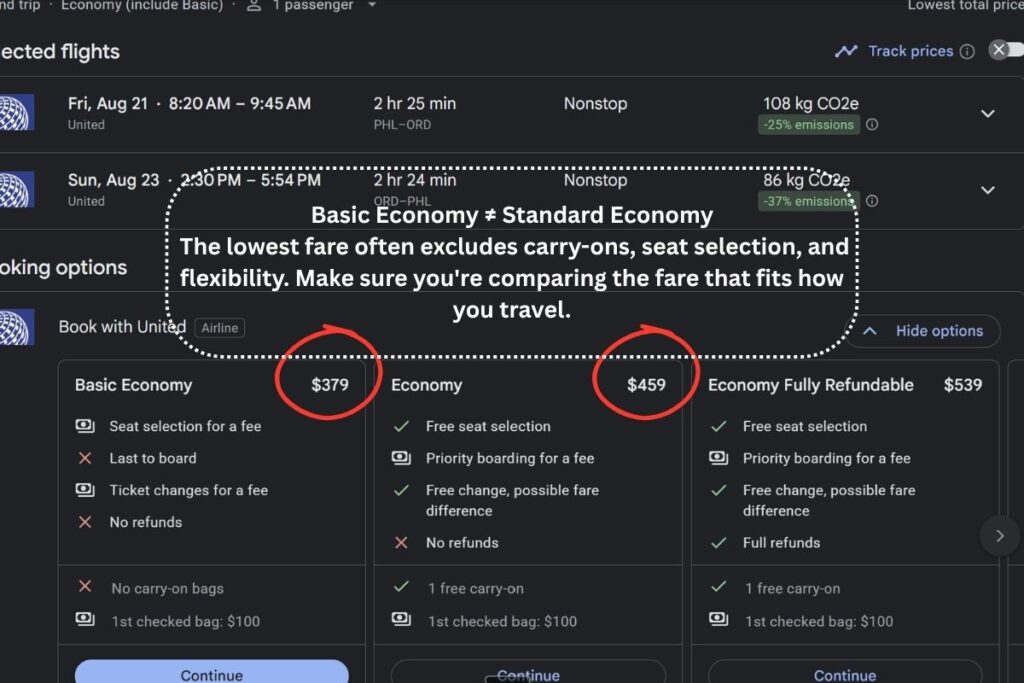

Google Flights is usually where I start planning any trip. It gives me a realistic cash price benchmark, making it easy to decide whether paying cash or redeeming points offers the better value before I book anything.
What Could That Actually Look Like?
Take a long weekend in Chicago.
When I priced out this example, I found a flight for $459 and a hotel that could be covered with approximately 42,000 Capital One miles. Neither redemption requires some elaborate around-the-world award strategy. It’s just a normal trip that someone might already be planning.
That’s where I think the Venture X makes the most sense. The $300 travel credit can go toward travel you’re already booking, the anniversary miles can offset another eligible travel expense, and lounge access or Global Entry/TSA PreCheck reimbursement becomes an additional benefit rather than something I need to inflate the value of to justify the annual fee.
The card doesn’t require you to become a points person. It just leaves the door open if you eventually want to become one.
Your First Taste of Airport Lounges
For many travelers, the Venture X may be the first card that introduces them to airport lounges. I don’t think lounge access completely transforms the travel experience, but it can make a long travel day considerably more pleasant.
Instead of paying airport prices for a sandwich and a drink, I can find somewhere comfortable to sit, grab something to eat, charge my devices, get some work done, or simply kill an hour before my flight. Venture X cardholders currently receive access to Capital One Lounges as well as participating Priority Pass lounges.
But this is also a good example of something that’s easy to forget when evaluating any travel card: benefits aren’t locked in stone.
When I first started using the Venture X, its lounge guest policy was considerably more generous, which was especially valuable when I traveled with family. Capital One has since changed that policy. I still receive lounge access as the cardholder, but bringing guests can now come with an additional cost depending on the lounge.
Does that suddenly make lounge access worthless to me? No. I travel solo often enough that I can still get plenty of use from it. But it does make the benefit less valuable when I’m traveling with other people, and that’s something I factor into how I evaluate the card today.
It’s also why I’m hesitant to assign an inflated dollar value to lounge access when deciding whether an annual fee makes sense. I enjoy the perk, and I’d absolutely miss it if it disappeared, but credit card benefits can—and do—change.
Simplicity Matters
One thing I appreciate about the Venture X is that it can be as simple or as complicated as you want it to be.
You don’t need to memorize bonus categories or constantly think about which card belongs in your wallet for a particular purchase. The Venture X earns 2 miles per dollar on everyday purchases, making it an easy catch-all card.
In fact, that simplicity is one of the main reasons I’ve recommended it to friends and family. Both my father and sister now carry the Venture X, and neither of them wants to spend much time thinking about which card to use at the grocery store, at dinner, or for some random purchase. They know they’ll earn at least 2 miles per dollar without doing any mental math.
For many travelers, simplicity is a feature, not a limitation.
The same thing applies when it’s time to use those miles. As we discussed earlier, you can redeem them against eligible travel purchases without learning the ins and outs of airline loyalty programs.
But the option to go deeper is still there.
Capital One miles can also be transferred to airline and hotel partners, which can open up opportunities to get more value from them. Some of the programs I use regularly are accessible through multiple transferable-points ecosystems, giving me more flexibility when I’m trying to build enough points for a particular trip.
Transfer partners and redemption opportunities can change over time, though, so I don’t think you need to choose this card based on one specific airline relationship—or learn all of those programs before you get started.
That’s what I like about the Venture X. My dad and sister can keep things simple. I can disappear down the transfer-partner rabbit hole when I want to. We’re all using the same card in the way that works for us.
Who I Think This Card Is Perfect For
I think the Venture X is a great fit for travelers who:
- Travel at least once or twice per year.
- Naturally spend enough on travel to use the annual travel credit.
- Want airport lounge access and other premium travel benefits.
- Want flexible miles without needing to learn transfer partners immediately.
- Like having the option to get more strategic with their miles later.
- Prefer simplicity over constantly optimizing every purchase.
You don’t need to be new to points and miles, and you don’t need to be an expert. I think the sweet spot is someone who travels enough to use the card’s core benefits and wants a premium travel card that doesn’t require much work to keep earning its place in their wallet.
That’s ultimately what makes the Venture X so easy for me to recommend. You can keep it simple, or you can go down the points-and-miles rabbit hole. The card works either way.
Final Thoughts
If you’re ready to level up from a more basic travel card, I think the Venture X is one of the easiest premium travel cards to recommend.
But here’s the part I think matters: leveling up your travel benefits doesn’t have to mean leveling up the amount of work you put into points and miles.
The Venture X gives you airport lounge access, premium travel benefits, transferable miles and enhanced travel protections while remaining relatively simple to use. You can earn 2 miles per dollar on everyday purchases, use straightforward redemption options, and never spend an evening studying airline transfer partners if you don’t want to.
Or you can go deeper. You can learn the transfer partners, look for better redemptions and become more strategic with your miles. The card gives you room to do both.
That’s ultimately why I find the Venture X so easy to recommend. It can feel like a meaningful step up in how you travel without requiring you to completely change how you earn, spend, or redeem your rewards.
For some travelers, it may be their first premium travel card. For plenty of others, it may be the only premium travel card they ever need.
Think the Venture X fits the way you travel?
If you’ve looked at the annual fee, travel credit and benefits and decided the card makes sense for you, you can support Travel Breakdown by applying through my referral link. I may receive points if you’re approved, at no additional cost to you.
→ View the current Capital One Venture X offer
Continue Learning
If the Venture X fits somewhere in your own points strategy, these posts take a few of the ideas from this article further:
Is the Chase Sapphire Preferred Worth It? — If you’re comparing the Venture X with a lower-fee travel card, this is how I evaluate whether the Sapphire Preferred earns its place in my wallet beyond the welcome bonus.
Are You Building, Earning, or Burning Points? — Not sure whether another card is actually your next move? This is the framework I use to figure out whether I should be learning, earning more points or using the ones I already have.
100,000 Points: Across the Ocean — Singapore — A look at what a large balance of transferable points can potentially unlock when the goal is a bigger international trip.
100,000 Points: Weekend Edition — Panama City — The opposite approach: using points to make a relatively simple, shorter trip cost less rather than saving everything for one huge redemption.