I Almost Turned Around at the Girona Train Station
If you’re just joining my Spain series, I recommend starting with Why Madrid Surprised Me, where I explain why the capital exceeded my expectations. This article picks up as we leave Madrid behind and make our way toward Costa Brava.
Ten minutes after arriving in Girona, I was ready to throw in the towel. In my head, I was already rehearsing the conversation with my family: “Let’s just go back to the station. We’ll catch the next bus and head straight to Tossa de Mar.”
Why did I just add complexity to a journey that was already destined for Costa Brava? At that moment, Girona felt like a huge mistake. Looking back now, I’m very glad I didn’t follow through.
Why We Added Girona to Our Spain Itinerary
The simplest option would have been taking the train from Madrid to Barcelona and then catching a direct bus to Tossa de Mar.
But where’s the fun in that?
Instead, I chose the more complicated route.
During my research, Girona kept appearing over and over again. Photos of its medieval streets, colorful riverside buildings, impressive cathedral, and ancient city walls made it look exactly like the type of place I love exploring.
Since we were already traveling from Madrid, I figured we could stop in Girona for five or six hours, explore the city, and then continue onward to Tossa de Mar.
On paper, it sounded perfect.
It also had the added benefit of simplifying the second half of our trip. After Tossa de Mar, our next stop would be Barcelona, which meant our onward journey would be a simple one-hour bus ride instead of backtracking through multiple connections.
Things Started Going Wrong Immediately
Our day started early with a train from Madrid-Puerta de Atocha-Almudena Grandes station to Barcelona Sants.
The high-speed train ride was smooth, comfortable, and arrived right on schedule. From Barcelona, we boarded a regional train to Girona, which took less than an hour.
The problems began as soon as we arrived.
My transportation research had suggested there were direct buses from Girona to Tossa de Mar. When I stopped at the bus ticket counter to confirm schedules, I learned we would actually need to transfer in Lloret de Mar.
Not ideal, but manageable.
Then came the luggage situation.
I had been under the impression that luggage storage was available inside the train station. Instead, after asking multiple station employees, I kept receiving different directions.
“No luggage storage here.”
“It’s somewhere across the street.”
“Try asking over there.”
Now picture four carry-on suitcases, four backpacks, temperatures approaching 30°C (85°F), and a family wondering why we’re wandering around Girona dragging luggage instead of sightseeing.
That was the moment I started questioning my decision.
Eventually, after walking into several businesses and asking for help, we discovered that Girona’s luggage storage was operated through a third-party luggage storage app. After downloading the app on the spot and paying roughly €50 to store our bags, we were finally free to explore.
By then, however, my confidence in this stop had taken a serious hit.
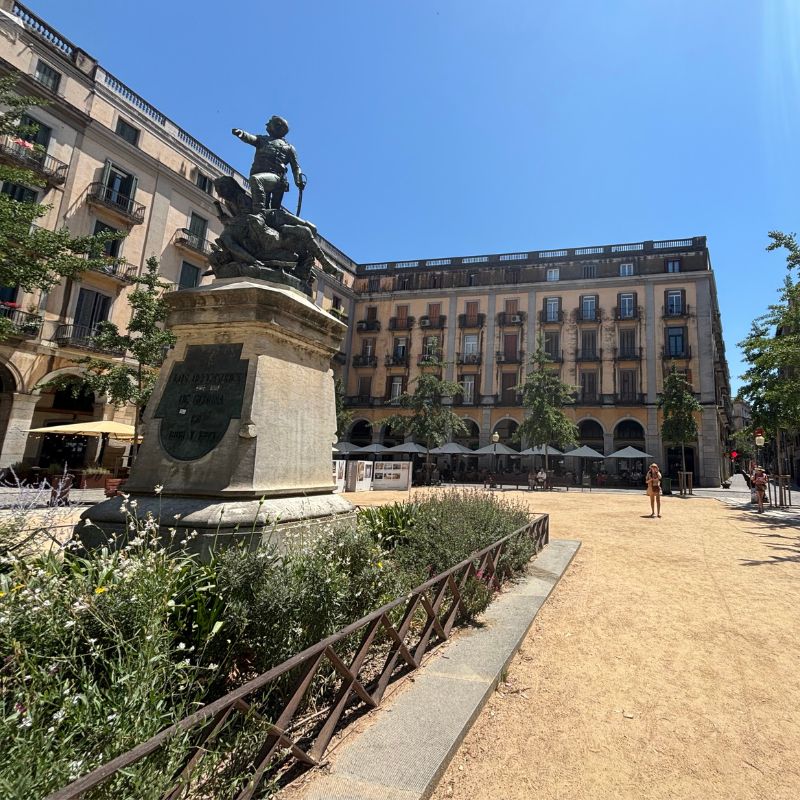
Plaça de la Independència gave us our first glimpse of Girona’s charm, and, more importantly at that moment, the perfect place to sit down, cool off, and reset over lunch.
Lunch Saved the Day
Before attempting any sightseeing, we needed a reset.
We made our way to Plaça de la Independència, one of Girona’s most recognizable squares, and settled into lunch at Casa Marieta. After an early morning, several trains, luggage frustrations, and the heat, the timing could not have been better.
We ordered a few dishes to share, including croquetas, and continued what had apparently become our Spain tradition of ordering tinto de verano. More importantly, we had air conditioning, cold drinks, and absolutely nowhere we needed to be for the next hour.
By the time we finished lunch, the Girona I had been ready to abandon less than an hour earlier was starting to feel a little more manageable. Sometimes the best travel decision isn’t squeezing in another attraction, it’s sitting down, eating something good, and giving everyone a chance to regroup.
The Girona I Came to See
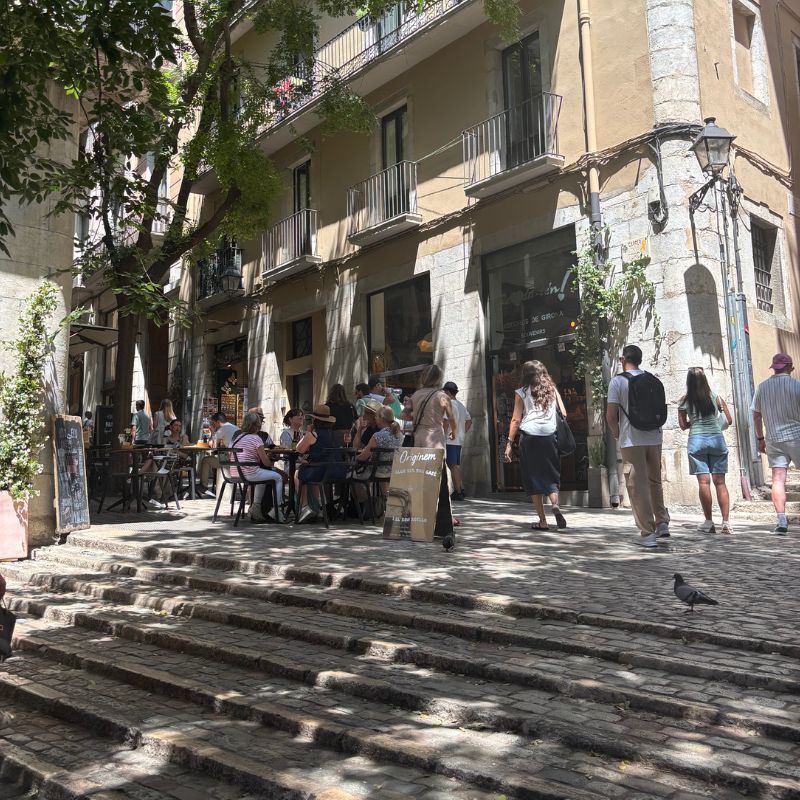
After lunch, we began walking toward Girona’s historic center, and almost immediately, the city started changing. The modern buildings and wider streets around the train station gradually gave way to narrow lanes, stone buildings, medieval walls, art galleries, and souvenir shops.
This was the Girona I had spent weeks looking at online. The farther we walked, the more excited I became—and the more ridiculous my earlier idea of abandoning Girona and heading straight to Tossa de Mar started to feel.
Eventually, we arrived at the magnificent staircase leading up to the Cathedral of Girona. Even if you’ve never heard of Girona before, there’s a good chance you’ve seen this part of the city in photographs. The cathedral towers over the historic center, while the enormous stone staircase leading to its entrance creates one of those scenes that somehow feels even more impressive when you’re standing at the bottom of it.
We spent quite a while exploring the surrounding streets, taking photos, browsing shops, and simply enjoying the atmosphere. The historic center was incredibly photogenic, with something new catching our attention every few streets. At one point, our only real mission became finding my mom a lighter shirt after realizing her long sleeves absolutely were not going to survive the afternoon heat.
By then, we were fully immersed in the Girona I had been so excited to see.
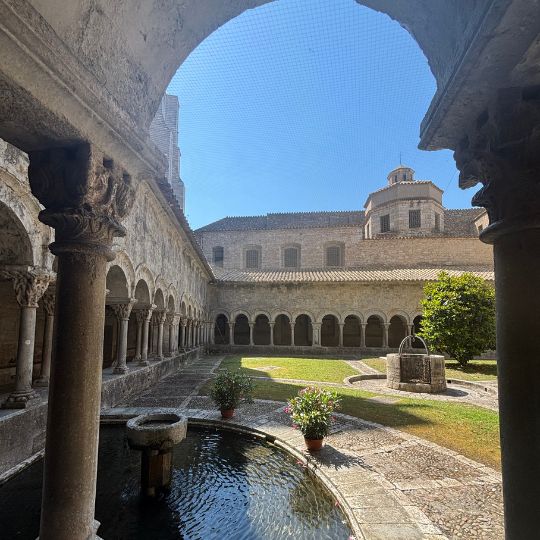
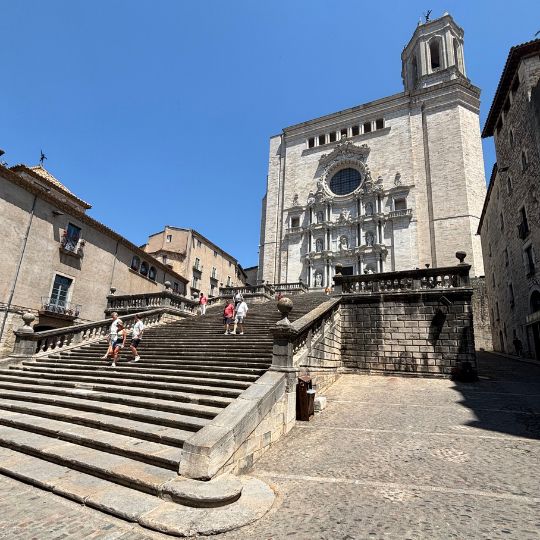
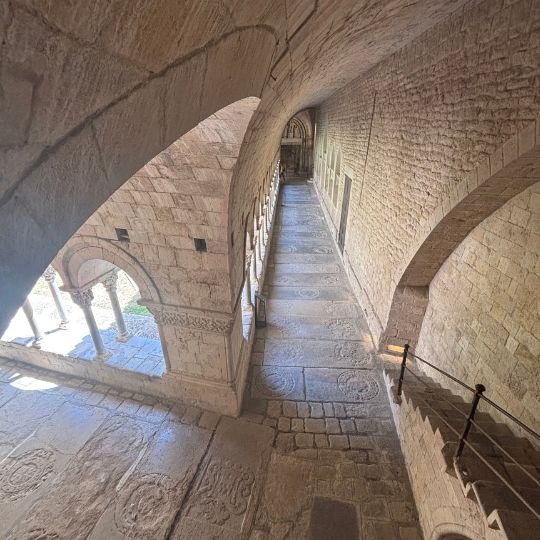
What I thought would be a quick look at Girona Cathedral turned into nearly an hour exploring its staircase, cloisters, and historic interior.
The Cathedral Detour That Wasn’t Supposed to Happen
Originally, I had no intention of visiting the cathedral itself. It wasn’t that I had decided to skip it for any particular reason. I had simply thought of the Cathedral of Girona as another beautiful European church to admire from the outside, take a few photos of the enormous staircase, and continue exploring the historic center.
Then someone opened the door.
A blast of cool air escaped into the afternoon heat, and suddenly the entire family agreed that perhaps seeing what was inside wasn’t such a bad idea after all.
What started primarily as an attempt to escape the heat ended up becoming one of the highlights of the day. The cathedral was far more interesting to explore than I had expected, with its soaring nave, side chapels, historic artwork and religious artifacts, along with access to the cloisters and treasury exhibits.
One of the most interesting parts was learning about the Creation Tapestry, one of the cathedral’s most important treasures. There was a small exhibit providing context for the medieval textile, which was exactly the kind of thing I would have completely missed had we simply taken our staircase photos and moved on.
The cloisters were another unexpected highlight. Stepping into the quieter stone corridors and courtyard felt completely different from the cathedral’s enormous interior, and together the different spaces made the visit feel much more substantial than simply walking inside another church.
We ended up spending about 45 minutes exploring before heading back into the sunshine. What I had barely registered as something to do in Girona turned out to have far more to see than I expected—and all because someone happened to open the door at exactly the right moment.
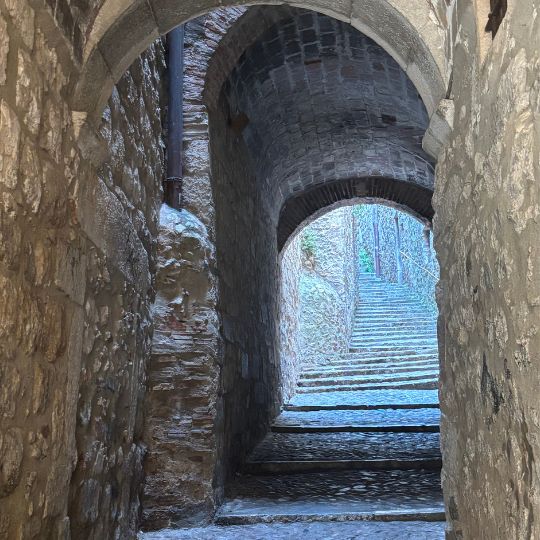
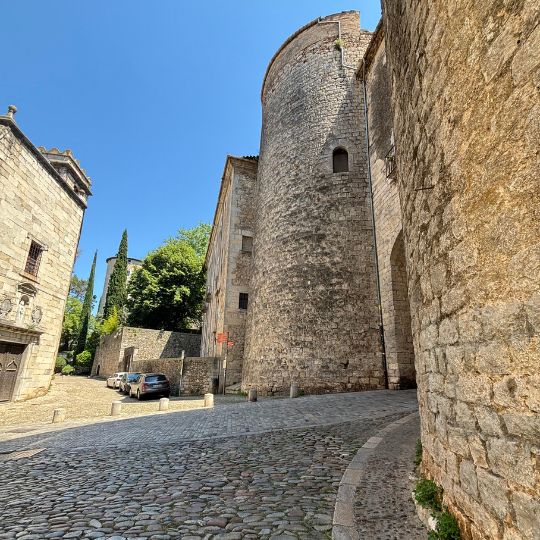
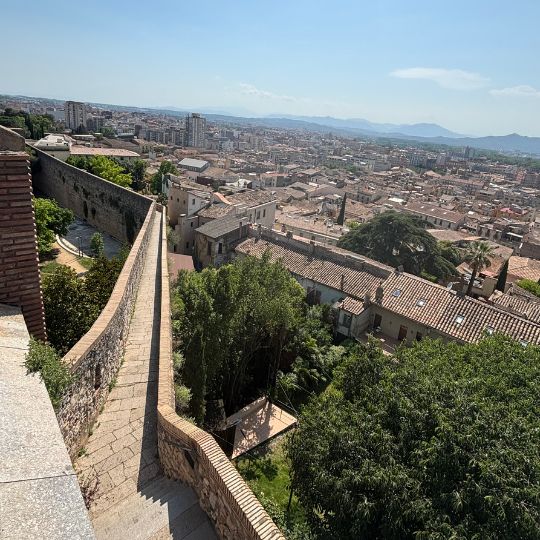
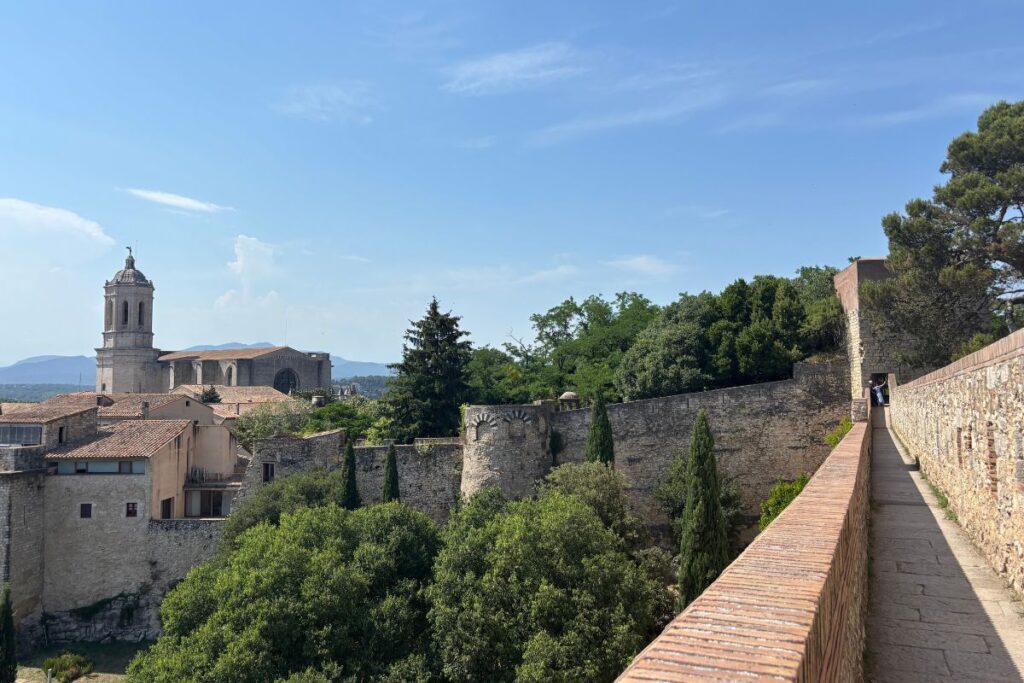
Girona’s medieval streets eventually lead up to the Passeig de la Muralla, where the views over the Old Town make the climb well worth it.
Walking the Medieval Walls
For me, however, the main attraction was still waiting: the Passeig de la Muralla, Girona’s medieval city walls.
The walls have origins dating back to Roman times and were expanded throughout the Middle Ages. Today, visitors can walk roughly 2.5 to 3 kilometers (about 1.5 to 2 miles) along various sections, making it one of the most unique ways to experience Girona. Walking the entire accessible route would probably take around 45 minutes to an hour if you kept moving, although realistically you’ll want extra time for the viewpoints and photos along the way.
As we climbed the first set of stairs and emerged onto the walls, the views immediately became the highlight. From above, we could see red rooftops stretching across Girona, church towers rising above the historic center, and sections of the medieval walls continuing into the distance. Every few minutes seemed to bring another slightly different perspective over the city.
What I particularly loved was how accessible the experience felt. You don’t have to commit to walking the entire route to enjoy it, since multiple entrances and exits make it easy to explore as much or as little as you like. We probably spent only 20 to 30 minutes walking different sections, but between the views and our constant photo stops, it still felt like we experienced one of the best parts of the walls.
If I had to choose just one experience in Girona, this would be it.
The Moment I Changed My Mind
As we made our way back through the Old Town and crossed the bridges over the Onyar River, Girona seemed to get prettier from every angle. The colorful buildings sit almost directly against the water, creating this dense wall of balconies and windows along the riverbank, while the bridges give you completely different views depending on where you stop. With the buildings reflected in the water and the historic center rising behind them, it was one of the most photogenic parts of the city.
By that point, I realized my mistake hadn’t been stopping in Girona. My mistake had been not staying longer. If I hadn’t been traveling with family and trying to minimize hotel changes, I would have seriously considered spending a night here.
The more I walked, the more I found myself imagining what Girona must feel like in the evening: the sunlight changing over the colorful riverside buildings, quieter streets after many of the day-trippers leave, dinner somewhere in the Old Town, and more time to explore without trying to fit everything into a few hours.
Looking back, I think Girona suffers a little from being treated primarily as a day trip. It’s easy to add to a larger Costa Brava itinerary, but between the medieval walls, cathedral, narrow Old Town streets, bridges, and beautiful Onyar River, there’s enough here to justify experiencing the city at a slower pace.
Girona felt like the kind of place that rewards slowing down. What had started as a stop between Madrid and Tossa de Mar ended up becoming one of the highlights of that entire stretch of the trip, and my first glimpse of just how much I was going to love this part of Spain.
Final Thoughts
By the end of the day, everyone in our group was surprised by how much we enjoyed Girona. What started as one of the most frustrating travel mornings of our Spain trip had become one of our favorite unexpected stops.
Would I recommend stopping for a few hours on your way to the Costa Brava? Absolutely. But if your itinerary allows it, I’d go one step further and spend the night.
Give yourself time to walk the medieval walls, wander through the Old Town, linger along the Onyar River, and see what the city feels like after the day-trippers begin to leave. A few hours gave us enough time to fall in love with Girona’s beauty, but not nearly enough time to feel finished with it.
Sometimes the places you almost skip become the ones you remember most. And Girona was only the beginning of what the Costa Brava had in store for us.
Next up in the Spain series: Looking for Beaches Near Barcelona? Why I Loved Tossa de Mar.
I thought Girona was beautiful, and then we arrived in Tossa de Mar. Between the medieval walls, turquoise water, and beaches tucked beneath the Old Town, I came away wondering if I could imagine a better European beach vacation.