How Many Days in Arequipa? City Highlights and Best Day Trips
If you have been to Cusco, arriving in Arequipa will feel familiar in at least one way: the Plaza de Armas is the center of everything.
You will probably pass through it multiple times a day without even planning to. The cathedral, balcony restaurants, souvenir shops, and streets leading toward many of Arequipa’s main attractions all surround the Plaza. So do plenty of guides and travel agencies advertising excursions outside the city.
That was when I realized just how much there was to do beyond Arequipa itself. Signs advertised Colca Canyon, the Ruta del Sillar, Laguna de Salinas, waterfalls, rafting, volcano treks, and activities I hadn’t even considered before arriving.
Fortunately, most of these excursions don’t require the same advance planning as Machu Picchu. You can generally arrive in Arequipa, compare itineraries and prices around the Plaza, and arrange something for the following day.
That also means you don’t necessarily have to decide how long to stay based on a rigid list of reservations. Start with the amount of time you want in Arequipa itself, then add time for whichever excursions genuinely interest you.
How Many Days in Arequipa? My Quick Take
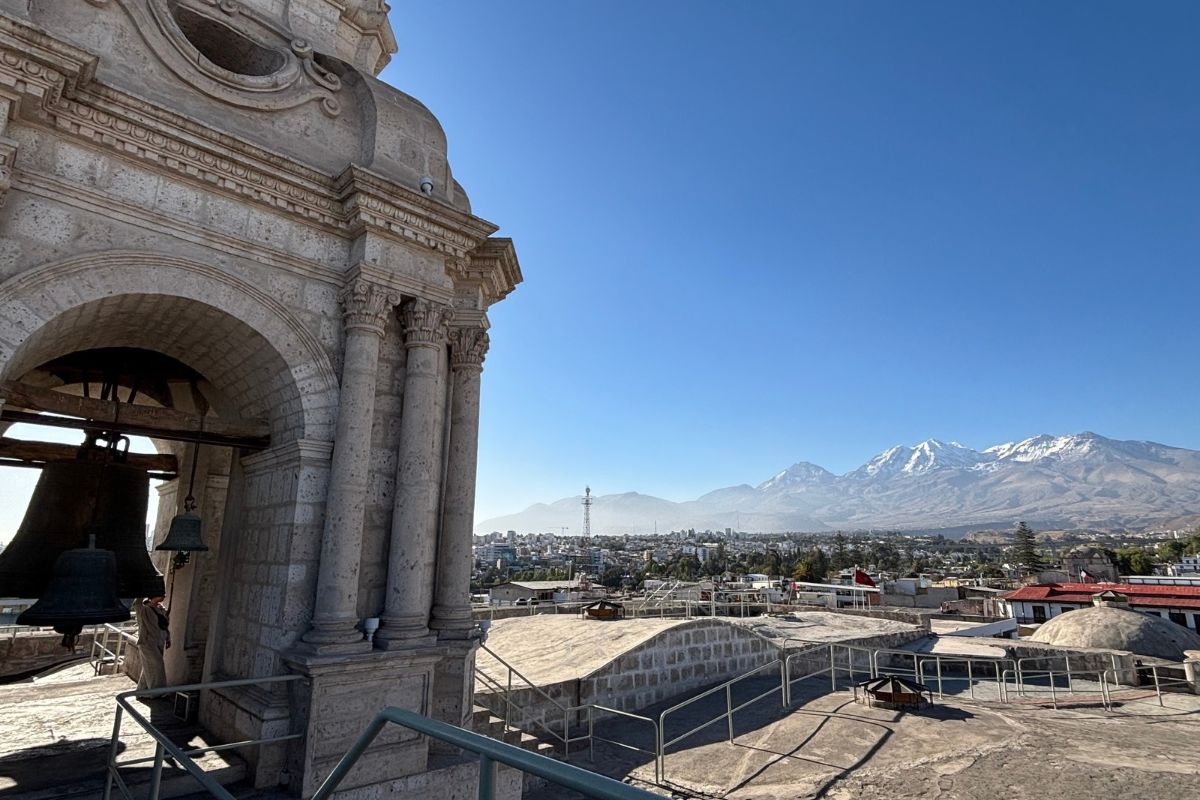
Two days for the city itself. That’s how much sightseeing time we had after our flight delay, and it was enough for Santa Catalina Monastery, the cathedral rooftop, San Camilo Market, and several viewpoints, with time for long lunches and evening walks around the Plaza de Armas.
Three days for the city and one excursion. Ruta del Sillar and Chili River rafting each take a few hours, so you can spend the rest of the day in town. Give Laguna de Salinas or Pillones Waterfall and the Imata Stone Forest a full day.
Four days if Colca Canyon is a priority. I’d keep two days for Arequipa and give Colca two days with an overnight stay. A day tour can work if you’re short on time, but it often starts around 3 a.m.
More time if you want to summit a volcano. For Misti or Chachani, I’d allow at least four to five days in the region so there’s time to acclimatize before the two-day trek.
How Many Days Do You Need in Arequipa?
I’d start with two full sightseeing days in Arequipa. We’d planned to stay longer, but flight delays left us with about two days. We decided to spend both in the city, and I’m glad we did. We could take our time at Santa Catalina Monastery, linger over lunch, and come back to the Plaza de Armas in the evening.
Two days felt like enough for a first visit because we spent them entirely in Arequipa. If there’s an excursion you’re excited about, I’d build in extra time for it. With only two days, I’d make the same choice we did and spend them getting to know the city.
What Can You See With Two Days in Arequipa?
Two days without any excursions will give you enough time for Arequipa’s main attractions without reducing the city to a quick stop between flights.
You will have time to explore the Plaza de Armas and historic center, visit San Camilo Market, tour the Cathedral and its rooftop, and spend a few hours inside Santa Catalina Monastery. You can also browse Fundo El Fierro, stop at the Claustros de la Compañía, enjoy a proper Arequipeña lunch, and make it to several of the city’s best viewpoints, including Yanahuara, Carmen Alto, and Mirador Arequipa.
That is already a full introduction to Arequipa’s history, architecture, markets, food, and volcano views. More importantly, we were able to fit those experiences into two days while still sitting down for meals, wandering around the Plaza in the evening, and enjoying the city without spending the entire time watching the clock.
If you want the exact route we followed, I break it down in my 2 Days in Arequipa itinerary. For planning purposes, though, the important takeaway is that excursions outside the city should generally be added on top of those two days rather than squeezed into them.
From there, how long you need in Arequipa depends on what you want to do next. Some activities require only a few hours, others take a full day, and the biggest excursions can add several days to your trip.
How Many Days Should You Add for Colca Canyon?
Colca Canyon is easily the star of Arequipa’s excursions. One of the deepest canyons in the world, the experience can include traditional villages, agricultural terraces, thermal pools, high-altitude landscapes, and wildlife. The best-known stop is Cruz del Cóndor, where visitors gather in the morning hoping to see Andean condors flying above the canyon.
You can technically visit Colca Canyon as a day trip from Arequipa, but it is a very long one. Many tours begin collecting passengers around 3:00 a.m. and do not return until early evening, with several hours spent traveling in each direction.
The route also takes you considerably higher than Arequipa. Some itineraries climb to viewpoints approaching 4,900 meters, compared with the city’s elevation of approximately 2,300 meters. Be prepared for colder temperatures and the possibility of feeling the altitude.
A one-day tour may make sense if your time is limited. Personally, if I were going to Colca, I would add two days to my Arequipa itinerary and stay overnight. That allows you to travel through the highlands at a more reasonable pace, spend the night around Chivay or elsewhere in the Colca Valley, and visit the canyon the following morning without squeezing everything into one extremely long day.
It is also important to distinguish between a sightseeing tour and a Colca Canyon trek. Standard tours focus primarily on viewpoints and stops throughout the valley, while trekking itineraries descend into the canyon and require considerably more physical effort, particularly on the climb back out.
Colca Canyon was never a priority for this particular trip. I enjoy landscapes and viewpoints, but I am not especially motivated by wildlife sightings, and our trip had already been shortened by flight delays. Traveling with my parents while my mom and I were both dealing with colds and congestion made a 3:00 a.m. departure followed by higher elevations and colder conditions even less appealing.
Skipping it gave us more time to enjoy Arequipa itself. But if I visit Colca in the future, a slower overnight trip would be much more appealing than trying to squeeze it into one day.
For planning purposes, I would allow:
- One additional day for a compressed sightseeing tour
- Two additional days for a more comfortable overnight experience
- Two to three additional days for a trekking itinerary
If Colca Canyon is one of the main reasons you are visiting Arequipa, build your schedule around it first and preserve at least two separate days for the city.
Explore: Colca Canyon Full-Day Guided Tour →
Do You Need an Extra Day for the Ruta del Sillar?
The Ruta del Sillar is one of the easiest excursions to add to an Arequipa itinerary because it typically takes only three to four hours. With morning and afternoon departures commonly available, you can visit without sacrificing an entire day in the city.
The route helps explain part of the story behind Arequipa’s nickname, the White City. Many of the churches, arches, and historic buildings around the center were constructed using sillar, the pale volcanic stone quarried outside Arequipa for generations.
Tours typically visit the working Añashuayco Quarry, where you can see local stonemasons cutting and carving sillar, before continuing to the Quebrada de Culebrillas for a short walk through a narrow canyon with high stone walls and petroglyphs. That gives the excursion a mixture of architecture, geology, local craftsmanship, and light hiking rather than making it solely a visit to a quarry.
The Ruta del Sillar may be particularly worthwhile if you’re interested in architecture or want to understand where Arequipa’s most recognizable building material comes from. Its shorter duration also makes it considerably easier to incorporate than Colca Canyon or one of the high-altitude full-day tours.
I wouldn’t add an entire day to your itinerary solely for the Ruta del Sillar. Instead, use it as part of a third day, pairing a morning or afternoon tour with a relaxed meal, museum, viewpoint, or more time in the historic center.
For most travelers, two days in the city plus a third day incorporating the Ruta del Sillar would provide a comfortable introduction to Arequipa without requiring an especially early start or overnight excursion.
Explore: Ruta del Sillar Tour →
Should You Add a Day for Laguna de Salinas?
Laguna de Salinas was the excursion that caught my attention most while looking at the options around Arequipa. The photographs of the salt flats and volcanoes reflected in shallow water immediately stood out, and several agencies advertised it as an alternative to the much longer trip to Colca Canyon.
Located within the Salinas y Aguada Blanca National Reserve, the lagoon sits at approximately 4,300 meters above sea level. Tours generally leave Arequipa early in the morning, with stops for volcano views and opportunities to see wildlife such as vicuñas, llamas, alpacas, and flamingos. Some itineraries also include thermal pools and other landscapes within the reserve.
Tour lengths vary more than I expected. Some return to Arequipa shortly after lunch, while others continue into the late afternoon, so this is one excursion where I would ask for the complete itinerary before booking rather than relying solely on the advertised name.
The biggest thing to understand is that Laguna de Salinas changes significantly throughout the year. The mirror-like reflections shown in many promotional photographs depend on there being enough water across the salt flat. During the drier months, the lagoon may instead appear as a broad white salt crust.
We visited Arequipa in August, during the dry season, so there was no guarantee of seeing the reflective conditions that had initially caught my attention. That doesn’t mean the landscape isn’t still beautiful, but it is worth knowing what the lagoon is likely to look like during your visit rather than assuming the promotional photographs represent every season.
For planning purposes, I would add one full day for Laguna de Salinas, even if your particular tour advertises an early-afternoon return. Between the early start, travel time, and several hours at high altitude, I wouldn’t plan another major activity afterward.
Explore: Laguna de Salinas and National Reserve Tour →
Should You Add a Day for Pillones Waterfall and the Imata Stone Forest?
Pillones Waterfall and the Imata Stone Forest were not even on my radar before arriving in Arequipa, but this excursion is very much up my alley. It combines high-altitude scenery, unusual geological formations, a waterfall, and enough walking to make the day feel more active than simply moving between viewpoints.
The two sites are generally combined into one full-day excursion. The Imata Stone Forest is a collection of large volcanic rock formations shaped by wind, rain, and erosion, with trails that allow you to walk among them and spot different shapes in the stone.
Pillones Waterfall requires a little more effort. Reaching it involves descending along a rocky trail and walking beside the river before climbing the same route back out. The descent may take only around 20 to 30 minutes, but it is more involved than stepping out of a tour vehicle at a viewpoint.
The excursion also takes you above 4,000 meters, so altitude, colder temperatures, and uneven terrain are worth considering. I would bring warm layers and shoes with good traction.
For planning purposes, add one full day for Pillones Waterfall and the Imata Stone Forest. Most itineraries begin early and return to Arequipa in the late afternoon, leaving enough time for dinner but not another major activity.
If you’re deciding between this and Laguna de Salinas, think about what appeals to you more: choose Pillones and Imata for waterfalls, rock formations, and walking; choose Laguna de Salinas for salt-flat scenery, volcano views, and wildlife.
Explore: Pillones Waterfall & Imata Stone Forest →
Can You Go Rafting Without Adding Another Full Day?
Rafting on the Chili River is one of the easiest ways to add some adventure without giving up a full day in Arequipa.
Most experiences take approximately three hours from pickup to return, with around an hour to an hour and a half actually spent on the water. Morning, midday, and afternoon departures are commonly available, making this easy to fit around a museum visit, long lunch, or more time exploring the historic center.
The route begins in the Chilina Valley, only a short drive from central Arequipa, and generally includes Class II and III rapids. Many tours are accessible to beginners and provide the necessary equipment and a safety briefing, although I would confirm the exact route and difficulty before booking.
Rather than spending several hours driving into the highlands, you get an active experience surrounded by the agricultural landscapes of the Chilina Valley, with potential views of Misti and Chachani.
Water conditions change throughout the year, so routes and availability can vary. During periods of higher water, operators may alter or suspend trips, making this one activity I would confirm is operating during your travel dates.
You do not need to add another full day to your itinerary for Chili River rafting. It could fit comfortably into a third day alongside another city activity, or even into a longer two-day visit if you’re comfortable keeping the rest of that day relatively light.
Explore: Chili River White-Water Rafting →
How Many Days Do You Need to Trek Misti or Chachani?
Trekking one of Arequipa’s volcanoes is a completely different commitment from visiting a viewpoint or joining a standard day tour.
The two most commonly advertised climbs are Misti, the nearly symmetrical volcano that dominates Arequipa’s skyline, and Chachani, which rises above 6,000 meters. Both are generally offered as two-day camping trips, although the experience is somewhat different.
Misti reaches approximately 5,822 meters and typically requires more elevation gain on foot, including a long ascent over loose volcanic terrain. Chachani reaches approximately 6,057 meters, but four-wheel-drive vehicles can take hikers much higher before the trek begins. That can mean less climbing on foot, but the extreme altitude, cold temperatures, and camping above 5,000 meters still make it a serious physical challenge.
These are not excursions I would book casually after seeing a sign around the Plaza. Even during favorable conditions, you need adequate acclimatization, strong fitness, appropriate cold-weather clothing, and a reputable mountain guide. Weather and snow conditions can also affect the route and equipment required.
The most important thing for itinerary planning is that a two-day trek does not simply mean adding two days to an otherwise short Arequipa visit. You also need time to acclimatize.
This may be one situation where visiting Arequipa after Cusco makes sense. After several days at higher elevations, you may arrive better acclimatized than someone flying directly from Lima or sea level. That still doesn’t guarantee how your body will respond above 5,000 or 6,000 meters, but it is worth considering when deciding the order of your trip.
For most travelers interested in a volcano summit, I would plan at least four to five days in the Arequipa region to allow time in the city, acclimatization, and the two-day trek itself. Build in even more flexibility if reaching the summit is one of the main reasons for your trip.
How to Fit Arequipa Into a Longer Peru Itinerary
Arequipa is relatively easy to combine with Cusco without backtracking through Lima. Direct flights connect the two cities in just over an hour, making them a natural pairing despite offering very different experiences.
If you are arriving internationally through Lima, one option is to fly to Arequipa, continue directly to Cusco, and then return to Lima for your flight home. You could also reverse that order and use Arequipa as a slower stop after the busier days surrounding Cusco and Machu Picchu.
Starting in Arequipa can provide a more gradual introduction to Peru’s higher elevations. The city sits at approximately 2,300 meters above sea level, lower than Cusco. Just don’t assume that means every excursion from Arequipa stays at a lower elevation. Several day trips in this guide climb above 4,000 meters, and volcano treks go considerably higher, so altitude should still factor into the order of your plans.
I wouldn’t rush Arequipa and Cusco simply because the flight between them is short. Cusco requires several days once you account for the Sacred Valley and Machu Picchu, while I would preserve at least two days for Arequipa itself before adding any excursions.
If your Peru itinerary is already packed, Arequipa doesn’t need to be squeezed in just because it fits neatly on the map. But with more time—or if you’ve already visited Lima and Cusco—Arequipa offers its own architecture, history, food, volcano views, and surrounding landscapes without feeling like a repeat of either city.
One practical note from our experience: leave some flexibility around your flights. Weather disruptions delayed our arrival in Arequipa by nearly a full day, so I would avoid building your itinerary around a tight onward connection.
How Many Days Should You Plan for Arequipa?
Whether you choose Arequipa simply for the volcano views, incredible food, and the chance to explore another striking Peruvian city—or add extra time for the activities surrounding it—Arequipa deserves a place in your Peru journey.
Start with two days for the city itself. Add a few hours for the Ruta del Sillar or Chili River rafting, one full day for Laguna de Salinas or Pillones Waterfall and the Imata Stone Forest, and at least two days for a more comfortable Colca Canyon experience. If climbing Misti or Chachani is the goal, allow additional time for acclimatization as well as the trek.
Our short visit was enough to leave me satisfied, but it also gave me plenty of reasons to return. And sometimes, that is the best way to leave a destination.
Continue Exploring Peru
- 2 Days in Arequipa: A Relaxed Itinerary for Peru’s White City — See how we spent two sightseeing days in the city itself.
- How Many Days Do You Need in Paracas, Ica, and Huacachina? — Compare the time needed for a coastal and desert extension.
- Cusco Is Not Just a Base for Machu Picchu — Give Cusco itself a place in your plans alongside its excursions.
- Lima Airport Flight Delays & Cancellations — Read the travel-day experiences that shaped my thoughts on leaving room for flexibility.