The Best Day Trips from Quito
This post is part of my South America series, following my five-week solo trip through Argentina, Uruguay, Chile, Ecuador, and Colombia. I share what I experienced, the day trips and regions I considered, and what I’d plan differently next time. You’ll find related guides in the Explore South America section at the end.
Quito is a city I fully intend to return to. Even while planning my short stay, I knew both the city and Ecuador had far more to offer than I could fit into a single trip. One of the reasons Quito makes such a great base is the incredible variety of day trips from the city. Within a few hours of the capital, you can hike an active volcano, explore a cloud forest, relax in natural hot springs, visit one of South America’s oldest Indigenous markets, or stand on the rim of a volcanic crater lake.
During my visit, I only had time for one day trip, to Cotopaxi National Park, and it proved to be the perfect introduction to Ecuador’s Andes. The hike was challenging at times, but also magical. After all, how often do you find yourself trekking up the side of a volcano while snow falls around you?
When I return to Quito, these are the day trips I’ll be choosing from next.
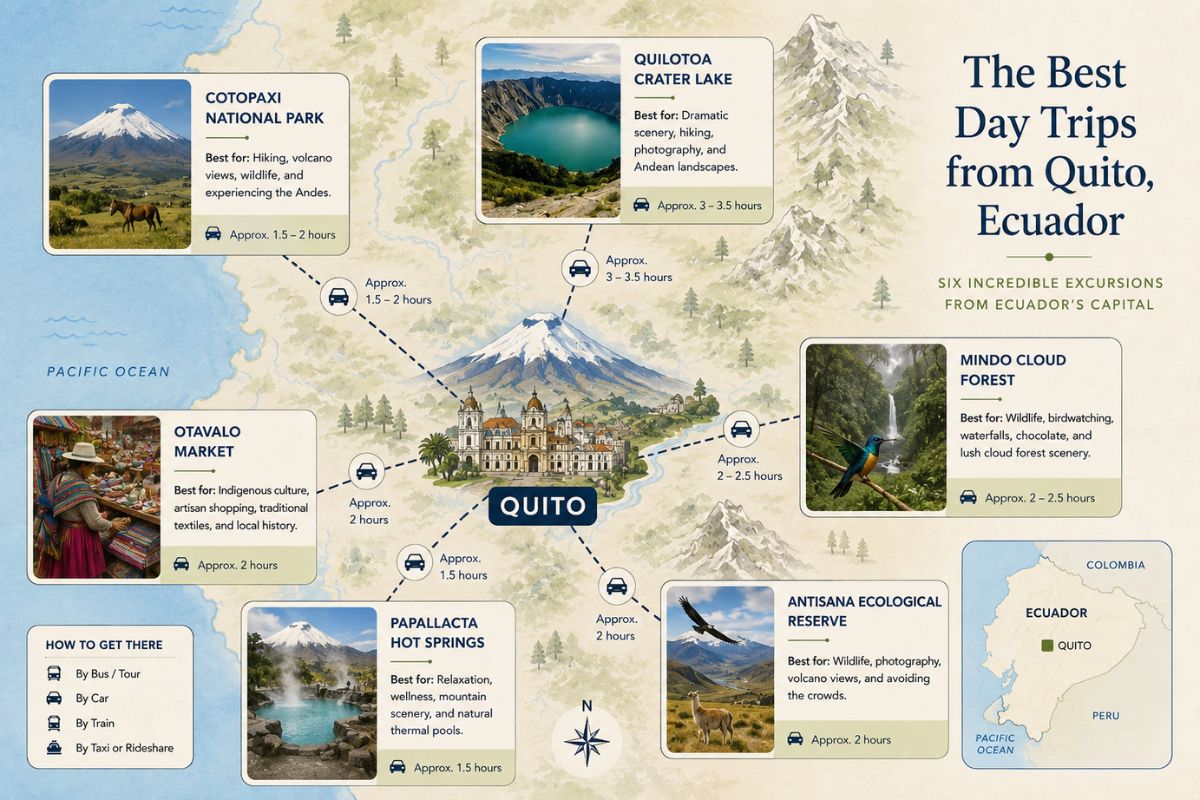
Cotopaxi National Park
Best for: Hiking, volcano views, mountain scenery, and experiencing the Andes beyond Quito.
Distance: Approximately 1.5–2 hours by car or guided tour
Getting There: Guided day tours are the easiest option and typically include transportation, breakfast, and a visit to José Ribas Refuge. Renting a car is also possible for experienced drivers.
If you’re only taking one day trip from Quito, this would be my recommendation. Home to one of the world’s highest active volcanoes, Cotopaxi National Park offers dramatic scenery, high-altitude hiking, wildlife, and the chance to experience the Ecuadorian Andes beyond the capital. Even before reaching the trailhead, the drive through the park is worth the trip, with wide-open grasslands leading toward Cotopaxi’s snow-capped peak.
My hike to José Ribas Refuge ended up being one of the highlights of my time in Ecuador. Between the altitude, changing weather, and incredible views, it was an unforgettable experience and one I’d gladly do again.
Explore Cotopaxi day trips from Quito →
Travel Breakdown Tip: Even if you’re not an experienced hiker, don’t overlook Cotopaxi. Most tours offer a manageable hike to the refuge, and the scenery alone makes it one of the best day trips from Quito.
Quilotoa Crater Lake
Best for: Hiking, dramatic scenery, photography, and experiencing the Ecuadorian Andes.
Distance: Approximately 3–3.5 hours by car
Getting There: Most visitors join a guided day tour, although independent travel by bus is also possible.
Located along Ecuador’s famous Avenue of the Volcanoes, Quilotoa is a massive volcanic caldera filled with a striking turquoise lake. Formed by a volcanic eruption hundreds of years ago, it’s now one of the country’s most photographed natural attractions and a favorite destination for hikers.
Most day tours include several stops before reaching the crater, often visiting Indigenous villages, local markets, or scenic viewpoints along the Avenue of the Volcanoes before arriving at Quilotoa. Once there, visitors can hike down to the lake, rent a kayak, or simply walk along the crater rim to enjoy panoramic views.
Even if you decide not to hike all the way to the water, the views from the crater rim alone are worth the journey. The lake changes shades of blue and green depending on the sunlight and weather, making every visit a little different. If you do hike to the shoreline, be prepared for a steep climb back to the top due to the altitude, although horses are available for anyone who prefers not to make the return hike on foot.
Explore a Quilotoa Crater Lake day trip from Quito →
Travel Breakdown Tip: This is one of Quito’s longest day trips, but if dramatic mountain scenery is what you’re looking for, few places in Ecuador are more rewarding.
Mindo Cloud Forest
Best for: Wildlife, waterfalls, chocolate, birdwatching, and escaping Quito’s altitude.
Distance: Approximately 2–2.5 hours by car
Getting There: Guided day tours are widely available from Quito, or you can travel independently by bus.
Located on the western slopes of the Andes in Ecuador’s Cloud Forest region, Mindo offers a completely different landscape from Quito. Instead of high-altitude volcanoes and mountain scenery, you’ll find lush forests filled with hummingbirds, orchids, butterflies, waterfalls, and some of the country’s best birdwatching. The region is considered one of Ecuador’s biodiversity hotspots, making it a favorite destination for nature lovers.
Most guided tours combine several activities into a single day, such as riding the Tarabita cable car across the valley before hiking to waterfalls, visiting a chocolate producer to learn how Ecuador’s famous cacao is transformed into chocolate, stopping at butterfly gardens or hummingbird sanctuaries, and spending time exploring the laid-back town of Mindo itself.
Explore a Mindo day trip from Quito →
Travel Breakdown Tip: If you’re looking for a completely different side of Ecuador than the high Andes, Mindo offers one of the biggest changes in scenery without requiring an overnight stay.
Otavalo Market
Best for: Indigenous culture, artisan shopping, traditional textiles, and local history.
Distance: Approximately 2 hours by car or bus
Getting There: Guided tours are widely available, or you can take a direct bus from Quito’s Carcelén Terminal.
Located in Ecuador’s Northern Highlands, Otavalo is home to one of the oldest and most famous Indigenous markets in South America. For centuries, the Otavalo people have gathered here to trade textiles, woven goods, jewelry, artwork, leather products, and handcrafted souvenirs, and the market continues to be an important cultural and commercial center today.
Most guided tours combine time at the market with visits to nearby artisan villages such as Peguche, where you can watch traditional weaving techniques, or stops at Cuicocha Crater Lake and scenic viewpoints around Imbabura Province. The result is a day that combines shopping with a deeper understanding of Ecuador’s Indigenous traditions.
Explore an Otavalo day trip from Quito →
Travel Breakdown Tip: Visit on Saturday if possible, when the market is at its largest and the surrounding streets come alive with vendors from across the region.
Papallacta Hot Springs
Best for: Relaxation, wellness, mountain scenery, and soaking in natural hot springs.
Distance: Approximately 1.5 hours by car
Getting There: Easily reached by car, taxi, or guided tour from Quito.
Nestled high in Ecuador’s Eastern Andes on the road toward the Amazon Basin, Papallacta is famous for its naturally heated thermal pools surrounded by mountain landscapes. The mineral-rich waters are fed by geothermal activity beneath the Andes and have made Papallacta one of Ecuador’s best-known spa destinations.
After several busy days exploring Quito’s Historic Center, Papallacta offers a completely different pace. Many visitors spend the day relaxing in the different pools, enjoying lunch at the resort, or taking short hikes through the surrounding páramo ecosystem before returning to the city refreshed.
Explore a Papallacta Hot Springs day trip from Quito →
Travel Breakdown Tip: If you’ve packed several busy sightseeing days into your Quito itinerary, Papallacta offers the perfect opportunity to slow down and recharge before continuing your trip.
Antisana Ecological Reserve
Best for: Wildlife, photography, volcano views, and avoiding the crowds.
Distance: Approximately 2 hours by car
Getting There: Best visited with a guided tour or private vehicle, as public transportation is very limited.
Located southeast of Quito in Ecuador’s Eastern Andes, Antisana Ecological Reserve protects one of the country’s most important high-altitude ecosystems. Dominated by the snow-covered Antisana Volcano, the reserve is best known for its incredible wildlife rather than hiking.
Compared to Cotopaxi, Antisana receives far fewer visitors, making it an excellent choice for travelers looking for quieter landscapes. Guided excursions typically focus on spotting Andean condors, one of the largest flying birds in the world, along with wild horses, foxes, deer, hummingbirds, and numerous waterfowl around the reserve’s lakes and wetlands. Many tours also stop at scenic viewpoints overlooking Antisana’s glacier-covered summit.
Explore an Antisana day trip from Quito →
Travel Breakdown Tip: If you’ve already visited Cotopaxi or simply prefer wildlife and photography over hiking, Antisana makes an excellent alternative day trip from Quito.
Final Thoughts
I originally viewed Quito as the destination and Cotopaxi as the side trip. By the end of my visit, that perspective had completely changed.
Quito isn’t just one of Ecuador’s most interesting cities, it’s the perfect gateway to experiencing the country’s incredible diversity. Whether your interests are hiking, wildlife, culture, photography, or simply seeing landscapes unlike anywhere else, there’s a day trip waiting just beyond the capital.
I only scratched the surface during my first visit, but that’s exactly why I know I’ll be back. Whether it’s hiking around Quilotoa, spotting condors in Antisana, relaxing in Papallacta, or finally exploring Mindo’s cloud forest, Quito has become one of those cities that feels less like a one-time destination and more like the starting point for future adventures across Ecuador.
Explore South America
- How I Spent 4 Days in Quito, Ecuador: Balance your excursions with time to experience Quito itself.
- Where to Go in Ecuador: The Best Regions for Your Trip: Consider which places deserve a longer stay beyond a day trip.
- The Best Day Trips from Santiago, Chile: Compare another capital’s options for exploring mountains, towns, and surrounding landscapes.
- Guatapé Day Trip or Overnight Stay? Here’s What I Chose: Another example of deciding when an excursion deserves its own overnight stay.