Barcelona Didn’t Capture Me the Way Madrid Did (And That’s Okay)
If you’re just joining my Spain series, I recommend starting with Why Madrid Surprised Me before reading this reflection. Barcelona is an incredible city, but comparing the two helped me better understand what I personally value when I travel.
Before this trip, if you had asked me which city in Spain I was most excited to visit, the answer would have been easy: Barcelona.
Barcelona had everything I thought I wanted from this trip—the famous architecture, Mediterranean coastline, historic neighborhoods, incredible food, and the kind of landmarks I’d seen in travel photos for years. Madrid was a city I was curious about. Barcelona was the city I expected to love.
Except by the time we arrived, the trip had already surprised me several times. Madrid had exceeded nearly every expectation I had for it. Girona had gone from a frustrating stopover to a city I wished we’d given more time. And Tossa de Mar had completely reset my standards for what I wanted from a beach vacation.
So Barcelona wasn’t arriving with a blank slate anymore. It was arriving with enormous expectations—and following three destinations that had each surprised me in completely different ways.
And for the first couple of days, Barcelona and I didn’t quite click.
That doesn’t mean I disliked it. There were things I thought were spectacular, places I genuinely enjoyed, and eventually one day that showed me exactly how I wanted to experience the city. But Barcelona took longer for me to understand than I expected.
Looking back, I think that may have had as much to do with how I was trying to travel through Barcelona as it did with the city itself.
First Impressions of Barcelona
Barcelona immediately felt bigger and busier than Madrid. There were more people, more tourists, and simply more movement around us. After the slower pace of Tossa de Mar, the difference felt even more dramatic.
We arrived by bus and grabbed an Uber to EnjoyBCN Patio de Gala Apartments. After more than a week of moving between hotel rooms, having an actual apartment with extra space felt incredible. By this point in the trip, I think we were all starting to appreciate the ability to spread out, unpack a little, and occasionally have an evening that didn’t involve another restaurant reservation or attraction.
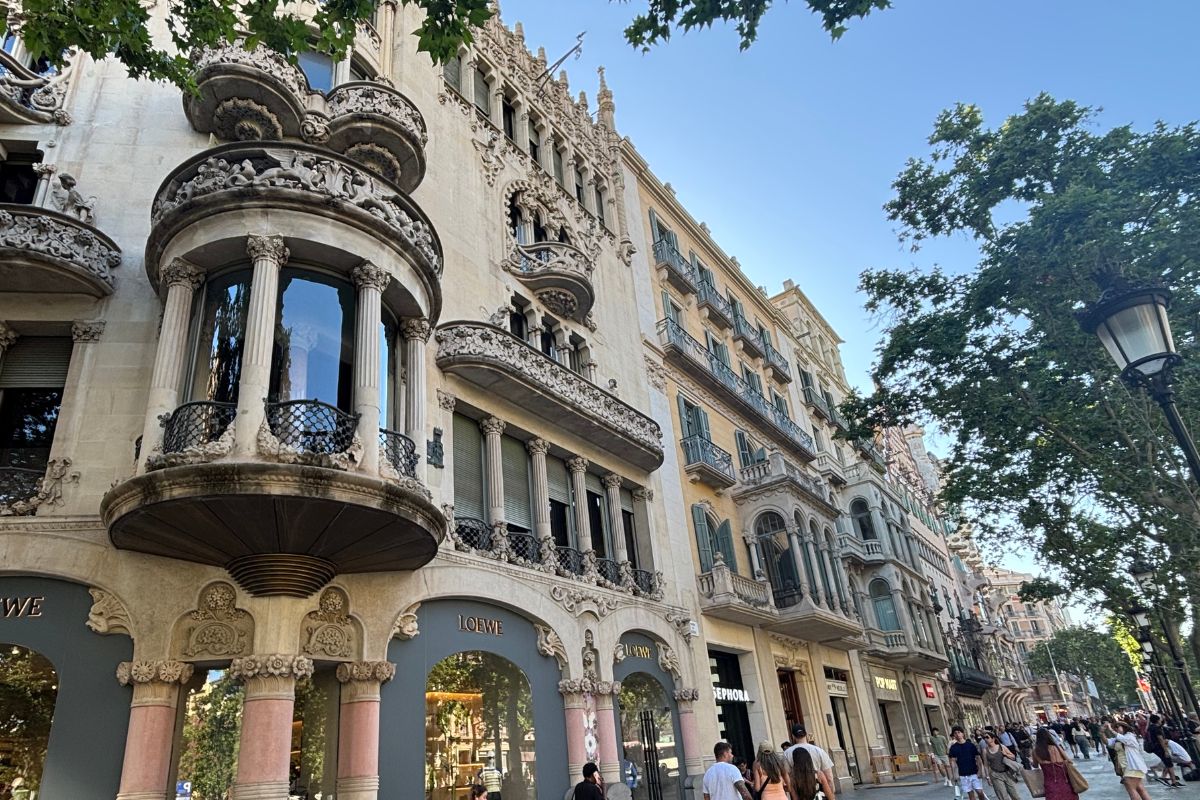
That evening, we joined a walking tour through the Gothic Quarter and El Born, which gave us our first real introduction to Barcelona. One of the things that struck me immediately was how dramatically the city changes from neighborhood to neighborhood. We took the metro through modern Barcelona before emerging near the Cathedral of Barcelona, where wide streets and newer buildings suddenly gave way to narrow medieval lanes, old stone facades, small plazas, and streets that felt centuries removed from the city we’d just traveled through.
That contrast was fascinating, and it was probably my first glimpse of the Barcelona I would eventually enjoy most.
But by the time the tour ended, we were exhausted. Instead of pushing ourselves to keep exploring simply because we were in Barcelona, we ordered pizza, stopped at Aldi for groceries, and spent the rest of the evening relaxing in the apartment.
It was one of the most ordinary evenings of the entire trip, and somehow one of the most satisfying. Looking back, that probably should have been my first clue that Barcelona was going to work better for me once I stopped trying so hard to experience it.
Explore EnjoyBCN Patio de Gala Apartments and check current rates →
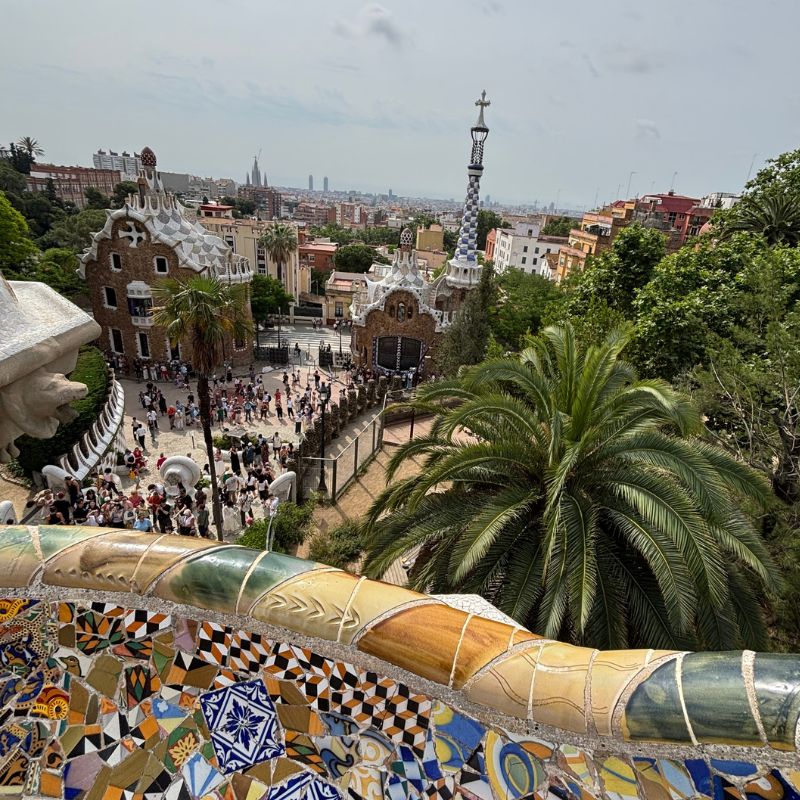
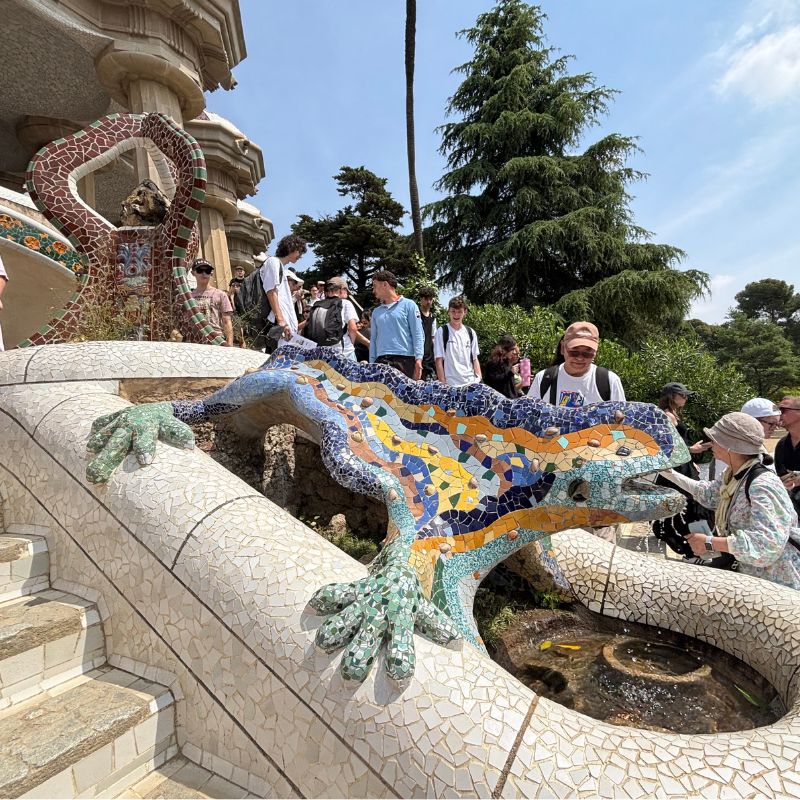
The Park Güell views I came to see—and the crowds that came with them. The quieter parts of the park ended up being just as memorable as its famous mosaics and landmarks.
Is Park Güell Worth Visiting?
The following morning, we had tickets for Park Güell, one of the Barcelona attractions I’d seen in photographs for years.
Going into the visit, I knew embarrassingly little about it. It was famous. It was designed by Gaudí. It had colorful mosaics and a salamander everyone takes a picture with. In my mind, that was enough information.
What I didn’t know—and really wish I had—was why Park Güell exists in the first place.
It wasn’t originally intended to be a public park. Industrialist Eusebi Güell commissioned Antoni Gaudí in 1900 to create an exclusive residential development, with around 60 homes surrounded by green space and communal areas designed around the natural landscape.
The residential project never really took off. Only two of the planned homes were built before work stopped in 1914, and Barcelona eventually acquired the property and opened Park Güell as a public park in 1926.
Learning that afterward completely changed the way I thought about what we’d seen. The pathways, viaducts, gathering spaces, and enormous columned hall weren’t simply whimsical Gaudí creations scattered across a hillside. They were pieces of a planned community. The Hypostyle Room was intended to serve as its market, while Nature Square was designed as a gathering space for residents.
I wish I’d understood that while I was standing there.
That morning, we realized there was a bus running directly from near our apartment to Park Güell, so we hopped on. What I wasn’t entirely sure about was which of the park’s multiple entrances we’d actually be using, and we didn’t arrive directly in front of the famous Dragon Stairway.
Instead, we found ourselves in one of the quieter areas and slowly followed signs toward the major landmarks. For a while, I was really enjoying myself. We wandered along pathways, stopped for views over Barcelona, and explored without feeling like we were at one of the city’s biggest tourist attractions.
Then we reached the famous parts.
And there were people everywhere.
By the time we reached the Dragon Stairway, mosaic salamander, Hypostyle Room, and Nature Square, the experience had completely changed. Everyone understandably wanted photographs of the same landmarks from the same handful of angles. The heat was intensifying, and every photo meant navigating around dozens of people trying to do exactly the same thing.
That’s when I very quickly became over it.
At the beginning of our visit, I’d been taking my time and paying attention to what was around me. Once we hit the crowds, my approach became: click, got it, let’s move on.
I stopped caring about getting the perfect photograph. Salamander. Click. Terrace. Click. View. Got it. Next.
Once crowd fatigue set in, I focused almost entirely on the famous things because those were the only things I knew I was there to see. Had I understood the story behind the park, I think I would have been more interested in wandering back toward the quieter areas and imagining what this strange, ambitious residential community was actually supposed to become.
So, is Park Güell worth visiting? Yes. And strangely, my first visit made me more interested in visiting it a second time.
I’ve found that I sometimes enjoy major tourist attractions more the second time around. I’ve already seen the highlights and taken the photos, so the pressure disappears. I can spend more time somewhere that catches my attention, skip something that’s packed, and simply take the crowds for what they are.
Park Güell feels like exactly that kind of place.
Next time, I’ll know what I’m looking at, be more mindful about when I visit, and spend more time exploring the parts of Park Güell I didn’t realize were worth paying attention to the first time.
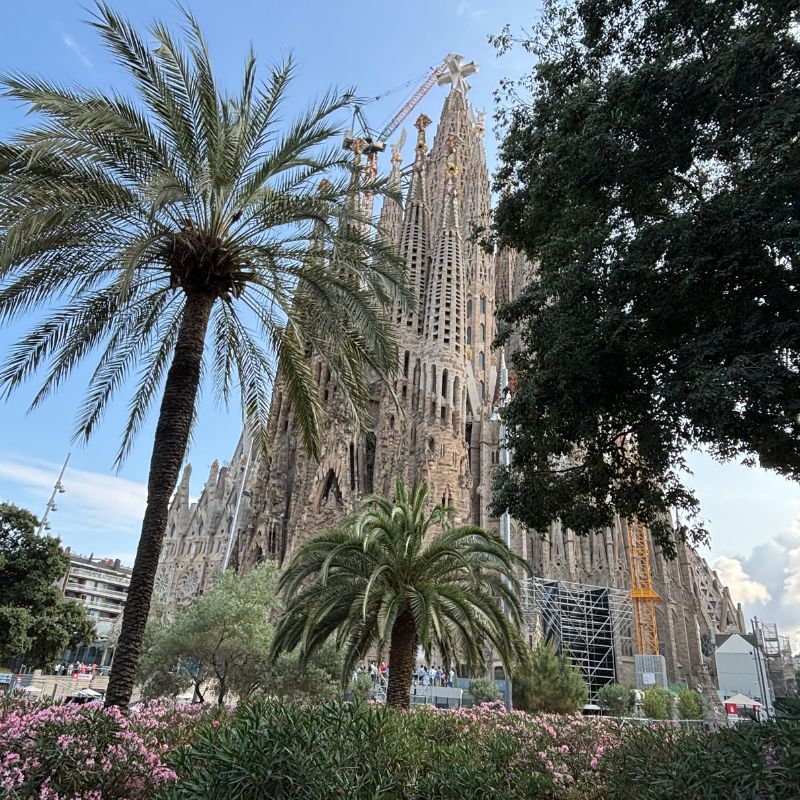
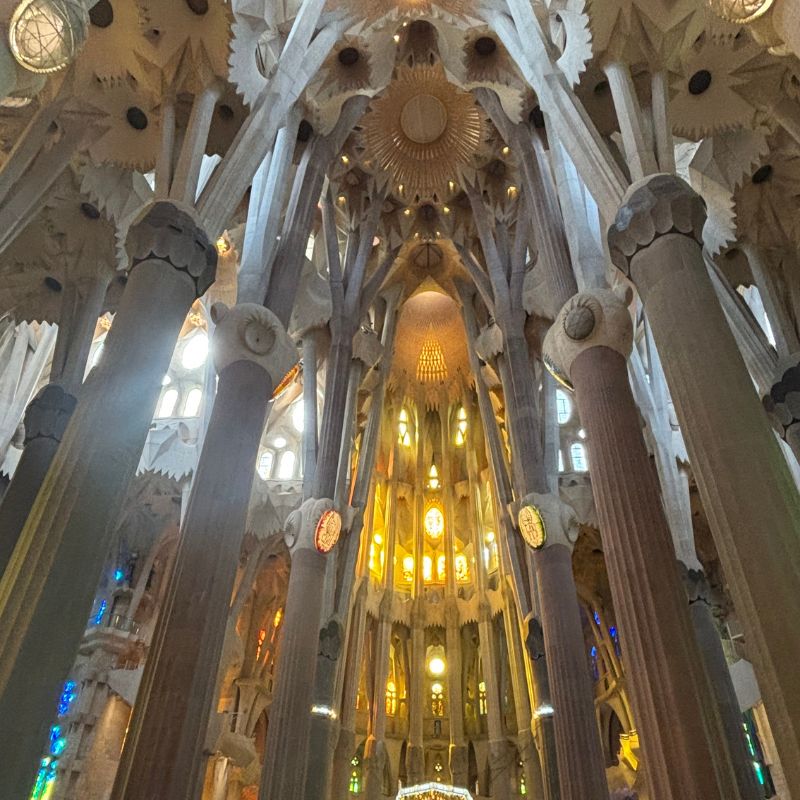
The crowds shaped my experience, but they couldn’t take away from the extraordinary grandeur and detail of Sagrada Família, inside or out.
Why Sagrada Família Is Different
If Park Güell left me thinking I’d like to try again under different circumstances, Sagrada Família taught me a slightly different lesson.
Before visiting, I was convinced this would be one of the highlights of Barcelona. You can see thousands of photographs of Sagrada Família, but the scale is difficult to understand until you’re standing beside it. Even under construction, the exterior is extraordinary, with an almost overwhelming amount of detail built into the facades.
It’s also surprisingly difficult to simply stand back and take it all in. Between the ongoing construction, fencing, equipment, surrounding buildings, traffic, and crowds gathered around the basilica, there really isn’t one perfect unobstructed view waiting for you. Eventually, I stopped trying to find it.
Inside, our guided tour lasted about fifty minutes and gave us much more context for the symbolism, carvings, stained glass, and architectural decisions throughout the basilica. The soaring columns and colored light are genuinely impressive, and I could appreciate why this building has fascinated people for generations.
But appreciating something and loving the experience of visiting it aren’t necessarily the same thing.
It was hot inside, and it was packed. Sagrada Família is enormous, yet with so many people moving through the interior and gathering around the grounds, it somehow didn’t feel enormous. Instead of experiencing that sense of openness and scale I’d expected, I was constantly aware of how many people were sharing the space with us.
And unlike Park Güell, I’m not sure there’s a simple lesson here about choosing a better time. Could I visit earlier, later, or during a cooler season and have a different experience? Probably. But sometimes you only learn what matters to you by actually doing the thing.
For me, Sagrada Família may have been one of those experiences.
I’m glad I went inside once. I’m glad I took the tour and learned more about what I was seeing. But looking back, I think I personally would have been perfectly happy seeing Sagrada Família from the outside as we passed through the city on a sightseeing bus.
Would my family have felt the same way? I’m not sure. And that’s part of traveling with other people: something that isn’t essential to me may still be an experience someone else would hate to miss.
Do I feel an urgency to return? Not really. I probably will someday, perhaps years from now when the construction is finally complete and enough time has passed that I’m curious to see it again.
But unlike Park Güell, I’m not leaving this experience thinking I need a do-over. Sometimes seeing something once is enough, and there’s nothing wrong with realizing that after you’ve seen it.
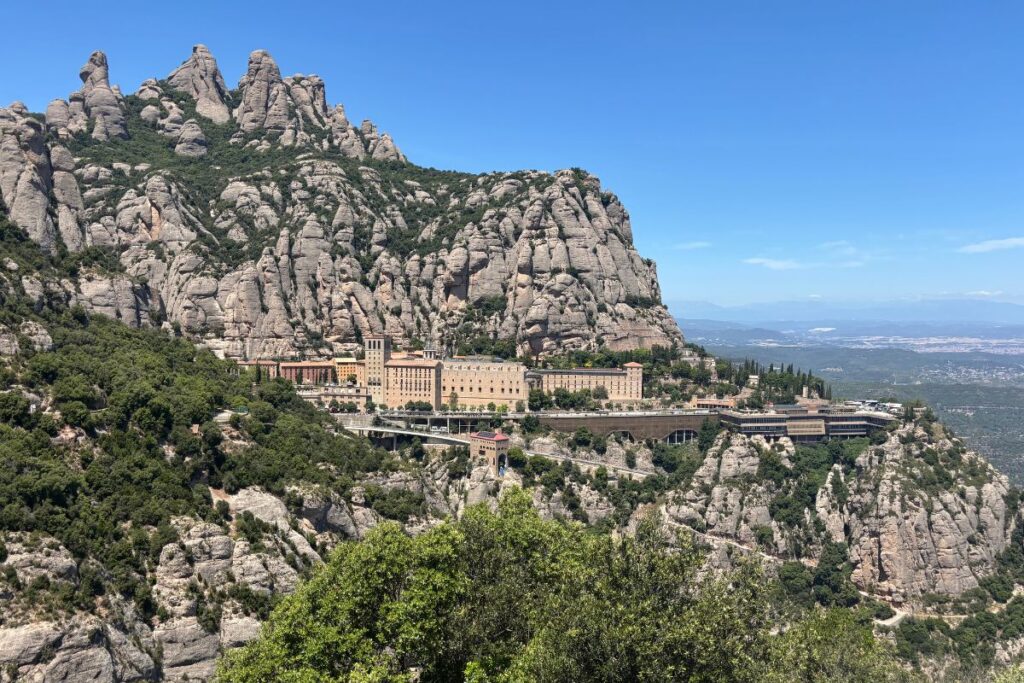
I went to Montserrat expecting a monastery visit. The dramatic mountain landscape, and how much there was to explore beyond the basilica, was the real surprise.
Montserrat Was the Change of Pace I Needed
By our third day, I realized I needed a break from the city.
Montserrat turned out to be exactly that, and far more interesting than I expected.
I’ll admit that during my trip research, I wasn’t particularly excited about Montserrat. It kept appearing as the day trip to take from Barcelona, and because we’d built enough time into our stay to leave the city for a day, I added it to the itinerary. But looking at photos beforehand, I wasn’t entirely convinced. A monastery in the mountains? Beautiful, sure. I also thought there was a decent chance I’d be bored after an hour.
I completely underestimated it.
Montserrat has been an important religious destination for centuries, centered around the Benedictine monastery of Santa Maria de Montserrat and its famous Black Madonna. But you don’t have to be particularly interested in religious history to understand why people make the trip. The monastery sits dramatically against Montserrat’s enormous rock formations, and once you’re there, there’s much more to do than simply visit the basilica.
You can explore the monastery complex and museum, follow walking and hiking paths through the mountains, or use the Sant Joan and Santa Cova funiculars to reach different areas and trails. Even getting up to the monastery gives you a choice: from the train line connecting Montserrat with Barcelona, you can continue up the mountain by rack railway, as we did, or take the Aeri de Montserrat cable car for a much more dramatic arrival.
The R5 train ride from Barcelona felt long and crowded at times, but about ten minutes before arriving, the massive rock formations began appearing outside the windows. Suddenly, everyone on the train was paying attention.
Once there, the museum gave us useful context about Montserrat’s history, while the basilica was beautiful without feeling overwhelming. After two days of navigating some of Barcelona’s busiest attractions, I also appreciated being somewhere where the experience wasn’t confined to one building or one famous thing everyone was trying to photograph.
The highlight for me was the walk to St. Michael’s Cross.
The path is paved and moderately uphill, but with shade, a breeze, and increasingly beautiful views as we climbed, I found the walk surprisingly enjoyable. There was no need to rush toward a particular photo spot or squeeze through a crowd. We could simply walk and enjoy where we were.
And when you reach the viewpoint, the reward is spectacular.
From St. Michael’s Cross, you get a sweeping view back toward the monastery tucked beneath those enormous rock formations, along with the valley stretching out below. It was easily one of my favorite viewpoints of the entire Spain trip.
I went to Montserrat largely because we had the time and everything I’d read told me this was the Barcelona day trip to take. I left understanding why.
It’s also somewhere I’d happily visit again. Now that I know Montserrat is much more than a monastery in the mountains, I’d give myself more time to explore the walking paths, take one of the funiculars farther into the mountains, and see more of the landscape beyond the main monastery complex.
Unlike some of Barcelona’s famous attractions that I left feeling satisfied to have experienced once, Montserrat felt like we’d only seen part of what was there.
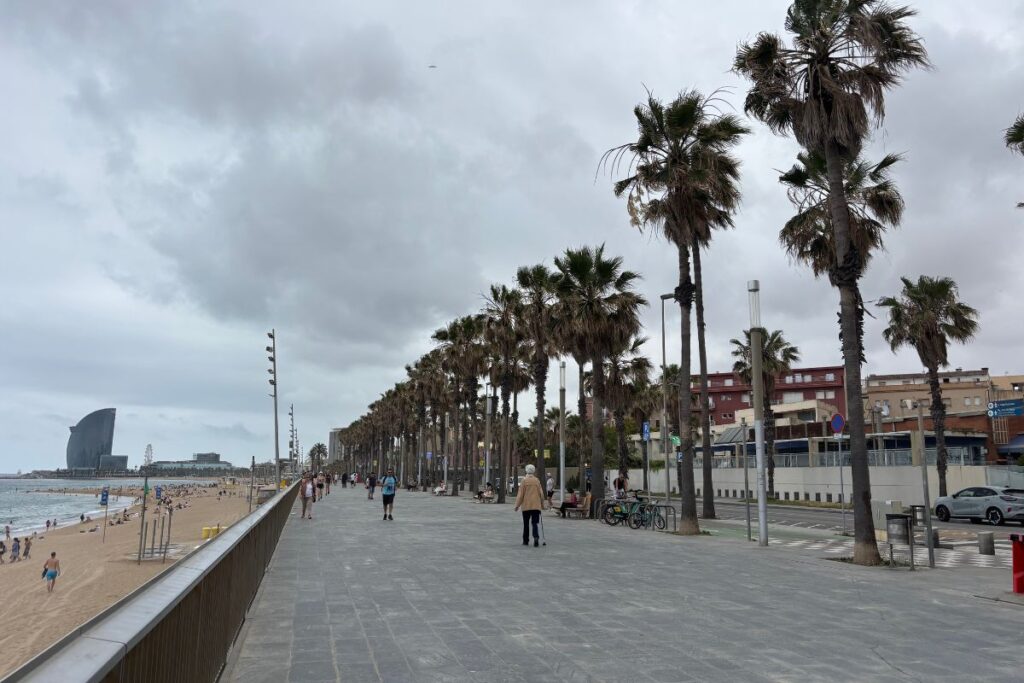
No tickets, no reservations, no major attractions, just a morning walking along Barceloneta Beach. Somehow, this became my favorite day in Barcelona.
My Favorite Day in Barcelona
Ironically, my favorite day in Barcelona was also our least ambitious.
There was no alarm clock, no attraction reservation, and no carefully planned itinerary. We didn’t have anywhere we needed to be at a particular time. The plan was basically to pick a direction and wander.
We took the bus to Barceloneta Beach and spent the morning walking along the shoreline. After several days of navigating crowded attractions and timed tickets, being able to simply walk beside the Mediterranean without trying to accomplish anything felt surprisingly good.
From Barceloneta, we made our way through Port Vell and eventually back into El Born, which by the end of the trip had become one of my favorite neighborhoods in Barcelona.
This was the version of the city I liked most: narrow streets, older architecture, small plazas, cafés and restaurants tucked into unexpected corners, and the feeling that you might find something interesting simply because you decided to turn down a different street.
We stopped for one final lunch at La Taverna del Coure, where we ordered fideuà, croquetas, crema catalana, and cava sangria before continuing to wander.
There was nothing particularly ambitious about the day. We weren’t checking off Barcelona’s biggest landmarks or rushing toward the next reservation.
And I think that’s exactly why I loved it.
After spending the first few days trying to figure out why Barcelona wasn’t capturing me the way I’d expected, I finally found the version of the city that worked for me.
It was exactly the type of day I travel for.
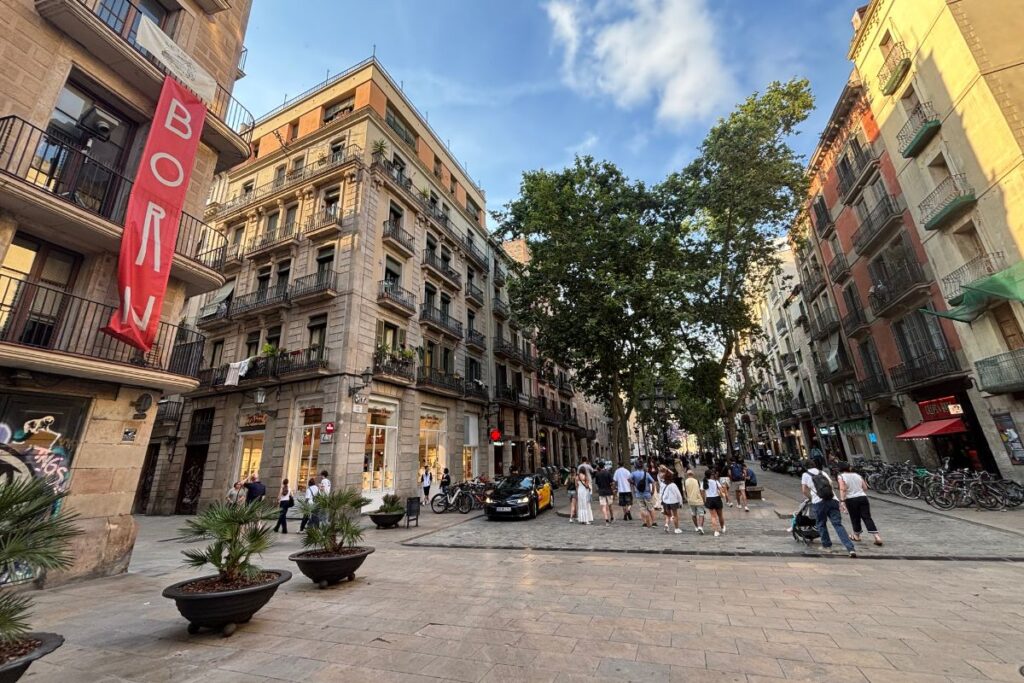
Barcelona took time to win me over, but neighborhoods like El Born helped me find the version of the city I enjoyed most.
Final Thoughts: Why My Feelings on Barcelona Are Still Mixed
Barcelona is beautiful. The architecture is remarkable, the food is excellent, and its most famous attractions deserve their reputations.
And yet, if I’m being honest, it wasn’t love at first sight.
And that’s okay. I’m only now starting to warm up to Paris, and I’ve been there a handful of times. Some cities grab me immediately; others take a second, third, or apparently several visits before I figure out what I like about them.
Barcelona may simply be one of those cities for me.
Before the trip, Barcelona was the city I was most excited about. Instead, Madrid impressed me far more than I expected, Girona surprised me, and Tossa de Mar completely stole my heart.
Barcelona took time.
The more I thought about my mixed feelings, though, the more I realized they weren’t entirely about Barcelona. They were also about how I was trying to experience it.
A few years ago, I probably would have wanted more museums, more attractions, and a more ambitious itinerary. Now, I’m much happier spending an hour on a beach, wandering through a neighborhood without a destination, or lingering over lunch without worrying about the next reservation.
Barcelona also reinforced something I’m getting better at accepting: you don’t have to visit something simply because you’re told it’s one of the things you “have to” see.
Sometimes the famous attraction will surprise you. Sometimes you’ll be glad you experienced it once. And sometimes the day trip you weren’t particularly excited about will end up being somewhere you can’t wait to visit again.
If I were planning my first Barcelona trip again, I’d also consider something I once might have dismissed as too touristy: the hop-on hop-off bus. Barcelona is spread out, with major sights scattered across different neighborhoods, and especially on a short trip or during a hot summer visit, there’s real value in seeing more of the city without turning every landmark into another timed reservation.
Not because it’s the most authentic way to experience Barcelona.
Because it might be the most enjoyable.
If I had extra days to redistribute across this Spain itinerary, I would probably still add them to Madrid and Tossa de Mar. That isn’t a criticism of Barcelona. It’s simply where I found myself wanting more time.
The version of me who planned this trip thought Barcelona would be the star.
The version of me who experienced it isn’t so sure, and I’m okay with that.
And with Barcelona, we’ve reached the end of this Spain trip. If you’ve been following the series from Madrid through Girona, the Costa Brava, and Barcelona, there’s one final question left: what did all of this actually cost?
I break down everything from flights and hotels to transportation, attractions, and tourist taxes in The Real Cost of a Comfortable Spain Trip in 2026.
Want to keep reading? Spain also gave me a new point of comparison for another European coastline I’d visited not long before. If you’re deciding between Spain’s Costa Brava and Italy’s Amalfi Coast, I break down how the two experiences compare in Amalfi Coast vs. Costa Brava: Which One Should You Visit?.