Argentina Beyond Buenos Aires: My Shortlist for Next Time
This post is part of my South America series, following my five-week solo trip through Argentina, Uruguay, Chile, Ecuador, and Colombia. I share what I experienced, the day trips and regions I considered, and what I’d plan differently next time. You’ll find related guides in the Explore South America section at the end.
Argentina is enormous.
Before planning my trip, I knew Argentina was a large country. I didn’t realize just how large.
Stretching roughly 2,300 miles (3,700 km) from north to south, Argentina is about the same distance as traveling from Maine to Miami. Once I saw that comparison, it completely changed how I thought about planning my itinerary.
I quickly realized that exploring multiple regions would often mean flying back through Buenos Aires between destinations, and I didn’t want to spend my trip constantly backtracking just to squeeze in another stop. Instead, I chose to focus on one region beyond the capital—Patagonia—knowing there would still be plenty of reasons to return.
As it turns out, I came home with an even longer list.
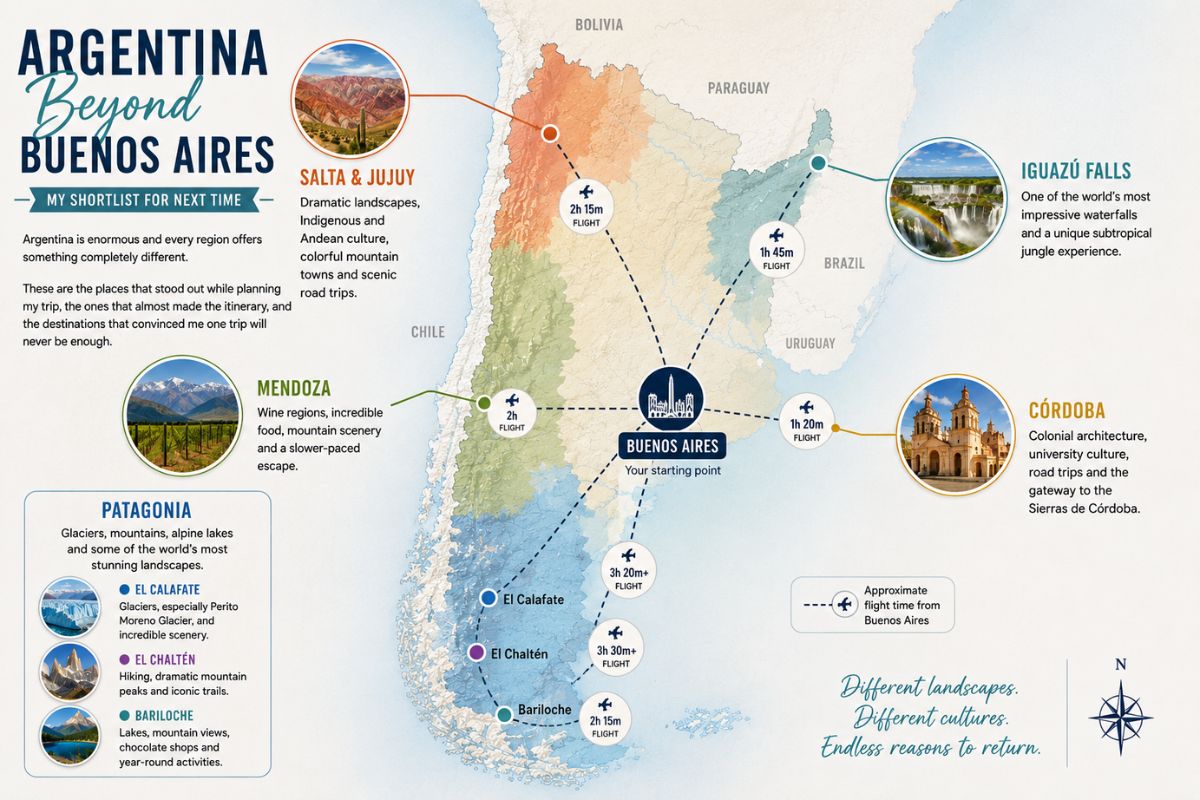
These are the regions that stood out most while planning my trip, the places that almost made the itinerary, and the destinations that convinced me one visit to Argentina will never be enough.
Mendoza
Flight time from Buenos Aires: About 2 hours nonstop
Best for: Wine lovers, food-focused travelers, mountain scenery and a slower-paced escape
Mendoza felt like one of those places I should visit on my first trip to Argentina. The country is so closely associated with wine—especially Malbec—that skipping its most famous wine region almost felt like visiting France without considering Bordeaux.
But Mendoza is much more than vineyards. Located near the Chilean border, the province combines world-class wineries with dramatic Andes scenery, creating a destination that’s appealing even if you aren’t a serious wine enthusiast. Flights from Buenos Aires take about two hours, but Mendoza is best experienced over several days rather than as a quick overnight trip.
The region’s three main wine areas—Maipú, Luján de Cuyo, and the Uco Valley—each offer something different. Maipú is known for its traditional wineries, Luján de Cuyo is considered the birthplace of Argentine Malbec, and the Uco Valley pairs high-altitude vineyards with spectacular mountain views.
A little planning goes a long way here. Many wineries require reservations, and tastings are often paired with vineyard tours or long, multicourse lunches. Most visitors either join a guided tour, hire a driver, or focus on one wine region each day rather than trying to see everything at once.
Beyond the wineries, Mendoza also offers horseback riding, rafting, cycling, and excursions into the Andes, including views of Aconcagua, the highest mountain outside Asia.
Even as someone who doesn’t plan trips around wine, Mendoza remains one of the biggest omissions from my first visit to Argentina. I can easily picture spending three or four nights here—enjoying a couple of wineries, lingering over long lunches, exploring Mendoza City, and setting aside a day to experience the Andes. It feels like the kind of destination that’s best appreciated at a slower pace rather than squeezed into a rushed itinerary.
Salta & Jujuy
Flight time from Buenos Aires: About 2 hours 15 minutes nonstop to Salta
Best for: Dramatic landscapes, road trips, Indigenous and Andean culture, colorful mountain towns and travelers looking for a side of Argentina that feels completely different from Buenos Aires
If Mendoza felt like an obvious omission because of Argentina’s wine reputation, Salta and Jujuy caught my attention for the opposite reason: I had no idea this part of the country looked like this.
Northwest Argentina couldn’t feel more different from Buenos Aires. Instead of grand boulevards and European architecture, you’ll find red-rock valleys, high-altitude deserts, enormous salt flats, and mountains painted in shades of red, orange, green, and purple. It’s one of the regions that best showcases just how diverse Argentina’s landscapes really are.
Most itineraries begin in Salta, reached by a nonstop flight of about two hours and 15 minutes from Buenos Aires. While Salta City makes a convenient base, what appeals to me most is exploring both Salta and neighboring Jujuy by road. Rather than treating them as a series of long day trips, I’d want to split my time between the two provinces and let the journey itself become part of the experience.
Salta and the Calchaquí Valleys
Best for: Scenic road trips, dramatic rock formations, high-altitude wineries, and travelers who enjoy slow-paced drives through spectacular landscapes.
South of Salta, the road to Cafayate passes through the Quebrada de las Conchas, a valley filled with sculpted rock formations and intensely colored cliffs. Cafayate is also one of Argentina’s important wine areas, best known for high-altitude vineyards and Torrontés, an aromatic white wine. That gives this region a completely different wine experience from Mendoza: less polished destination winery, perhaps, and more dramatic road-trip scenery.
Another possible route leads toward Cachi, passing mountain roads, giant cacti and Los Cardones National Park. This is the kind of landscape that would make me want to stop constantly rather than rush between headline attractions.
Jujuy and the Quebrada de Humahuaca
Best for: Colorful mountain landscapes, Indigenous and Andean culture, UNESCO heritage sites, and photographers.
Farther north, Jujuy’s biggest draw is the Quebrada de Humahuaca, a UNESCO-listed valley that has served as an important trade and cultural route for thousands of years. Along the way, you’ll find Andean towns like Purmamarca, Tilcara, and Humahuaca, each surrounded by dramatic mountain landscapes.
Purmamarca is famous for the Hill of Seven Colors, while Humahuaca serves as the gateway to Hornocal, whose striking mountain range is often described as having 14 colors. Just beyond the mountains lie the Salinas Grandes, where the road climbs through the Andes before opening onto one of Argentina’s vast white salt flats.
What draws me here isn’t just the scenery. Salta and Jujuy also offer a much stronger connection to Argentina’s Indigenous and Andean heritage through their food, markets, crafts, and local traditions. It feels like a region best experienced slowly rather than as a series of photo stops.
I think I’d want at least five or six nights, and ideally a full week, to experience both Salta and Jujuy without rushing. More than almost anywhere else on this list, this region makes me want to return because it offers a version of Argentina that’s completely different from the one I experienced on my first trip.
Iguazú Falls
Flight time from Buenos Aires: About 1 hour 50 minutes nonstop
Best for: Nature lovers, first-time visitors to Argentina, photographers and anyone wanting to experience one of the world’s most spectacular waterfalls
Some destinations become famous because of a single attraction.
Iguazú Falls is one of those rare places where the attraction actually lives up to the hype.
Made up of more than 250 waterfalls stretching nearly two miles across the Argentina-Brazil border, Iguazú is considered one of the world’s great natural wonders. Around 80% of the falls are in Argentina, where an extensive network of trails and boardwalks lets visitors experience the waterfalls from multiple perspectives.
Most travelers spend two or three days based in Puerto Iguazú, exploring both the Argentine and Brazilian sides. The Argentine park is home to the famous Devil’s Throat, while Brazil offers sweeping panoramic views that showcase the scale of the entire waterfall system. Together, they provide two very different experiences.
I nearly included Iguazú on my first trip to Argentina but ultimately decided against it for one simple reason: I didn’t want my itinerary to become a series of flights back through Buenos Aires. Looking back, I still think that was the right decision. Iguazú deserves more than a rushed two-day detour squeezed between other destinations.
When I return, I’d rather combine Iguazú with another destination in northern Argentina—perhaps Salta and Jujuy—and spend enough time exploring the region instead of flying in just for the falls. That approach feels much more aligned with how I like to travel.
Patagonia
Flight time from Buenos Aires: Varies by destination, but expect 2½–3½ hour nonstop flights to the main gateways.
Best for: Glaciers, hiking, dramatic landscapes and travelers looking to experience one of the world’s most iconic wilderness regions.
Patagonia had been on my travel list for years, but I never really understood how all the pieces fit together.
When I thought of Patagonia, I pictured experienced hikers carrying heavy backpacks, tackling multi-day treks, and braving unpredictable weather. I wasn’t sure where someone like me—a traveler who enjoys nature but doesn’t build entire vacations around strenuous hikes—fit into the picture.
That changed when I visited El Calafate.
It wasn’t just one of my favorite stops in Argentina, it completely changed how I thought about Patagonia. I realized it isn’t one destination but a vast region, with each area offering a different experience. Some travelers come for glaciers, others for world-famous hikes, and others simply to experience some of the most spectacular landscapes in South America.
I left knowing I had only scratched the surface. One day, I’ll be back to explore more of this remarkable region.
El Calafate: My Introduction to Patagonia
Best for: First-time visitors to Patagonia, glacier lovers, scenic landscapes, and travelers who want to experience Patagonia without committing to multi-day hikes.
If you’re looking for an accessible first experience in Patagonia, I don’t think I could have picked a better destination than El Calafate.
A nonstop flight from Buenos Aires takes about 3 hours and 20 minutes, and within minutes of arriving, you’re surrounded by landscapes that feel completely different from anywhere else in Argentina. The town is compact, easy to navigate, and an excellent base for exploring the region.
The highlight is Perito Moreno Glacier. I’d seen glaciers in photos, but nothing prepared me for standing across from a wall of blue ice, waiting to hear the crack of ice breaking away before it crashed into Lago Argentino. It’s one of those places where simply standing still becomes the experience.
What surprised me most was how approachable Patagonia felt. I wasn’t carrying camping gear or tackling multi-day hikes, I was simply able to experience one of the world’s most spectacular landscapes without complicated logistics.
I left realizing I hadn’t seen Patagonia, I’d simply been introduced to it. El Calafate was the perfect first stop, and it made me want to return for places like El Chaltén, Torres del Paine, and Ushuaia.
El Chaltén: Argentina’s Hiking Capital
Best for: Day hikers, experienced trekkers, and anyone wanting to experience Patagonia’s iconic mountain scenery.
Before visiting Patagonia, I had never heard of El Chaltén.
By the time I left El Calafate, it had moved near the top of my travel list.
Located about three hours north by bus, El Chaltén is widely considered Argentina’s hiking capital. Several of its most famous trails begin just a short walk from town, making it an unusually accessible base for exploring Patagonia.
The biggest draw is Mount Fitz Roy, whose dramatic granite peaks have become one of the region’s defining images. The hike to Laguna de los Tres is Patagonia’s signature trek, while shorter trails lead to waterfalls, viewpoints, and equally spectacular mountain scenery.
One thing I hadn’t considered while planning my trip was that many solo travelers join guided hikes instead of exploring independently. Meeting several women doing exactly that completely changed how I think about visiting. If I return, that’s probably how I’ll experience El Chaltén.
For me, El Chaltén represents the next chapter of my Patagonia journey. El Calafate introduced me to Patagonia’s glaciers; El Chaltén is where I’d return for its mountains. This is one destination I’d rather give several days than try to squeeze into a rushed itinerary.
Bariloche: Patagonia’s Lake District
Best for: Scenic drives, lakes, mountain views, outdoor activities, and travelers looking for a more relaxed Patagonia experience.
If El Calafate is known for glaciers and El Chaltén for hiking, Bariloche showcases Patagonia’s lakes and alpine scenery.
Set along Nahuel Huapi Lake and surrounded by the Andes, Bariloche is often compared to a Swiss alpine town. Its European-inspired architecture, crystal-clear lakes, forests, and snowcapped peaks create a landscape unlike anywhere else in Patagonia.
You don’t have to be an avid hiker to enjoy Bariloche. Many highlights are easily reached by car or scenic chairlift, making it easy to spend your days driving the famous Circuito Chico, taking in panoramic viewpoints, relaxing by the lake, or sampling the city’s renowned chocolate shops and cafés.
For those seeking more adventure, Bariloche also offers hiking, kayaking, mountain biking, and winter skiing. That flexibility is part of its appeal, it can be as active or as relaxed as you want it to be.
The more I learn about Patagonia, the more I realize it isn’t defined by a single landscape. El Calafate introduced me to glaciers, El Chaltén represents its iconic mountain trails, and Bariloche highlights its lakes and forests. It’s another destination that’s high on my list for the next time I return to southern Argentina.
Córdoba: Argentina’s Second City
Flight time from Buenos Aires: About 1 hour 20 minutes nonstop
Best for: Colonial architecture, university culture, road trips and travelers looking for a more local side of Argentina.
If Buenos Aires is Argentina’s cultural and economic heart, Córdoba is often considered its intellectual one.
As the country’s second-largest city and home to one of South America’s oldest universities, Córdoba offers a different side of Argentina, blending historic churches, youthful energy, and a thriving café culture.
What makes Córdoba especially appealing is its location. The city serves as the gateway to the Sierras de Córdoba, where rolling mountains, scenic valleys, and charming towns like Villa General Belgrano, La Cumbrecita, and Villa Carlos Paz make it easy to combine a city break with a road trip.
Unlike Patagonia or Iguazú Falls, Córdoba isn’t a destination most international visitors prioritize on their first trip. That’s exactly what appeals to me. It feels like the kind of place that rewards returning travelers, offering a slower-paced look at regional culture, everyday life, and the smaller towns that many visitors overlook.
Final Thoughts
Looking back, limiting my Argentina itinerary to Buenos Aires and El Calafate was absolutely the right decision.
Both destinations deserved to be adventures in their own right, not just quick stops on a much larger itinerary. Had I tried to squeeze Mendoza, Iguazú or Salta into the same trip, I know I would have spent far more time in airports than actually enjoying the places I had traveled so far to see.
Ironically, spending less time in Argentina only made me want to return even more.
When I eventually do, I still don’t expect to see everything. I’ll probably choose just one or two regions, perhaps Mendoza paired with Córdoba, or Salta and Jujuy, and explore them at a slower pace. I’ve learned that constantly hopping between flights isn’t how I enjoy traveling. I’d rather spend an extra day discovering a destination than another morning checking in for a flight.
Argentina isn’t a country you “finish” in one visit. It’s a country you return to, each trip revealing a different region, a different landscape and a different side of the country.
Explore South America
- What to Do in Buenos Aires: A Realistic First Visit: Start with the capital before deciding which other parts of Argentina to add.
- Day Trips from Buenos Aires Worth Adding to Your Itinerary: Consider options that expand your visit without another major move.
- El Calafate Was My Introduction to Patagonia: The part of Argentina I experienced firsthand that left me wanting more.
- How I Built a Five-Week South America Trip Using Points, Credits, and Cash: See how Argentina fitted into the route and how I approached the cost.