Why I Used a Local Agency for Machu Picchu—Twice
Planning a trip to Cusco? This post is part of my Cusco series, where I share why we chose a local agency for Machu Picchu, how an unexpected flight delay changed our itinerary, and why Cusco deserves more than a quick stop before the Inca citadel.
Planning Machu Picchu looks simple at first.
Until you realize it’s not just one ticket.
It’s train schedules, timed entry circuits, buses, transportation between Cusco and Ollantaytambo, altitude adjustment, guides, and constantly changing availability.
By the second time I planned Machu Picchu, I already knew one thing for certain:
I was absolutely using a local agency again.
What’s funny is that I normally plan almost everything myself when I travel. Flights, hotels, transportation, pacing, spreadsheets, Google Maps — all of it.
But Machu Picchu was one of the few trips where handing over part of the logistics genuinely made the experience better. And after doing the trip twice—once in 2019 with my family and again in 2025 with my sister and one of our best friends—I feel even more confident saying that now.
The First Time I Planned Machu Picchu
My first trip to Cusco and Machu Picchu was in 2019. There were six of us traveling together: my parents, my sister, my cousins, and me. It was everyone’s first time visiting both Cusco and Machu Picchu, and the planning process felt overwhelming almost immediately.
Part of the confusion came from trying to understand all the different moving pieces:
- Machu Picchu entry tickets
- train options
- transportation between Cusco and Ollantaytambo
- Sacred Valley tours
- timing everything correctly
- understanding different pricing structures
- figuring out what actually needed to be booked in advance
When you’re planning a family trip like that, the pressure feels different. You don’t want to be the person responsible for getting six people all the way to Peru only to discover you misunderstood one very important piece of the Machu Picchu puzzle.
Thankfully, one of my cousins already knew a local Cusco-based travel agency her family had used before. I had never used a travel agency before and normally wouldn’t have thought to hand over any part of the planning, but at that point I was overwhelmed enough to at least see what they had to offer.
Everything was coordinated through WhatsApp. We told them how many people were traveling, what kinds of excursions we were interested in, our general pace, and how many days we’d be staying in Cusco. From there, they helped us start putting the pieces together.
I had already booked our flights and accommodations independently, so I wasn’t looking for someone to plan the entire trip for us. But they offered those services too. If we had wanted, they could have handled much more of the trip; I chose to use them for the pieces I actually wanted help coordinating.
I don’t remember exactly what we paid anymore, but I do remember that there wasn’t much hesitation once we saw the quote. For the added coordination and having someone else keep track of all those moving pieces, booking with them felt like an easy decision.
And almost immediately, the stress level dropped.
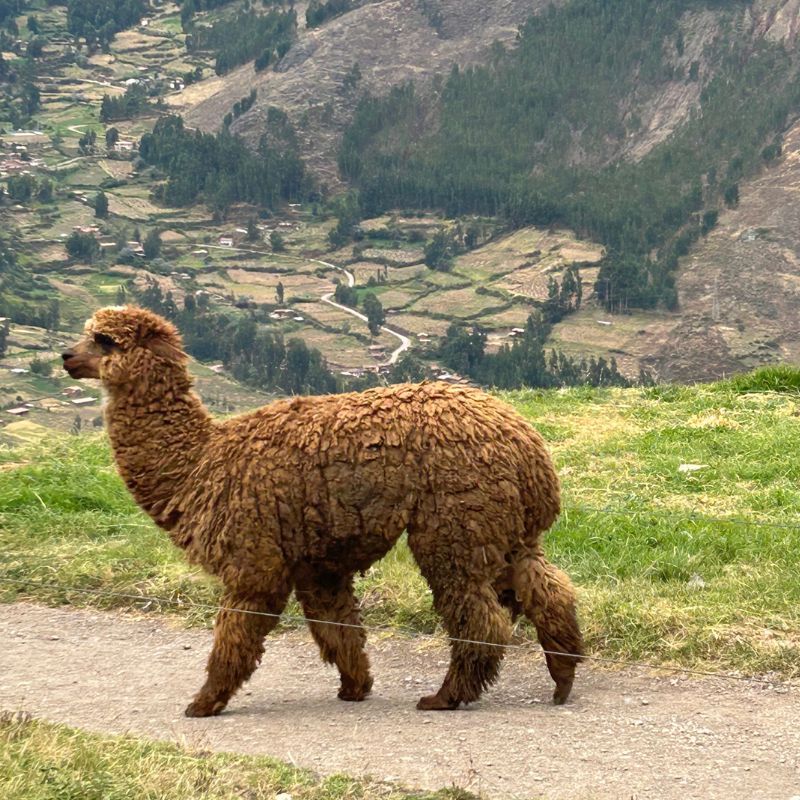
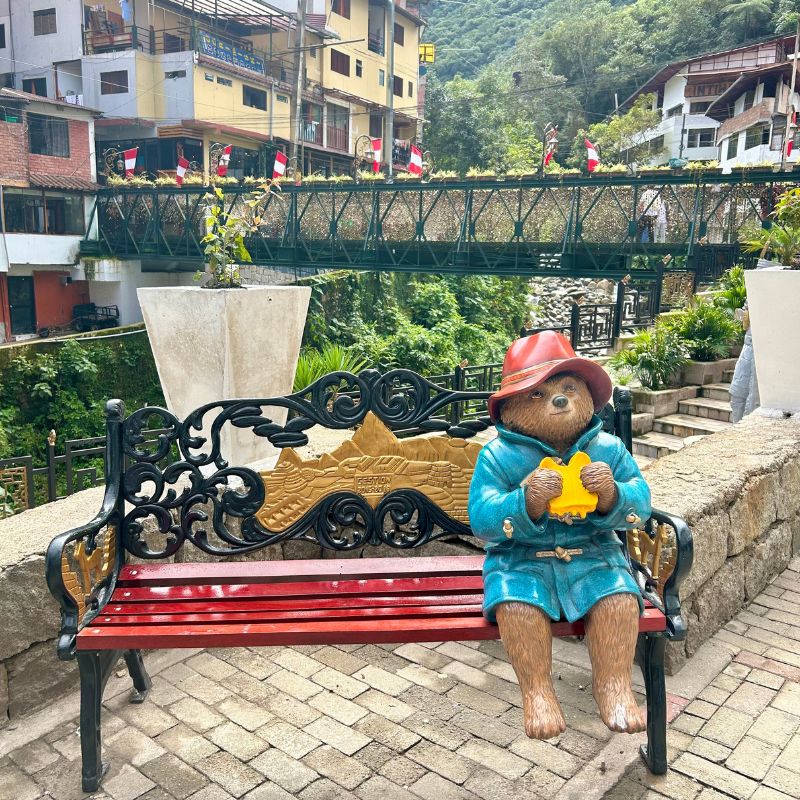
An alpaca in the Sacred Valley and a very unexpected Paddington Bear in Aguas Calientes, two of the more memorable faces we met along the way.
What the Agency Actually Handled
This is where people underestimate what a Machu Picchu tour from Cusco can actually involve behind the scenes.
On our first trip, we booked three guided excursions through the agency. When I returned in 2025, we used the same agency again and expanded that to four. Rather than booking each piece separately, they coordinated the transportation, tickets, meals where included, and guides for each day.
We also had some choice in how those tours were structured. On our first trip, we chose Spanish-speaking tours since everyone in our group spoke Spanish. When I returned with my sister and friend, we chose English-speaking tours instead.
Here’s what the agency actually handled:
- Sacred Valley: Transportation from Cusco and back, a full-day guided tour, and lunch.
- Machu Picchu: Transportation from Cusco to Ollantaytambo, train tickets to Aguas Calientes, bus tickets up to Machu Picchu, entry tickets, a guide at the archaeological site, and transportation back to Cusco afterward.
- Cusco panoramic bus tour: On our first trip, we chose a roughly three-hour panoramic tour around Cusco.
- Cusco city tour: On our second trip, we swapped the panoramic bus for a roughly four-hour guided city tour that included several archaeological sites around Cusco.
- Rainbow Mountain: We added this on our second trip. Transportation there and back, a light breakfast, lunch, a guide, and trekking poles were all included.
We weren’t traveling as a fully private group, either. Most of our excursions were small-group tours—our Sacred Valley group, for example, had around 10 people—which worked perfectly for us. We got the convenience of having everything coordinated without needing a private guide and driver every day.
By the time I started planning my second trip, I wasn’t even debating whether I’d use the agency again. The group was originally going to be much larger, and I was 100% planning to hand those logistics back over to them. As the trip slowly shrank until it was just three of us, it never occurred to me that the smaller group size should change that decision. I still reached out to the same agency without hesitation.
It actually wasn’t until months after the trip that I sat down and compared what we’d paid with what it might have cost to book the same pieces independently. I was genuinely happy to find that, by my estimate, the convenience of having the agency coordinate everything had only added roughly $50–$100 per person.
Of course, that won’t be the exact difference for every trip. What you book, which train you choose, how many excursions you want, and how much you arrange independently can all change the math. That’s part of what I liked about the setup: it didn’t have to be an all-or-nothing travel package.
And as the person who usually plans the trip, there is no better feeling than someone asking, “What are we doing tomorrow?” and being able to say, “Hold on, let me read the itinerary they sent over.”
For once, I didn’t have to be the person keeping every pickup time, train ticket, meeting point, and reservation straight in my head. Someone else had already done that part for me.
I had already handled our accommodations myself, and I was perfectly happy with that decision. With six people on our first trip, an Airbnb in Cusco made much more sense for us than booking multiple hotel rooms. But staying in Cusco also meant accepting a very long Machu Picchu day.
Another option is to spend the night in Aguas Calientes before visiting Machu Picchu, which puts you much closer to the entrance the following morning and removes some of the same-day transportation. We didn’t do that on either trip, but it’s something I’d seriously consider next time.
My hesitation is entirely personal: I hate switching hotels for one night. Packing up, checking out, moving everything, and checking in somewhere else just to sleep there once is exactly the kind of travel logistics I usually try to avoid. So even after two trips, I’m not convinced which option I’d choose.
And that gets at what I liked about using the agency in the first place. I could still make those decisions for myself while handing over the logistics I didn’t want to manage.
When you’re dealing with altitude, early mornings, and multiple moving parts, removing that friction changes the entire experience.
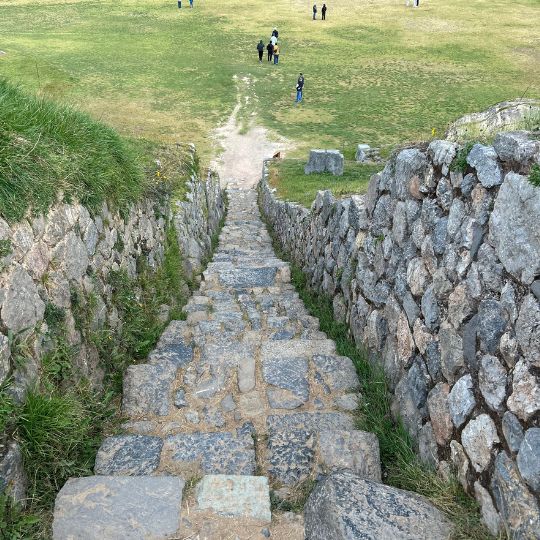
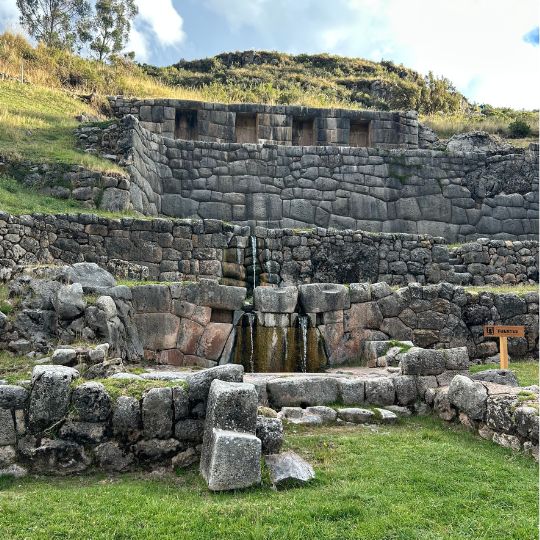
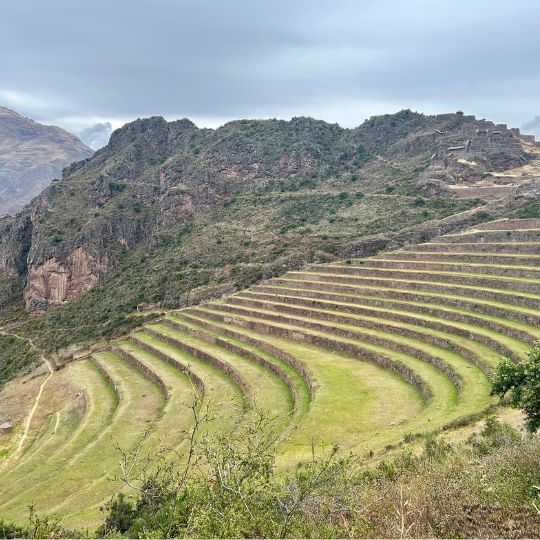
The archaeological sites around Cusco range from intricate Inca stonework to sprawling agricultural terraces, and each stop feels completely different from the last.
The Other Cusco Excursions We Booked
If you’re planning several days in Cusco, the Sacred Valley will probably be one of the first excursions you come across—and it became one of my favorite days on our first trip.
You move through a mix of ruins, terraces, mountain viewpoints, artisan workshops, and small towns that can feel completely different from one stop to the next.
Two that stand out in my memory are Moray, with its circular agricultural terraces carved into the earth, and Ollantaytambo, where massive Inca stonework and steep terraces climb above the town. We also stopped at weaving cooperatives, textile demonstrations, ceramics workshops, and small markets along the way.
It’s a full day, but it gives you a much better sense of how much there is to see around Cusco beyond Machu Picchu.
We also did two different Cusco city tours across our trips, and I appreciated both for very different reasons.
The more traditional tour is history-focused and actually takes you into archaeological sites in and around Cusco, including Qorikancha (Temple of the Sun) and Sacsayhuamán, along with other nearby ruins. There’s considerably more walking, but you get much closer to the history and stonework you’re seeing.
The panoramic bus tour is almost the opposite. You’re mostly sightseeing from the bus as it makes its way through Cusco and climbs into the surrounding hills before eventually looping back toward the historic center.
If you want something low-effort on your arrival day while you’re still adjusting to the altitude, this is the one I’d choose. It requires very little walking but still gives you an incredible first look at the city.
I don’t think the two tours overlap in a frustrating way; they complement each other. If I returned with someone visiting Cusco for the first time, I’d probably recommend they do both.
And I’d happily get back on the panoramic bus with them.
I still remember sitting on the top deck absolutely freezing, wrapped in scarves as the sun disappeared and the lights of Cusco slowly came on below us. That might have been the exact moment I fell in love with the city.
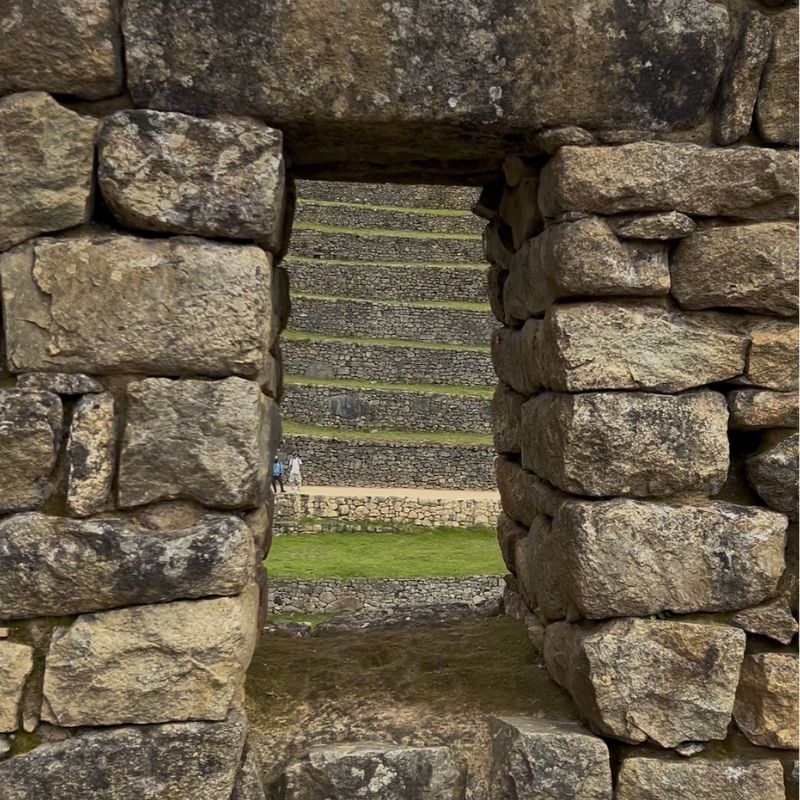
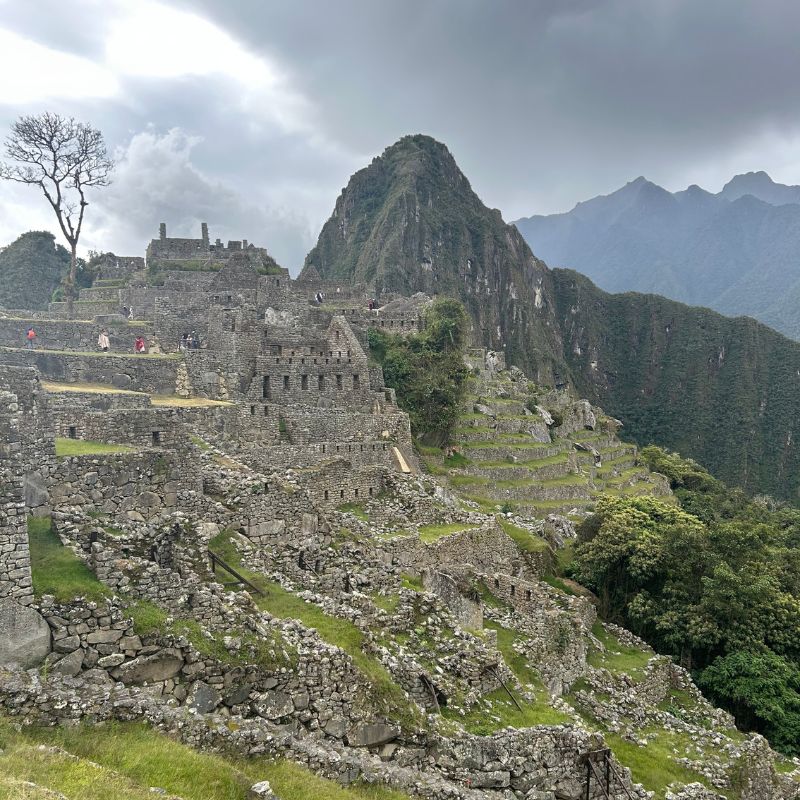
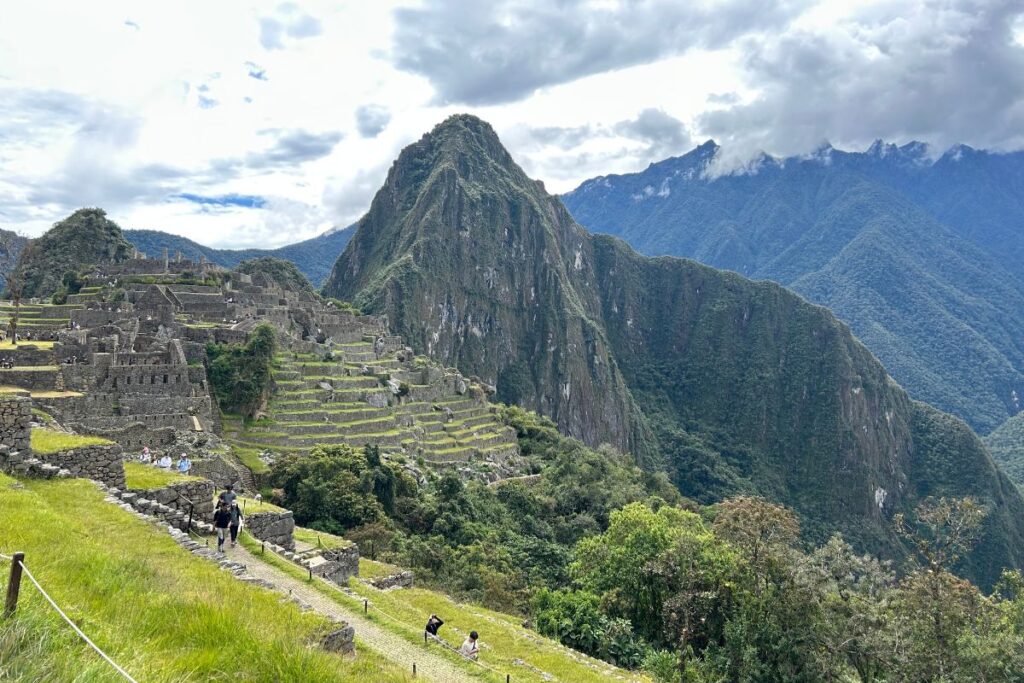
Machu Picchu is impressive from the iconic viewpoints, but walking through the stonework makes you realize just how much there is beyond the view everyone recognizes
The Journey to Machu Picchu
Our Machu Picchu day started before sunrise both times.
From Cusco, we made our way toward Ollantaytambo, where we boarded the train to Aguas Calientes, the small town sitting below Machu Picchu.
The first time, the agency booked us on the VistaDome train, with panoramic windows that turn the Sacred Valley into part of the experience itself. Mountains, rivers, cliffs, fog, and tiny villages unfold along the route, and it feels cinematic in a way that’s hard to fully appreciate until you’re on it.
I honestly don’t remember which train we took the second time. I had assumed it would be the same experience, so I never thought to ask. It wasn’t. The train was perfectly fine for getting us there, but it didn’t have the same panoramic feel I remembered from that first trip.
That was partly on me. By the second trip, I trusted the agency enough that I wasn’t asking nearly as many questions. If the train experience matters to you—and you’re booking far enough in advance that there are options—ask which train and service you’re being booked on. Having an agency handle the logistics doesn’t mean you can’t be specific about the parts of the experience that matter to you.
And then you arrive in Aguas Calientes.
I know it’s essentially a tourism hub built around getting people to and from Machu Picchu, but there’s something about it I find incredibly inviting. Maybe it’s the mountains rising almost vertically around the town, the river running through it, or the fact that nearly everyone there is excited about where they’re about to go. Both times, I found myself wishing we had a little more time to wander before moving on.
From Aguas Calientes, you still have one more decision to make: bus or walk. There’s a pedestrian route connecting the town with Machu Picchu, but we chose the bus both times. Maybe one day I’ll convince someone traveling with me that walking uphill to Machu Picchu sounds like fun. So far, the bus has won unanimously.
Once we arrived, someone from the agency met us, made sure we had our bus tickets, and coordinated the final steps before entry. On both trips, we also had a private guide waiting for us at Machu Picchu itself, so even though much of the trip had been done in small groups, our time inside Machu Picchu was just us and our guide.
One thing that had changed significantly between my two visits was the entry system. Machu Picchu now uses different circuits and routes, and the ticket you book determines which parts of the site you’ll actually visit. That makes choosing your entry ticket more important than simply finding an available time slot.
Once inside, you follow the route attached to your ticket through different parts of the archaeological site. That structure keeps visitors moving, but it also means you don’t necessarily have unlimited freedom to wander back toward a viewpoint once you’ve moved on.
My only regret both times was wanting a little more stillness—a little more time to simply sit, take it in, and look out over the valley without moving.
I almost wish there were a Machu Picchu circuit where the entire itinerary was just: sit here for an hour and marvel at your surroundings. I’d happily pay for that ticket.
Photos and videos capture the ruins, but they don’t really capture the scale of what surrounds them. The mountains feel enormous, the valleys seem to drop away forever, and Machu Picchu somehow feels both monumental and tiny within all of it. You don’t fully understand that vastness until you’re standing there.
Both times, I found myself wanting everyone to stop moving for just a little while so I could absorb where I actually was.
Because Machu Picchu isn’t just about the view. It’s about having enough time to actually look at it.
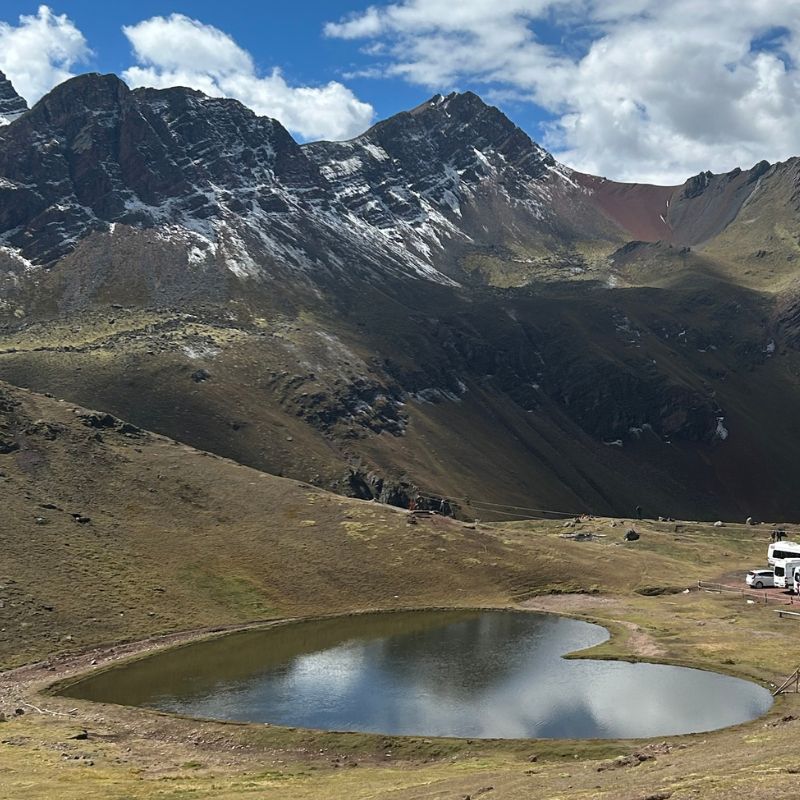
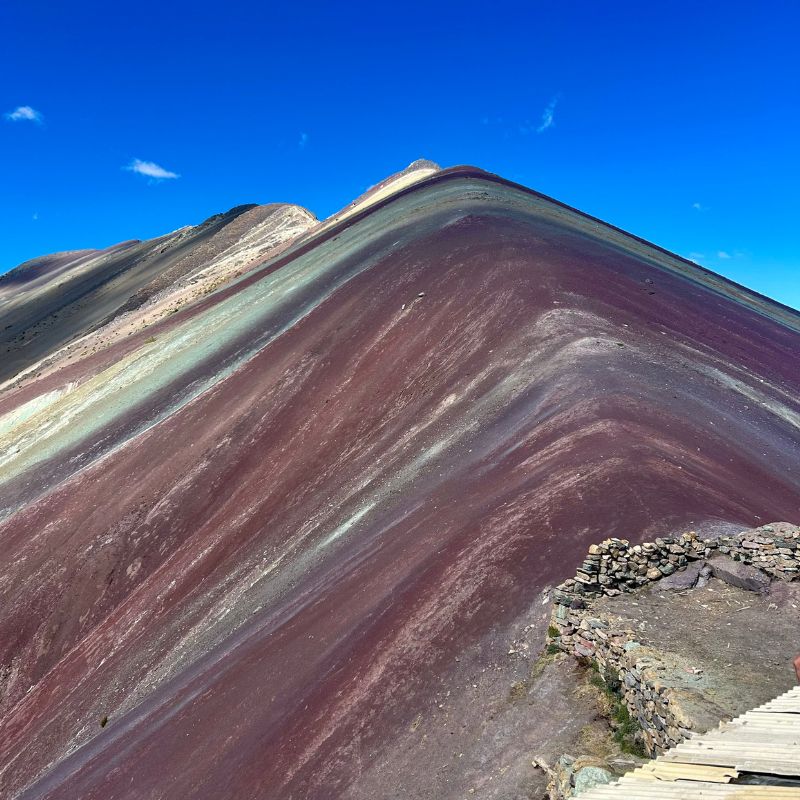
Rainbow Mountain gets the attention, but the landscapes along the way are part of the experience, high-altitude valleys, mountain lakes, and the first hints of those colorful Andean ridges.”
Rainbow Mountain Humbled Me
Our last excursion of the second trip also came with our earliest wake-up call: Rainbow Mountain.
The 3 A.M. Start
Our pickup was around 3 a.m., which is exactly as unpleasant as it sounds. From Cusco, it takes roughly three hours to reach the area, with a stop for a light breakfast along the way.
Somewhere during that drive, the scenery starts to change. The city disappears, the roads become more remote, and eventually you’re surrounded by wide Andean valleys with very little development around you.
Then you notice your phone has stopped getting a signal.
That’s about when you realize you’re heading somewhere very different.
I somehow haven’t mentioned this anywhere else in my Cusco series, but layers are your best friend here. At 3 a.m., I was essentially wrapped from head to toe. Once you reach the trailhead and start walking, though, you warm up surprisingly quickly and those layers start coming off.
The walk itself is beautiful long before you reach the famous striped mountain. The landscape feels almost unreal: enormous valleys, mountains stretching in every direction, grazing animals, and very little around you to interrupt the view.
Rainbow Mountain may be the destination, but the walk toward it is part of what I remember most.
Why Such a Short Hike Feels So Hard
Before going, I had done what everyone does: researched the hike and tried to figure out exactly how difficult it would be. Based on all the photos of exhausted hikers, horses, and people using supplemental oxygen, I had somehow pictured a five-mile trek just to reach the viewpoint.
Then I saw the actual distance and had the same questions you might be asking now: That’s it? Why does everyone make this look so hard? Are people exaggerating?
When you first start walking from the parking area, that suspicion almost feels justified. You feel fine. Sure, breathing takes a little more effort, but the path is manageable, the scenery is gorgeous, and you start thinking this might not be nearly as difficult as everyone made it sound.
Give it another 15 minutes.
Those tiny inclines start feeling considerably less tiny. You slow down. You stop more often. Suddenly, a stretch of trail that would barely register as uphill anywhere else has you wondering why your legs and lungs have entered negotiations.
And then you see the final climb to the viewpoint.
I remember looking up at it and genuinely contemplating what I had signed up for. If the gradual inclines I’d just walked had me pausing every few steps, how exactly was I supposed to get up that?
That’s when Rainbow Mountain finally makes sense. The distance isn’t what makes the hike feel so difficult. The altitude is.
And just when you’re feeling pretty accomplished for steadily making your way uphill, your guide will humble you all over again by casually mentioning that they can run up from the parking area in about 20 minutes.
Meanwhile, I was very proud of myself for continuing to put one foot in front of the other.
Reaching Rainbow Mountain
Once you finally make it to the viewpoint, you’ll probably experience several emotions at once: gratitude that you actually made it, awe as you take in Rainbow Mountain and the enormous landscape around it, and just a tiny bit of annoyance that there are so many other people standing between you and the photo you’ve been imagining.
Because yes, Rainbow Mountain is spectacular.
And no, you will not have it to yourself.
Unfortunately, you don’t have an unlimited amount of time at the viewpoint, either. Your guide still has a schedule to keep, so the longer it takes you to reach the top, the less time you may have once you get there.
That’s one reason I wouldn’t immediately dismiss the other ways of getting up. You can walk, take a horse, and in some cases use a motorbike for portions of the route. My friend started on foot and eventually switched to horseback when the altitude became too much, and the guides handled the change seamlessly.
Our guide also carried supplemental oxygen and kept an eye on how everyone was handling the elevation. It was reassuring to know it was there if someone needed it, and another reminder that this wasn’t an elevation to take lightly.
So make the most of whatever time you have at the top. Admire the view, accept that other people will be in it, and work around the crowds to get the photos you want.
Thankfully, once it’s time to leave, most of the journey back to the parking area is downhill.
We returned to the same place where we’d stopped for breakfast earlier that morning, this time for lunch. That was actually the first time on either of my Cusco trips that I started to feel genuinely off from the altitude.
I had very little appetite and a growing headache, but I knew I should eat something, so I stuck mostly to the soup. After that, I had roughly three hours in the car back to Cusco to close my eyes, take some aspirin, and hope I’d feel better by the time we arrived.
Thankfully, I did.
At that elevation, pride disappears pretty quickly. Whether that means walking more slowly, taking the horse, using another available option, or simply admitting you need a break, the goal isn’t proving you can walk every step. It’s getting up there, enjoying the experience, and getting back down feeling okay.
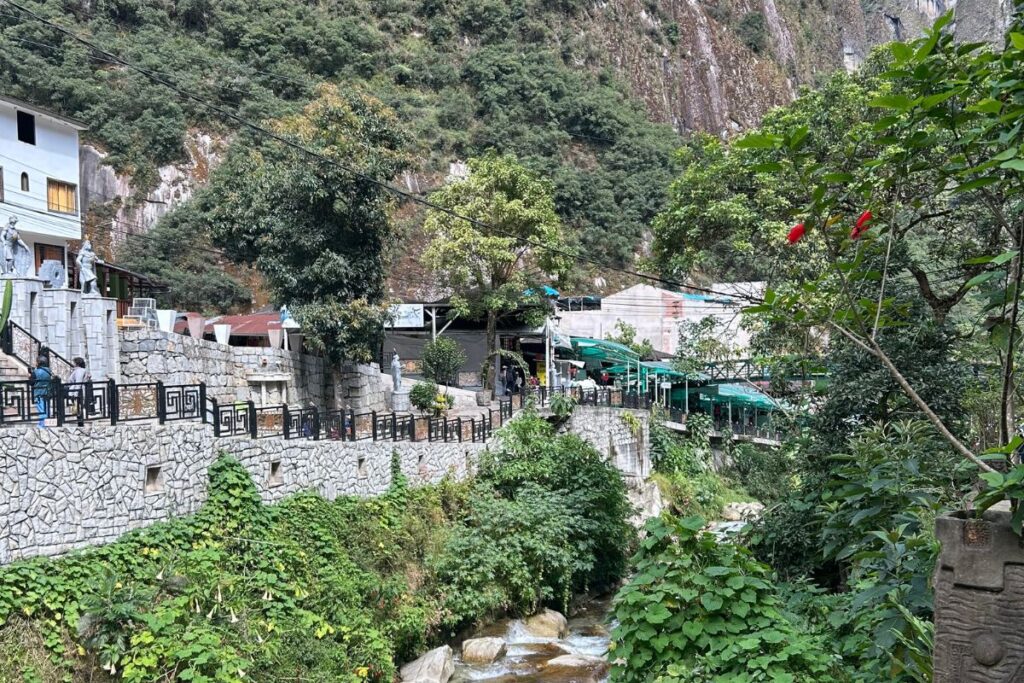
Aguas Calientes is built around the journey to Machu Picchu, but tucked between the mountains and the river, it’s more inviting than I expected, and somewhere I’d happily spend a little more time next trip.
The Second Trip Made the Decision Feel Intentional
By 2025, I approached the trip differently. This time it was just me, my sister, and one of our best friends—a smaller group, with more flexibility and less pressure.
But I also knew what we were getting into. I remembered the early mornings, the altitude, how rushed some excursions could feel, and how much I’d wished we had slowed down the first time.
And yet, I still chose the exact same local agency.
The first time, using them had felt like reassurance. I was overwhelmed by the logistics and relieved to have someone help me make sense of them.
The second time, it felt intentional.
By then, I knew the value wasn’t simply convenience. It was removing friction from a trip with a lot of moving pieces while still letting me decide which pieces I wanted them to handle.
I also learned that using an agency doesn’t mean you stop paying attention. The train experience is a perfect example: I assumed we’d be booked on something similar to the VistaDome we’d taken the first time, never asked, and ended up with a perfectly functional train ride that wasn’t nearly as memorable. Next time, I’d ask.
Machu Picchu itself had changed too. We booked our first trip farther in advance and had more flexibility in our entry options. On the second trip, some circuits were already unavailable by the time we booked, so the agency helped us secure another route that still gave us incredible panoramic views.
That reinforced what I liked about having local support in the first place. Machu Picchu isn’t a static travel experience. Entry systems, available routes, and logistics can change, and this was someone dealing with those details every day rather than me trying to decipher them from home.
Could I plan the entire thing independently now, after doing it twice?
Probably.
But I still don’t think I would.
I’d rather spend my energy deciding which experiences matter to me—and then actually experiencing them—than managing every ticket, transfer, pickup time, and reservation myself.
Final Thoughts
Machu Picchu absolutely deserves its reputation. But after visiting twice, I’ve realized how much the experience surrounding it shapes the trip too: the train through the Sacred Valley, the early mornings, adjusting to the altitude, the excursions around Cusco, and finally standing in places that look completely different from anything a photo prepared you for.
My first trip taught me how overwhelming Machu Picchu planning can feel. My second confirmed something much simpler: sometimes the best travel decision is knowing what you don’t need to control yourself.
If I return to Cusco again—which I fully expect I will—there are still plenty of things I’d do differently. I’d explore more remote day trips, finally make it to the Maras Salt Mines, maybe return to Rainbow Mountain with considerably less pride about taking the motorbike option, and perhaps even commit to the Inca Trail someday.
But I’d keep the same core approach: structure where it matters, and enough space everywhere else to actually experience the place you’re in.
Letting a local agency handle part of our trip didn’t make either experience feel less personal. It just meant that when someone asked me what we were doing tomorrow, for once, I wasn’t the person who had to have all the answers.
Continue Exploring Cusco
If you’re planning your own trip to Cusco, these stories continue with what I learned once we actually had time to experience the city itself:
→ Cusco Is Not Just a Base for Machu Picchu
After two trips, I realized that counting your excursions isn’t the same thing as counting how much time you actually have in Cusco. Here’s how I’d plan the city differently now.
→ The Day Cusco Gave Us Back Time (Even When Our Flight Didn’t Go to Plan)
A disrupted flight gave us something our original itinerary hadn’t: an unexpected afternoon to wander San Blas, attempt San Pedro Market, and spend a little more time simply enjoying Cusco.