How to Plan Your First Trip to Barcelona
Barcelona took me a little longer to warm up to than I expected. On our first family trip to Spain, we spent four nights there after Madrid and Tossa de Mar. By then, I was used to stepping out of our hotel and seeing where the day took us. In Barcelona, I had a list of places I wanted to see, and it took me a while to realize how spread out they were.
One of my favorite afternoons was when we walked from Barceloneta to El Born. We started by the water, turned inland, and had time to see what caught our eye along the way. I still wanted to see Sagrada Família and Park Güell, but that walk helped me figure out how I’d plan another visit. I’d pick one part of Barcelona to spend time in each day, book the one thing I really want to see, and give myself time to explore around it.
How I’d Put Together a First Barcelona Trip
- With two days. Give one day to the Gothic Quarter, El Born, and as much waterfront as you feel like adding. Use the other for Sagrada Família and either Passeig de Gràcia or Park Güell.
- With three days. Give Eixample and Gràcia separate days. That frees up time for a Gaudí interior, a longer lunch, and some wandering around each reservation.
- With four full days. Use the extra day for Montjuïc or a day trip to Montserrat, depending on whether you want more time in the city or a day in the mountains.
Getting to Barcelona and Getting Around
We arrived in Barcelona by bus from Tossa de Mar, so our first trip across the city was from the bus station to our apartment. If you’re flying into Barcelona–El Prat Airport (BCN), I’d pull up your hotel on a map before deciding how to get there. The best option depends on where you’re staying and how much walking or transferring you feel like doing with your luggage.
How to Get From Barcelona Airport to Your Hotel
- Aerobús is where I’d start if you’re staying near Plaça de Catalunya or Plaça d’Espanya. Take the A1 from Terminal 1 or the A2 from Terminal 2. Both run around the clock and have their own fare.
- The L9 Sud metro serves both terminals. Check how many transfers it takes to get to your hotel before choosing it. You’ll need an airport metro ticket or a pass that covers the airport, such as the Hola Barcelona Travel Card. A regular single metro ticket or T-casual won’t cover entry or exit at the airport metro stations.
- A taxi is what I’d consider after an overnight flight, especially with several people and bags. Compare the cost for the whole group with buying individual tickets and making the last leg to your hotel.
Getting Around Barcelona and Paying for Transit
I’d take the metro or bus to the area I want to explore, then walk once I’m there. That’s what I’d do differently in Barceloneta. We walked all the way there, and next time I’d save that energy for the promenade, the side streets, and the walk back through El Born. The same idea works for the rest of the city. Start near the thing you most want to see and give yourself time to explore around it.
Can you just tap your credit card? On TMB buses, yes. On the metro, only at entrances with a dedicated bank-card reader. On the bus, tap at the reader by the driver to buy and validate a single ride. That fare covers that bus ride, so if you’re planning to transfer, look at an integrated ticket instead. On the metro, I’d buy a ticket at the station machine if I didn’t see a dedicated reader.
For a few days of sightseeing, I’d look at the T-casual if you expect to take several rides. It gives one person 10 journeys, so each traveler needs their own. If you expect to use transit frequently and plan to take the metro both ways to the airport, compare it with the Hola Barcelona Travel Card, which includes those airport metro trips
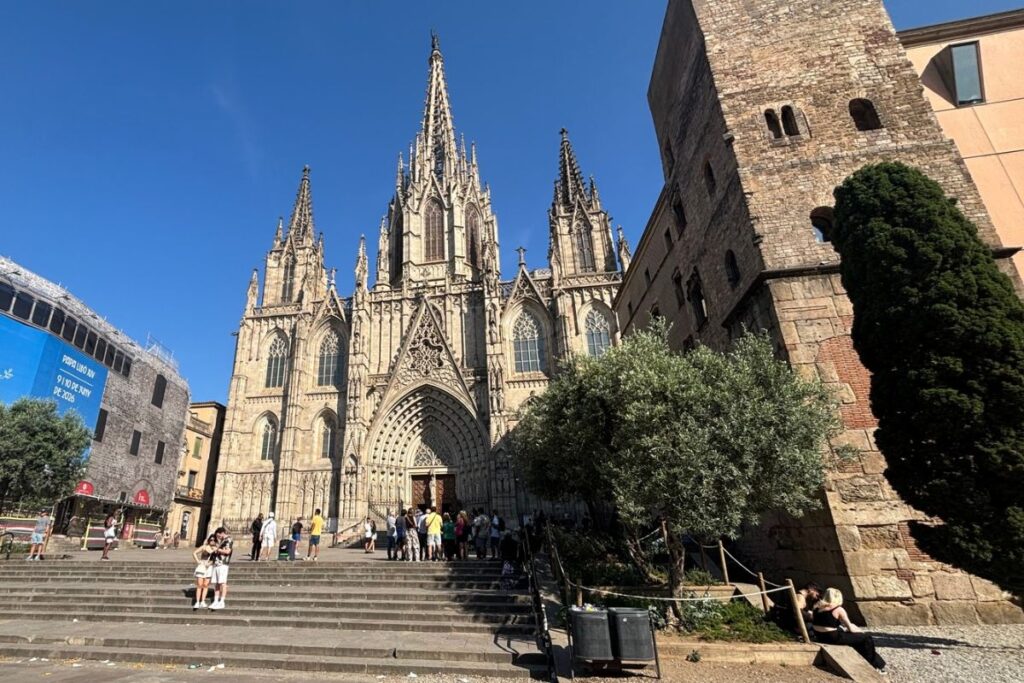
Barcelona Cathedral is where I’d start a walk through the Gothic Quarter. Take a moment in the square to look up at the façade before turning into the narrow streets around it.
The Gothic Quarter
The Gothic Quarter was our first stop in Barcelona. We arrived by bus from Tossa de Mar that afternoon, checked into our apartment, and headed back out. We got there early enough to grab a quick snack before our evening walking tour. After spending part of the day in transit, I was happy to let someone else lead the way through streets I probably would’ve gotten lost in on my own.
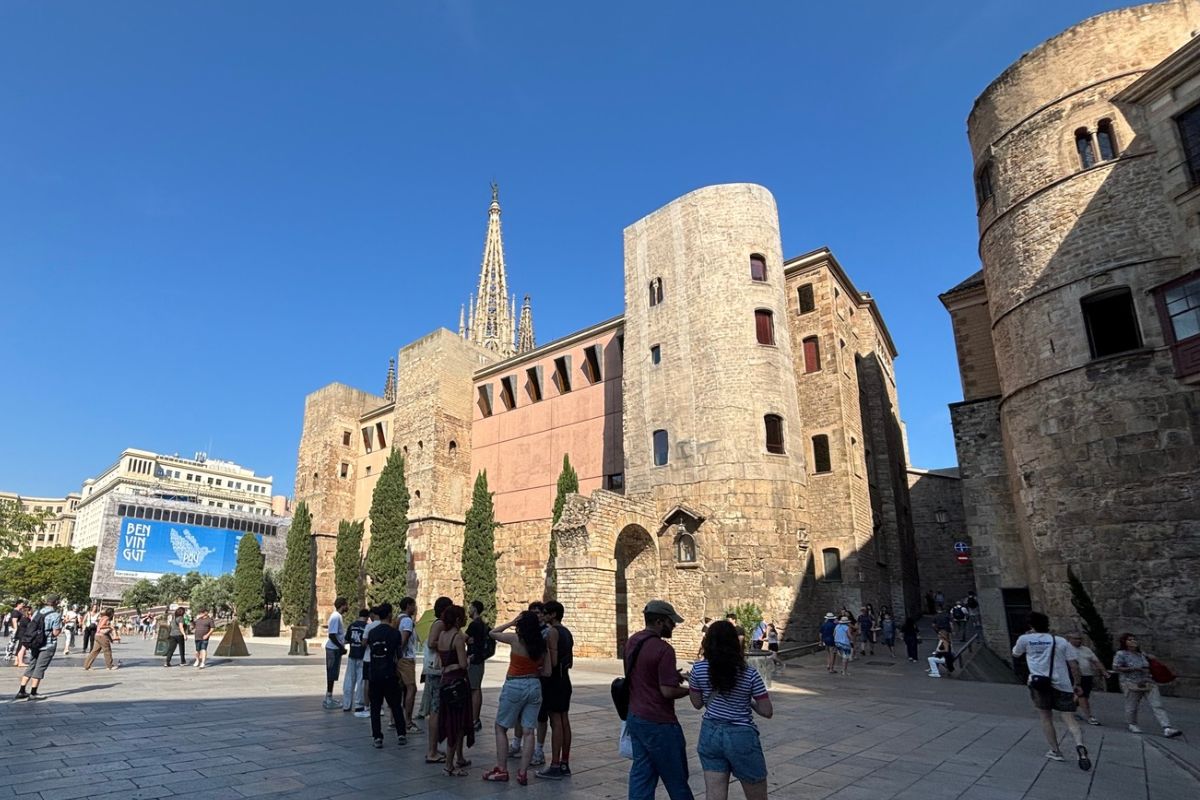
What makes the Gothic Quarter such a good introduction to Barcelona is how much of the city’s history you can see in a short walk. This was the heart of Roman Barcino, and you can still see columns from the Temple of Augustus near Plaça Sant Jaume. A few minutes away, Plaça del Rei is framed by medieval royal buildings, with more of the Roman city preserved beneath the square. I like that you can spend an evening walking through the neighborhood and have a reason to come back the next day to see what’s underneath it.
If you’re exploring on your own, I’d start in front of Barcelona Cathedral, then make a short loop past Plaça del Rei and Plaça Sant Jaume. Leave time for a detour into Plaça de Sant Felip Neri, a small square tucked behind the cathedral. The squares, side streets, and cathedral exterior are all free to explore, so this is an easy first-evening walk even if you haven’t booked anything.
If you want to see inside the cathedral, the sightseeing ticket includes the cloister and rooftop. I’d come back for that when I had time to linger. For our arrival evening, the walking tour was just right. It gave us some context for the neighborhood and a sense of where we wanted to wander on our own.
Explore Gothic Quarter walking tours →
El Raval and La Boqueria
La Boqueria was on our first-trip list, so we stopped in while exploring the old city. It was quieter than I’d expected, and we had plenty of time to walk the aisles and see what the different vendors were selling. Honestly, we were a little underwhelmed. A lot of the prepared food looked like it had been sitting out for a while, and we saw only a few things being cooked to order. We ended up browsing for a bit and moving on. I’m glad we saw it, but I’d treat it as a quick stop off La Rambla and leave lunch open.
If you’re already at the market, it’s easy to walk a little farther into El Raval. I’d head down Rambla del Raval to see Fernando Botero’s giant bronze cat, then wander toward Plaça dels Àngels, the square in front of the Barcelona Museum of Contemporary Art. It’s a short detour from the Gothic Quarter and gives you a look at another side of the old city.
The market, the cat, and the neighborhood walk are free to explore. If contemporary art is something you’d make time for, MACBA is the ticketed stop I’d build the visit around. Otherwise, I’d keep El Raval as a flexible extension of your Gothic Quarter walk.
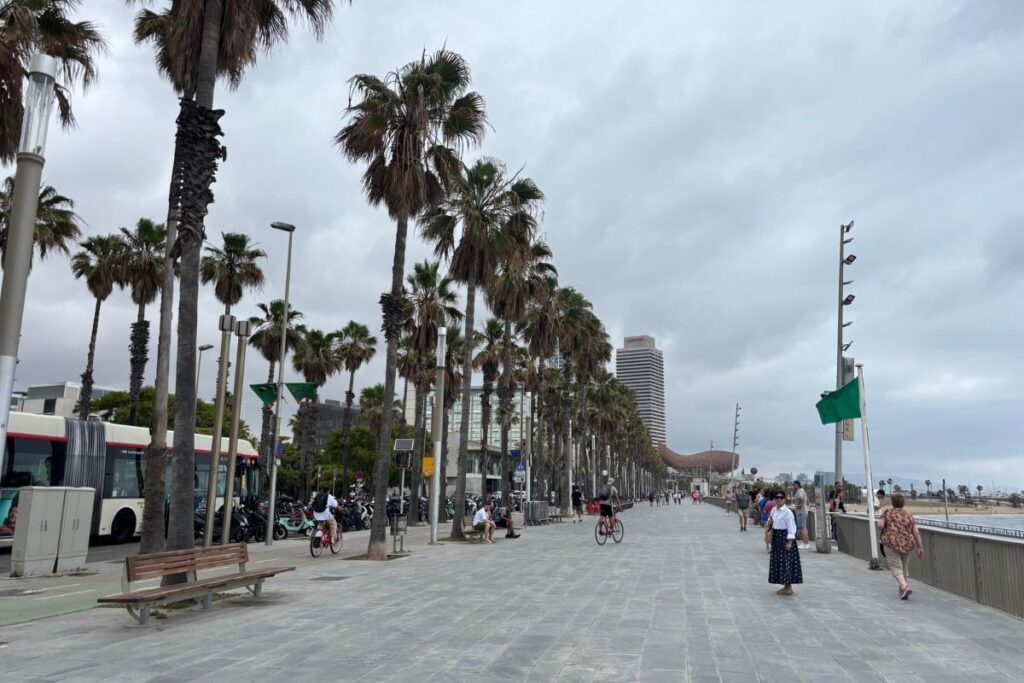
We started by the water in Barceloneta and walked inland to El Born for lunch. Even under gray skies, it was one of my favorite walks in Barcelona.
Barceloneta and the Waterfront
It was overcast the day we went to Barceloneta, so we didn’t get the sunny Mediterranean backdrop I’d pictured. I still wanted to see this part of Barcelona, and I’m glad we went. After the narrow streets of the Gothic Quarter and El Born, it felt good to be somewhere as open as the waterfront.
The Passeig Marítim de la Barceloneta is a wide seaside promenade lined with palm trees, beachside cafés, and stretches of sand. The walk from Barceloneta Beach toward Port Olímpic is about 1.25 km (just under a mile) one way. You can follow the water for as long as you like, then turn inland to explore the narrower streets of the old maritime neighborhood. The beach, promenade, and neighborhood are all free to explore.
We walked there, but next time I’d take public transportation to the waterfront and walk back at our own pace. If you want to start at the port end, take the L4 metro to Ciutadella–Vila Olímpica, then follow the promenade toward Barceloneta Beach. The same line also stops at Barceloneta if you’d rather start on the neighborhood side. I’d save my energy for the walk by the water, a few detours through the side streets, and the stroll into El Born
El Born and La Ribera
I loved El Born for the same reason I loved the Gothic Quarter. The stone buildings and narrow lanes felt so different from the more modern part of Barcelona where we were staying. El Born is part of La Ribera, a medieval district just east of the Gothic Quarter. Its alleyways felt like a maze, and this was one of the parts of Barcelona where I was happy to get a little lost.
For a first visit, I’d start at Santa Maria del Mar, a 14th-century basilica and a standout example of Catalan Gothic architecture. From there, walk along Passeig del Born, where jousting tournaments once took place, toward the old Born Market. The market’s iron-framed building now shelters the remains of streets and houses from around 1700. Those two landmarks give you a good starting route, and then you can take whichever side street catches your eye. The busiest streets have plenty of the usual souvenir shops. A turn or two off them is where I’d look for smaller boutiques worth browsing.
Our last lunch in Spain was at one of those restaurants you could easily write off as touristy. We sat facing a square with musicians playing, and I remember thinking it was exactly where I wanted to be on our last afternoon. If you’re walking over from Barceloneta like we did, I’d leave yourself enough time to stop for lunch and keep wandering afterward.
You can spend an entire afternoon here without booking a thing. The Picasso Museum is the ticket I’d consider for a return visit. We left it off this trip, but I’d like to see the work Picasso made as a young artist and get a better sense of how his style developed. The setting is part of the draw for me, too. The collection occupies five historic palaces on Carrer de Montcada, so the visit is also a chance to see some of the architecture I loved from the inside.
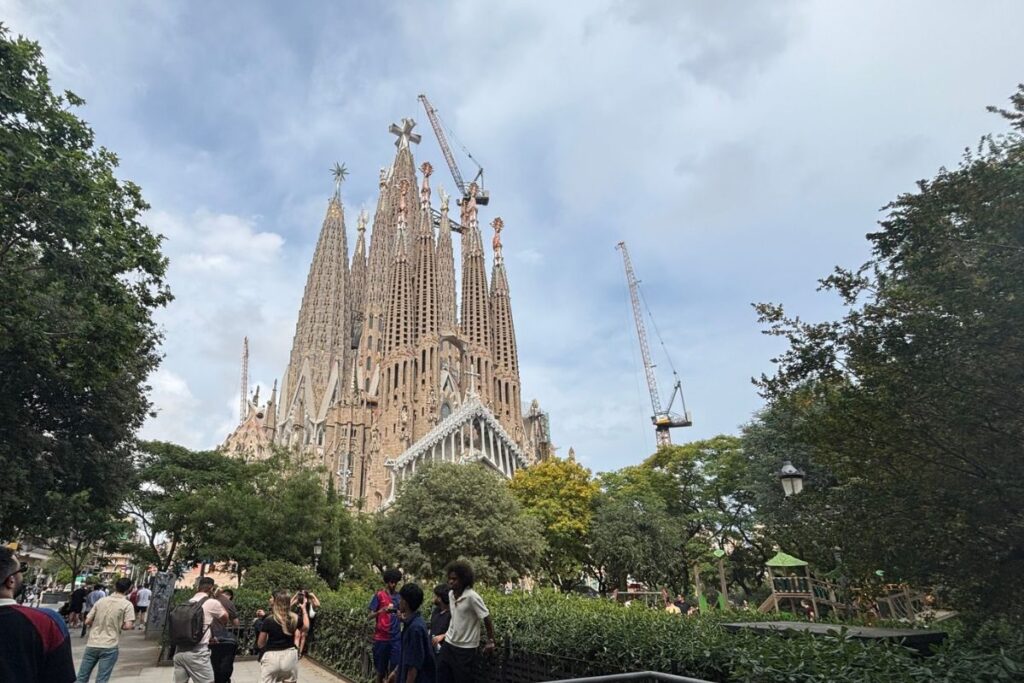
Sagrada Família from across the street, with the construction cranes in the photo too. They’re part of the skyline for now.
Sagrada Família and the Neighborhood Around It
We booked an evening guided tour of Sagrada Família, and I appreciated how much detail the guide pointed out, both inside and out. Standing at the foot of the basilica is the only way I really got a sense of its size. Then the guide got us looking more closely at the exterior, where individual sculptures tell stories I would’ve walked right past on my own.
Would I call the guided tour a must? I’d leave that up to how curious you are about the building. Our evening slot was packed, with several tour groups around us at once, and it got overwhelming. I’d try an early slot next time out of curiosity. If all you want is a look at Gaudí’s most famous building, I’d happily see it from the sidewalk or a sightseeing bus. You only need a ticket if you’re going inside. If you have time, get off the bus and walk around the basilica so you can see how different it looks from each side.
By the time we finished the tour, it was our last stop of the day and we were ready for dinner. We noticed quite a few international restaurants nearby and ended up changing things up with some delicious Peruvian food. Next time, I’d come earlier and leave time to walk up Avinguda Gaudí, which cuts diagonally across the Eixample grid and connects the basilica to Sant Pau Recinte Modernista. Sant Pau is a former hospital complex designed by Lluís Domènech i Montaner. Even if you’re out of energy for another interior visit, the avenue gives you a short walk with a very different piece of Barcelona architecture at the other end.
Explore Barcelona hop-on hop-off bus tours →
Passeig de Gràcia and the Eixample
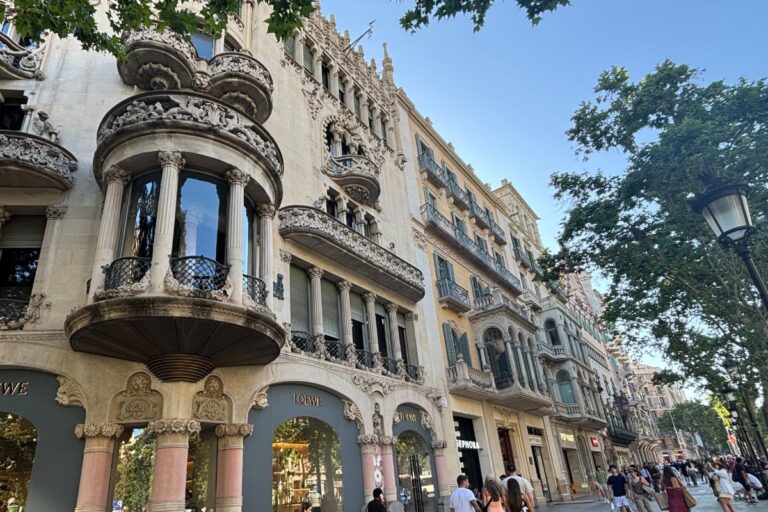
If you want to do some shopping and see more of Gaudí’s architecture, I’d start at Plaça de Catalunya and walk up Passeig de Gràcia. The boulevard is lined with designer shops, and two of Gaudí’s most recognizable buildings are right along the way. At Casa Batlló, look up for the colorful façade and mask-like balconies. A few blocks farther up, La Pedrera has an undulating stone façade that looks different depending on where you stand.
Seeing both façades is free. If you want to go inside, I’d pick one and book ahead. I’d choose Casa Batlló if you’re drawn to Gaudí’s use of color and the details inside the house, or La Pedrera if you’re most curious about the rooftop and its sculptural chimneys.
For the walk back, I’d go one block over to Rambla de Catalunya. That gives you a different street for browsing shops or sitting down for coffee, and the whole outing works even if you leave both interiors for another trip.
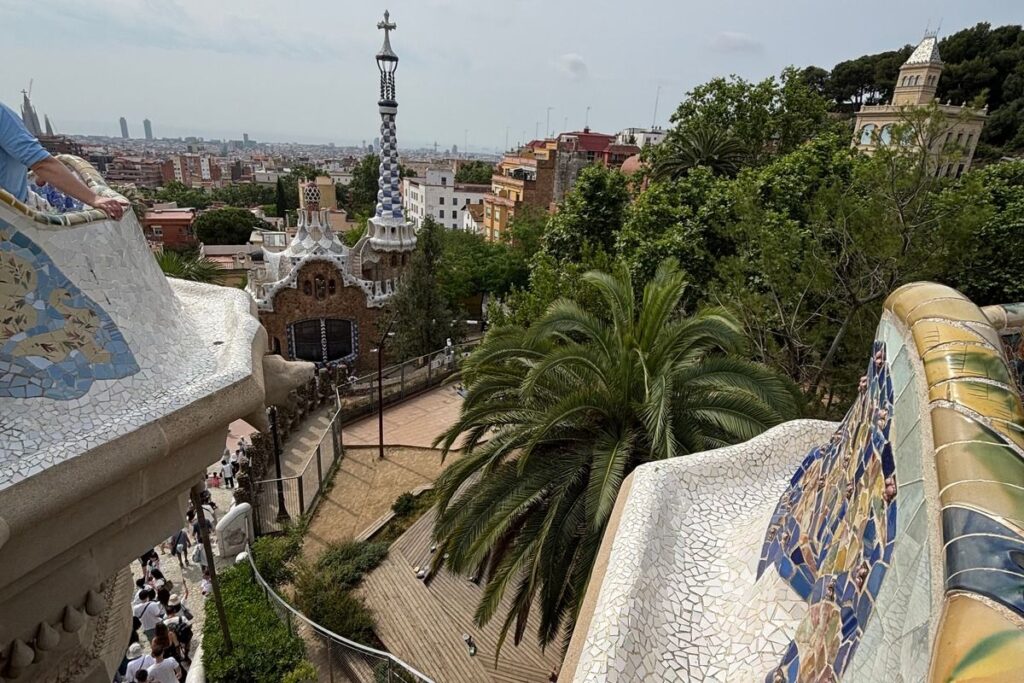
The view from Park Güell’s terrace was one I wanted to photograph. Next time, I’d head straight there after entering and save the quieter paths for later.
Park Güell and Gràcia
We booked one of the earliest entry times at Park Güell, and I’d do that again. If you’re visiting in high season, reserve a timed ticket ahead of time. My biggest tip is to check where your bus drops you off and aim for the main entrance on Carrer d’Olot, especially if you want photos before the crowds build. That entrance puts you right by the Dragon Stairway and its colorful mosaic salamander. At the top of the steps is the Hypostyle Room, where rows of stone columns support Nature Square, the terrace with the curved mosaic bench and views over Barcelona.
The bus from our apartment dropped us near a different entrance. At first, I was glad it did. There were so few people around that we could take our time walking the paths and enjoying the park. Then we made it to the staircase and terrace and realized everyone else had gone there first. By then, getting a clear shot was hard because so many people wanted the exact same photo. If photos are a priority, go straight to the staircase and terrace, then take your time on the quieter paths. I loved that part of our visit and would still leave time for it.
After the park, I’d head downhill into Vila de Gràcia for lunch and a walk. Gràcia was once a separate village, and you can still get a feel for that around its small squares. I’d start at Plaça de la Virreina, browse along Carrer de Verdi, and find somewhere to sit near Plaça del Sol. The squares and side streets are free to explore, and after a timed start at Park Güell, I’d be happy to leave the rest of the morning open.
Montjuïc: Gardens, Museums, and Views Over Barcelona
Montjuïc is one area I’d make time for on a return trip. It’s a hill overlooking the city and port, with gardens, art museums, and a castle at the top. There’s enough spread across the hill that I’d give it at least half a day and pick one main stop before deciding what else to see.
For a walk without booking anything, I’d head to Mirador de l’Alcalde for views over the port, then spend some time in the gardens. If you want to go inside somewhere, I’d choose the Museu Nacional d’Art de Catalunya for art or Montjuïc Castle if you’re more interested in the fortress and its setting. Both are ticketed stops, and either one would give the afternoon a focus.
To save some uphill walking, take the funicular from Paral·lel. It’s covered by the regular metro fare and brings you partway up the hill. From there, you can walk or pay separately for the Montjuïc cable car up to the castle. I’d save the cable car for a clear day, when I’d want to enjoy the views on the way up.
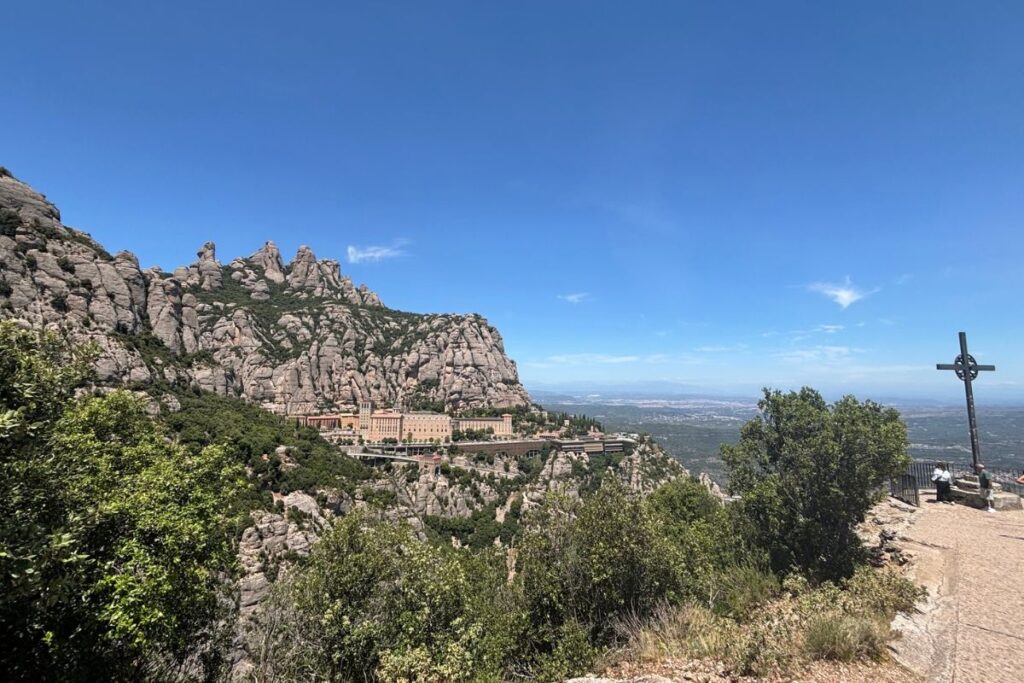
We walked uphill from the monastery to the Sant Miquel Cross. Seeing the monastery from across the valley made me glad we’d given Montserrat a full day.
A Day Trip to Montserrat
Montserrat was the day trip everyone seemed to recommend from Barcelona, and I wasn’t sure I’d love it as much as everyone said I would. We had enough time to give it a full day, so I went for it. We absolutely loved it. You start to see the cliffs as the train approaches, and by the time you’re standing at the monastery looking up, you get a sense of how much bigger the mountain is than it looks in photos.
From Plaça d’Espanya, take the train toward Montserrat. There are two ways up to the monastery complex. Get off at Aeri de Montserrat for the cable car or Monistrol de Montserrat for the rack railway. If you want to bundle the day into one ticket, the Tot Montserrat pass includes round-trip transportation from Barcelona, your choice of the cable car or rack railway, the mountain funiculars, admission to the basilica and the Montserrat Museum, and lunch.
The basilica and museum are right there at the monastery, but I’d head straight for the Sant Joan funicular. It takes you up to Pla de les Taràntules, where you can follow the trail downhill toward the monastery and detour to the Creu de Sant Miquel, or Sant Miquel Cross. We walked uphill from the monastery to the cross. Next time, I’d start higher up and walk down so I could see more of the mountain with less climbing. Some stretches are still steep, so I’d give myself time.
From the cross, you can look back across the valley and see the monastery tucked beneath the rock formations, with the landscape opening up in every direction. That was the view that made me glad we’d set aside an entire day. I’d leave time to stop along the trail, take photos, and see the basilica once you’re back down.
How I’d Pair Barcelona’s Neighborhoods
Gothic Quarter + El Raval. Spend the morning in the Gothic Quarter, then cross La Rambla for a quick look at La Boqueria. If you want to visit MACBA, make that your afternoon plan.
Barceloneta + El Born. Take the metro to the waterfront and walk inland to El Born for lunch. Leave the afternoon open for browsing, or plan it around a Picasso Museum ticket.
Sagrada Família + Sant Pau. Avinguda Gaudí connects the two, so they make an easy half-day pairing. I’d book one interior and see the other from outside if I wanted a relaxed morning.
Passeig de Gràcia + Rambla de Catalunya. These parallel streets make a simple loop for architecture, shopping, and coffee. You can pair the walk with Sagrada Família on the same day if you’re only booking one interior between the two outings.
Park Güell + Vila de Gràcia. Give the park your morning, then walk downhill into Gràcia for lunch and a wander. I’d leave the afternoon free and see how long we felt like staying.
Montjuïc or Montserrat. Choose Montjuïc for a half-day in Barcelona or Montserrat for a full day in the mountains.
How I’d Plan My First Trip to Barcelona Again
It took me a few days to warm up to Barcelona. By the end of our short stay, I was already thinking about what I’d do with another afternoon. I’d go back to El Born for the Picasso Museum, give myself time to see what’s beyond Sagrada Família, and spend half a day exploring Montjuïc.
If I were planning our first trip again, I’d pick one part of the city for each day and book the sight I was most excited to see. Then I’d leave enough time to follow a side street, browse a small shop, or sit down for lunch in a square with musicians playing. That last lunch in El Born is still one of the things I remember most about Barcelona.
With its international airport and high-speed trains from Barcelona Sants, I can see plenty of future trips starting or ending in Barcelona as I continue exploring Spain. That made it easier to leave with a few places still on my list. Next time I’m passing through, I’d happily stay a few days, revisit a favorite neighborhood, and see where a new walk takes me.