The Travel Accessories That Solved Problems I Didn’t Know I’d Have
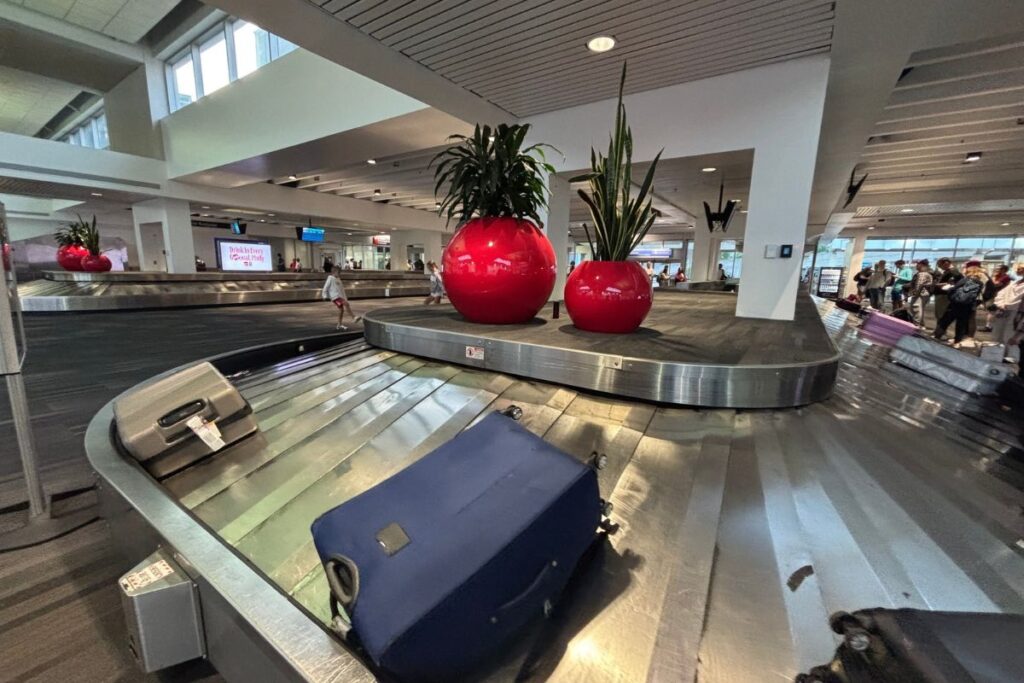
One of those travel moments that made me rethink what earns a permanent place in my suitcase.
Some of the most useful things I pack aren’t things I ever thought I needed.
They’re the little additions that came after something went wrong, cost more than it should have, or simply made a travel day more complicated than it needed to be. A suitcase that didn’t show up at baggage claim. A phone bill that made me finally reconsider how I stayed connected abroad. Another spring trip where I somehow underestimated how cold Europe could be.
None of these were major travel disasters. Most were just small inconveniences that made me think, There has to be an easier way to do this.
Over time, the solutions became part of how I travel. Some cost very little. One is something I put together entirely from things I already had at home. Others are purchases I resisted making or changes I put off because what I was already doing seemed easier.
That’s really what this list is about. Not buying more things just because they’re marketed to travelers, but finding a few simple solutions to problems I’ve actually encountered and would rather not solve twice.
I’m pretty skeptical of anything marketed as a travel essential. If something is going to earn a permanent place in my suitcase, it needs to make traveling noticeably easier without adding unnecessary clutter. These are the few accessories and small habits that have done exactly that.
Apple AirTags
AirTags are one of those travel purchases I made hoping I’d never actually need them. Thankfully, I haven’t had to use one to recover a lost suitcase, but they’ve still become one of the easiest ways to give myself a little extra peace of mind when I check a bag.
I really appreciated having them after our Central Europe trip. We had a 22-hour layover in Dublin, and airline staff told us our checked bags would be waiting for us at baggage claim. We landed, made our way through the airport, and waited, but our suitcases never appeared.
Without AirTags, that would have immediately turned into a guessing game. Had the bags stayed behind in Amsterdam? Did they make it onto our flight? Were they sitting somewhere else in the Dublin airport?
Instead, I opened the Find My app and could see that every suitcase had made it to Dublin and was actually just a short distance away. We still had to figure out where the airline had put them, but knowing they were physically in the airport completely changed the situation.
That peace of mind matters even more when I’m traveling with my family. I’m usually the default person everyone turns to when there’s a question about a flight, hotel, reservation, or in this case, missing luggage. Being able to pull out my phone and show everyone that their suitcases were right there gave them the same reassurance it gave me.
That’s ultimately why I travel with AirTags. Of course, I want the ability to locate a suitcase if one ever truly goes missing, but most of the time their value is much simpler. They give me peace of mind when I hand over my luggage at the airport and let me give my family that same peace of mind when something doesn’t go according to plan.
Every checked suitcase we travel with now has one tucked inside.
Check the current price on Amazon →
eSIMs
I was embarrassingly late to the eSIM party. For years, I simply paid for AT&T’s International Day Pass because it was easy. There was already enough to figure out before a trip, and this was one thing I didn’t have to think about. I could land, turn on my phone, and everything worked. The downside usually came a few weeks later when I opened my monthly phone bill.
The turning point was a 10-day family trip through Italy. There were four of us traveling, and I knew I should probably figure out eSIMs before we left. I really didn’t want one more thing to research, set up, and potentially troubleshoot, so I didn’t. Then the phone bill arrived. Well over $200 in international charges will make you reconsider how complicated an eSIM really seems.
I decided that on our next trip, we were finally going to try them. Our first attempt honestly wasn’t great. We had connectivity issues after landing, and I spent more time than I wanted trying to figure out why the eSIM wasn’t working before eventually giving up. It would have been very easy to decide they were too complicated and go straight back to the International Day Pass.
But with a three-week trip coming up, the potential cost of doing that was enough motivation to try again. This time, I used Airalo, and the experience was completely different. Setup was easy, the service worked wonderfully, and suddenly I understood why everyone had been telling me to switch for years.
I generally choose an unlimited data package because I probably use my phone far more than I should when I travel. Between Google Maps, WhatsApp, train schedules, restaurant reviews, reservations, and everything else I’m constantly looking up, I don’t want to spend the trip monitoring how much data I have left or risk getting caught without service when I actually need it.
Airalo is what has worked well for me, but new eSIM providers continue to emerge, and my first experience taught me something important. If your first eSIM doesn’t work well, don’t immediately assume eSIMs are too complicated for you. Try a different provider. The difference between my first attempt and my experience with Airalo was night and day.
Now an eSIM is simply another part of my pre-trip checklist. It took a phone bill of more than $200 and one failed attempt to get me there, but I’m officially no longer late to the party.
Uniqlo HeatTech Layers
For some reason, no matter how many times I travel to Europe in the spring, I continue to underestimate how cold it’s going to be. I always convince myself it will be warmer than it actually is. You would think that by my third spring trip to Europe I would have learned my lesson, but apparently not.
On my most recent trip, I was traveling through Central Europe for three weeks and had once again packed for slightly warmer weather than the weather I actually got. By the time I reached my second country, I gave in. I bought gloves from a tourist shop and went searching for tights I could wear under my clothes. I eventually found some at a mall, and while they weren’t exactly what I wanted, they would do for the moment.
The trip ended in Amsterdam, where we decided to try one more time. This time we went to Uniqlo because I already knew exactly what I wanted: HeatTech. I have HeatTech layers at home and had actually considered packing them before the trip, but decided I probably wouldn’t need them. Of course, because it was already late spring, the Amsterdam store barely had any left. Apparently both Uniqlo and I thought the weather should have been warmer by then. The weather had other plans.
That experience reminded me how frustrating it can be to replace something while traveling that you already own at home. Finding the exact item you need is rarely as simple as finding a store that sells it. Seasonal inventory changes, the thing you want might be sold out, and eventually you end up buying something that isn’t quite right simply because you need something.
And in my case, all of this could have been avoided by packing a layer that takes up almost no room in the first place.
Shoulder season is still my favorite time to travel. The crowds are smaller, flights and hotels can be more affordable, and I generally prefer the weather to the peak of summer. But part of traveling during shoulder season is accepting that temperatures can be unpredictable. A beautiful sunny afternoon can turn into a very chilly evening, and apparently I need to relearn that lesson every few years.
So now, if there’s even a reasonable chance of cooler weather, a HeatTech layer goes into my suitcase. It weighs next to nothing, takes up almost no space, and gives me something I value more and more when I travel: flexibility.
Hopefully, by my fourth spring trip to Europe, I’ll finally remember to pack it.
A Foldable Reusable Tote Bag
A reusable tote is already part of my everyday routine at home, so eventually it made sense to carry that habit into my travels too. It takes up almost no space, weighs practically nothing, and is easy enough to tuck inside whatever bag I’m carrying for the day. Then somehow, by the end of the day, it becomes a lifesaver.
One of my favorites actually started as a souvenir. A few years ago, I took a long weekend trip to Paris with friends while my cousin was studying just outside the city. It wasn’t my first visit, so I didn’t feel the same pressure to see everything or come home with souvenirs just because I was in Paris.
We spent time shopping throughout the city, but nothing really spoke to me. Years earlier, I probably would have bought something simply because I felt like I should leave Paris with a souvenir. Instead, I was perfectly content to come home with the memories.
Then we visited an art exhibit, and in the gift shop I spotted a simple foldable tote featuring artwork from the exhibition. It wasn’t expensive or flashy, but I immediately knew I would actually use it. That ended up being the only souvenir I brought home from Paris.
Four years later, it’s still folded inside my everyday purse. It comes with me on grocery runs, farmers markets, and just about every international trip I take.
When I’m traveling, that tiny extra bag gets used for everything. Maybe I’ve picked up a few things while walking around, the day has warmed up and I’m suddenly carrying the layers I took off, or I’ve gotten a little too excited wandering through a local grocery store. Instead of trying to cram everything into my purse or carrying a collection of shopping bags for the rest of the day, I already have somewhere to put it.
It’s such a small thing to pack that it never feels like a burden, but I’m constantly glad I have it. And I still love that the tote I use most often started as the one souvenir I chose to bring home from Paris.
Sometimes the best souvenirs aren’t the ones you put on display. They’re the ones that quietly become part of your everyday life.
My Ready-to-Go Medicine Bag
A medicine bag is one of those things that’s easy to dismiss if you rarely get sick while traveling. Why take up suitcase space with something you probably won’t use?
That was my thinking for a long time. Then I had one or two trips where I did get sick, and suddenly packing a few basics stopped feeling unnecessary. Now I’d much rather carry a small pouch that I never open than find myself searching for medicine when I actually need it.
Of course, there are pharmacies almost everywhere I travel. The problem isn’t whether I can find medicine. It’s whether I want to deal with finding it when I’m already not feeling well. There might be a significant language barrier, the brands may be completely unfamiliar, or I might know from experience that I prefer certain products that work well for me.
And sometimes the problem is much simpler: I forget to go to the pharmacy.
There have been plenty of mornings when I’ve left my hotel room telling myself, Make sure you stop at a pharmacy while you’re out today. Then I spend the day sightseeing, eating, walking around, and doing everything else I came there to do. Hours later, I’m back in my hotel room getting ready for bed when it suddenly hits me. I never went to the pharmacy, and now, of course, I’m actually in need of whatever I meant to buy.
After enough experiences like that, I finally grabbed a small zippered pouch I wasn’t using and filled it with medicine I already had at home. There was nothing special I needed to buy. I just pulled together the basics I already know and use and gave them a permanent home in my travel drawer. Now the pouch stays packed and ready to be tossed into my suitcase before every trip, so I don’t have to remember each individual item while I’m packing. Hopefully, I never need to open it.
But if I do, it’s there.
It’s certainly not the most exciting thing in my suitcase, and most of the time it comes home completely untouched. That’s perfectly fine with me. I’d rather carry something I never need than have to solve the problem from scratch when I’m already feeling miserable.
The Travel Accessories That Earned a Place in My Suitcase
Your version of this list might look completely different from mine, and that’s the point.
The things you pack should reflect the way you actually travel, the problems you’ve encountered, and what makes a trip easier for you. And even then, the list probably won’t stay the same forever. Mine certainly hasn’t. The more I travel, the more I figure out what I can leave at home, what I wish I’d brought, and which small things consistently make enough of a difference to keep packing.
For me, that means an AirTag in every checked suitcase for peace of mind, an eSIM so I’m not surprised by another international phone bill, a HeatTech layer because apparently I still can’t be trusted to accurately predict spring in Europe, a foldable tote that takes up almost no room but somehow gets used constantly, and a medicine bag filled with things I already had at home.
None of them are particularly exciting, and that might be exactly why I like them. They didn’t earn a place in my suitcase because someone told me they were travel essentials. They earned it because at some point during my travels, I needed exactly what they now provide.
And if my packing habits continue to change as much as they have over the years, this list probably will too. That’s okay. I’d rather keep adjusting what I pack based on how I actually travel than fill my suitcase with things I’m told I’m supposed to need.
See How These Travel Lessons Play Out on Real Trips
A lot of the things I pack today came from lessons learned somewhere along the way. These are a few of the trips that helped shape how I travel now.
- The Travel Gear I Would Replace Tomorrow If I Lost It — The natural companion post and the most important internal link.
- What I Learned After Two Weeks in Central Europe — Best match for the overall article. AirTags and HeatTech both come directly out of that travel period, so this is much stronger than randomly choosing one Central Europe city post.
- Planning a 6-Day Amsterdam Trip (And Why We Chose Slow Travel) — Amsterdam is specifically part of the HeatTech story, and this is your strongest broad Amsterdam planning gateway rather than one of the tulip-specific posts.
- What the Amalfi Coast Taught Me About Traveling With Family — I actually really like this connection because 10.8 repeatedly touches on how your travel habits change when you’re responsible for/ traveling with family. It also gets us into Italy without forcing an Amalfi article to pretend it’s related to the specific 10-day Italy trip.
- Why I’ll Stop Saving Central America for “Someday” — broad gateway to the Central America cluster and another trip period that helped shape how you travel now.