Is Huacachina Worth Visiting? What to Do in Ica & Peru’s Desert Oasis
The first thing you notice as you approach Huacachina is the sand.
We had spent the previous hour driving from Paracas toward Ica, and once we reached the city, the scenery felt surprisingly familiar. Ica reminded me a little of a smaller Lima: cars, traffic, businesses, people moving around, and the general commotion of a busy Peruvian city.
We’d just spent two nights in Paracas, taking a boat out to the Ballestas Islands and exploring the dramatic coastal cliffs of the Paracas National Reserve. Ica was the next stop on our trip, and Huacachina was one of the main reasons we’d come.
Then, within about 15 minutes, enormous sand dunes started rising around us.
That’s the first wow moment.
We weren’t even heading directly into Huacachina. Our driver was taking us straight to the dune buggies, so within minutes of getting out of the car, we were walking uphill through the sand toward the waiting vehicles.
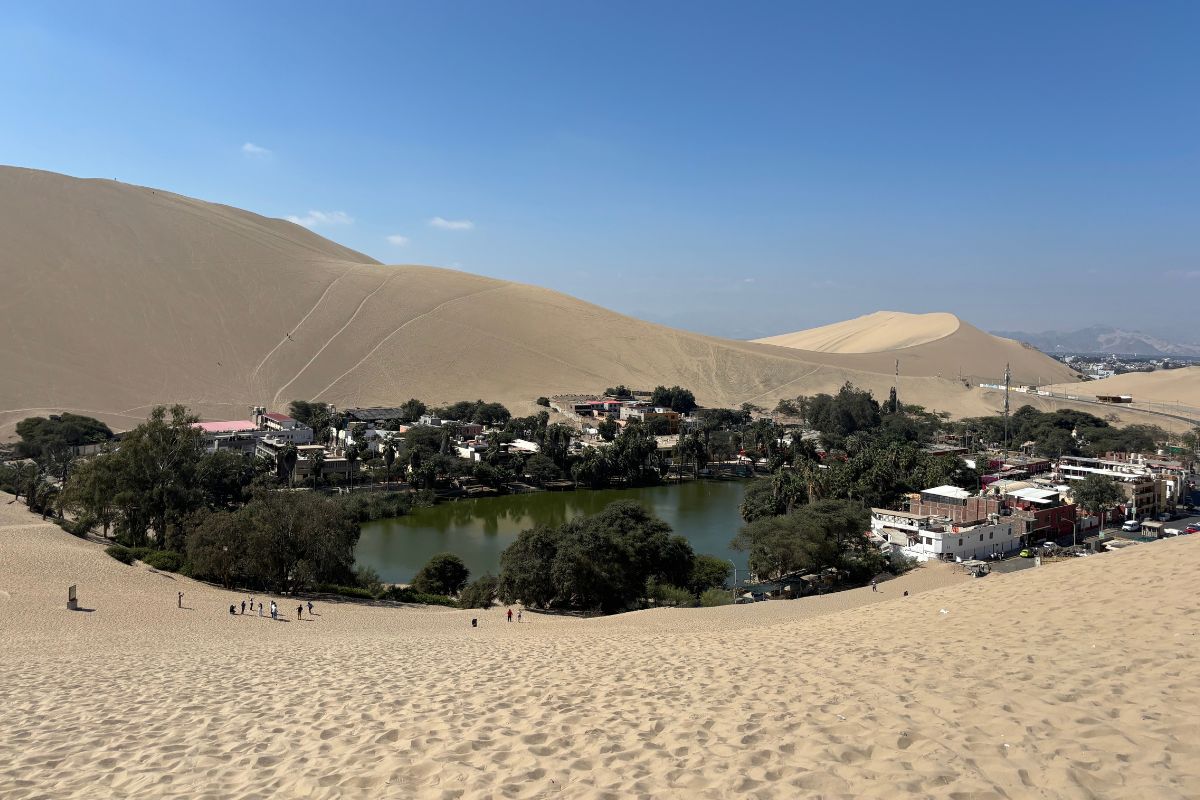
As we climbed, I could see trees appearing below us. Then we got high enough to look down and suddenly there it was: a lake surrounded by palms and buildings, completely encircled by sand.
My immediate reaction was basically: wow, it really is real.
Before visiting, I’d wondered whether Huacachina was one of those places that looks more impressive in carefully framed Instagram photos than it does in person. Instead, that tiny patch of green and water surrounded by enormous dunes looked almost more improbable in real life.
Huacachina absolutely has a wow factor. What surprised me was how little time you actually need to experience it.
Huacachina & Ica at a Glance
Worth visiting? Yes. The oasis and enormous dunes impressed me more in person than in photos.
Main experience: Dune buggies and sandboarding, followed by time around the lagoon near sunset.
Where we stayed: Ica, a short drive from Huacachina, made returning for dinner easy.
What else deserves time: A leisurely lunch and winery tour at Tacama were highlights.
My takeaway: Plan Huacachina alongside Ica’s wine and pisco experiences, rather than expecting the oasis alone to fill your stay.
What Is Huacachina?
Huacachina is a tiny natural desert oasis immediately outside the city of Ica, about four to five hours south of Lima and roughly an hour inland from Paracas.
And yes, the oasis itself is real. The lagoon wasn’t created as a tourist attraction. Huacachina developed around a naturally occurring lagoon in the middle of Peru’s coastal desert, and over time hotels, restaurants, and other businesses grew around it as the area became a popular place to visit. Today, the lagoon and surrounding desert are part of a protected conservation area.
The lagoon and palm trees are surrounded by genuinely enormous dunes, while the little tourist center is filled with hotels, restaurants, tour agencies, and souvenir vendors.
And when I say little, I mean little.
Before visiting, I had mentally pictured Huacachina as more of a desert town. In reality, everything wraps around a small lagoon that you can walk around remarkably quickly.
Dune buggies and sandboarding get most of the attention, but you don’t have to spend your entire visit flying across the desert. The lagoon itself is easy to walk around, with restaurants, small shops, and places to sit along the way. We also saw little pedal boats out on the water, which could be a fun option if you want something considerably calmer than a dune buggy.
You can also climb the surrounding dunes on your own. Plenty of people were making their way up as sunset approached, and from the top you get the classic view looking down over the lagoon with Ica stretching out beyond the sand.
That said, I wouldn’t build a huge sightseeing list for Huacachina. Part of the appeal is simply being somewhere that looks so unusual. Walk around the lagoon, stop for a drink or dinner, get out onto the dunes, and give yourself enough time to see the oasis as the light changes.
The dunes are still the main event.
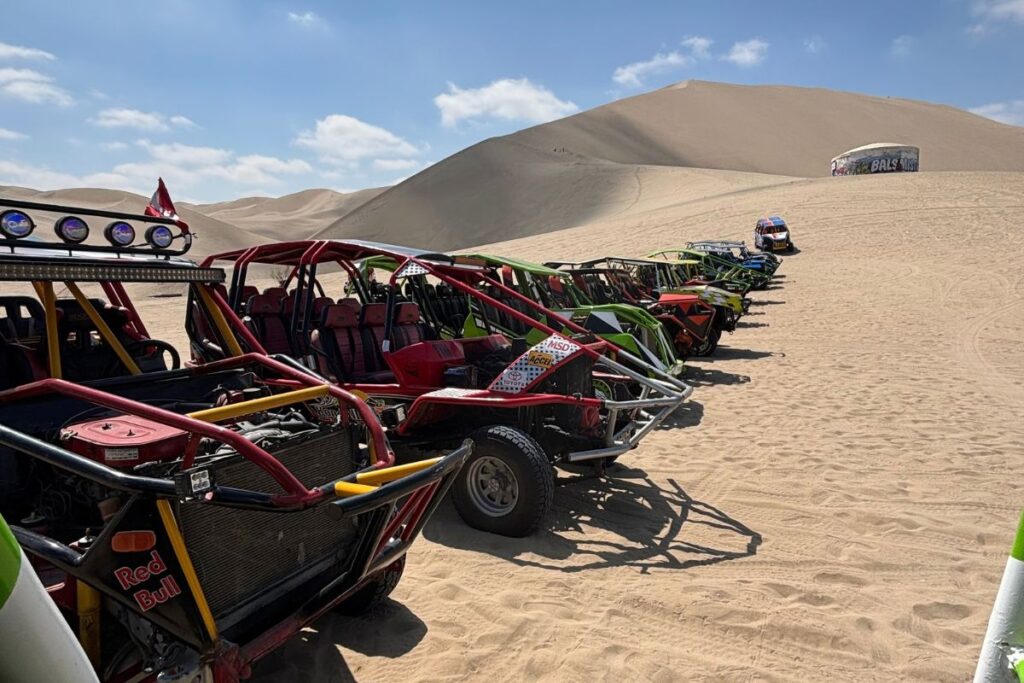
The dune buggies looked intimidating from the start but this ended up being one of the most fun things we did in Huacachina.
Are the Huacachina Dune Buggies Worth It?
This was the activity I was most unsure about before visiting.
Every video I’d seen made the dune buggies look somewhere between a sightseeing excursion and a roller coaster without tracks. I’m not someone who needs an adrenaline activity everywhere I travel, so when it came time to choose my seat, I deliberately went for the middle.
I wasn’t taking any chances.
Then we started moving.
There are sharp turns, moments when the buggy feels like it’s traveling sideways across the dunes, and that split-second anticipation when you reach the top of a drop and know you’re about to go down the other side.
But I had an absolute blast.
The ride was less intense than I had imagined but somehow more fun than I expected. It was thrilling without reaching the point where I was wondering why I’d agreed to it.
I attempted to take videos along the way, which was its own adventure. You’re bouncing around so much that every bump sends the camera pointing somewhere completely different.
Even if adrenaline activities aren’t normally your thing, I wouldn’t automatically skip this one. The buggy is fun, but it’s also one of the best ways to get out into the desert and appreciate just how massive the surrounding dunes really are.
What Is Sandboarding Actually Like?
Then came sandboarding, and I had a little baggage here.
I’d previously gone volcano boarding down Cerro Negro outside León, Nicaragua, and I still remembered looking down that enormous black volcanic slope and questioning several of my life choices.
So when I looked down the first dune in Huacachina, I hesitated. Fortunately, I immediately noticed two things: this was a much shorter drop, and we weren’t going nearly as fast.
I still made my dad go first.
Once it was my turn, the entire ride probably lasted about five seconds and I actually really enjoyed it.
For us, sandboarding felt less like an extreme sport and more like a fun addition to the buggy experience. You slide down, laugh, collect yourself at the bottom, and get back into the buggy.
Sandboarding was optional on our excursion. Someone in our group skipped it and rode down with the driver in the buggy to meet us at the bottom. The group was small, so the stop only took a few minutes, and we probably spent more time taking photos than actually sliding down.
If sandboarding doesn’t appeal to you, I wouldn’t let it put you off the dune buggy excursion. For me, it was a fun bonus rather than the reason to go.
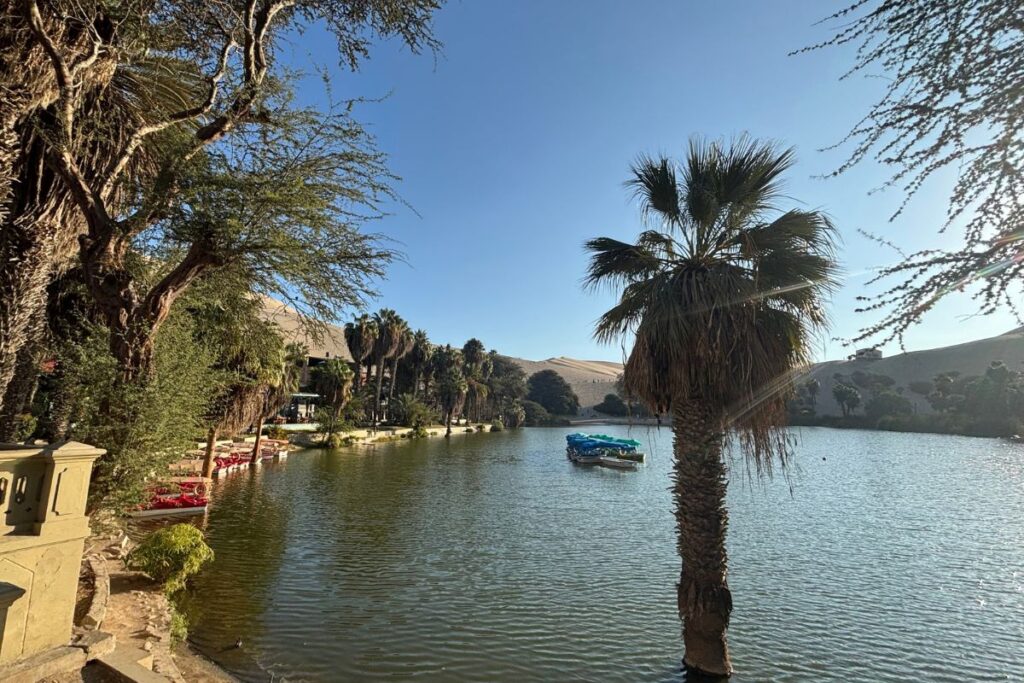
Coming back to Huacachina later in the day gave us time to slow down and experience the oasis beyond the dune buggies and sandboarding.
Huacachina at Sunset
Our first visit to Huacachina was almost entirely about the dunes. Once the buggy and sandboarding excursion ended, our driver took us to our Airbnb in Ica. We checked in, changed, realized how hungry we were, and promptly headed straight back.
This time, we actually got to slow down and experience the oasis itself.
We arrived shortly before sunset and took advantage of the remaining light for photos. Dune buggies were still heading into the desert, while other visitors were climbing the dunes surrounding the lagoon to watch the sunset from above.
That’s actually the one Huacachina experience I wouldn’t mind coming back to do. I would happily sit at the top of a dune and watch the sun disappear over the desert.
Getting myself up there is another matter. I was perfectly content staying on flat land this time.
From below, the lagoon was beautiful as the light changed. The trees reflected around the water, the dunes rose behind everything, and Huacachina really did feel like the little desert oasis I’d seen in photographs.
We stayed for dinner and walked around the lagoon afterward, browsing the handful of vendors along the way. Within about half an hour, we’d essentially made our way around the oasis.
Had we based ourselves in Ica for the entire Paracas-Ica-Huacachina portion of our trip, I probably would have come back one more time.
Not because there was something else I needed to do, but because I’d want another chance at that perfect Huacachina sunset moment, this time from the top of one of the dunes.
That’s ultimately what I liked about Huacachina. There isn’t an endless list of attractions, but the landscape itself is special enough that I wouldn’t have minded seeing it one more time.
Should You Stay in Huacachina or Ica?
This was one of the decisions I second-guessed most while planning the trip.
Would we regret staying in Ica? Would Huacachina have more atmosphere at night? Would we constantly be traveling back and forth?
After visiting, I’m very happy we stayed in Ica.
Huacachina is only around 10–15 minutes from central Ica. We could do the dune activities, head to our Airbnb to shower and change, and return for sunset and dinner without thinking twice about it.
Our accommodation reinforced that decision. We paid approximately $91 total for two nights for a spacious, modern Airbnb in Ica that we loved. Just a few days earlier, we’d paid roughly $301 for two nights in Paracas for an Airbnb that wasn’t nearly as nice.
Obviously, those are two individual properties rather than a scientific comparison of accommodation prices. But while searching, hotels and Airbnbs in Ica generally felt more comfortable price-wise, too.
Most importantly, I didn’t feel like we’d sacrificed the Huacachina experience by sleeping somewhere else.
I wouldn’t stay in Ica because the city itself is more exciting than Huacachina. I’d stay there because it gives you a comfortable, practical base with Huacachina practically on your doorstep.
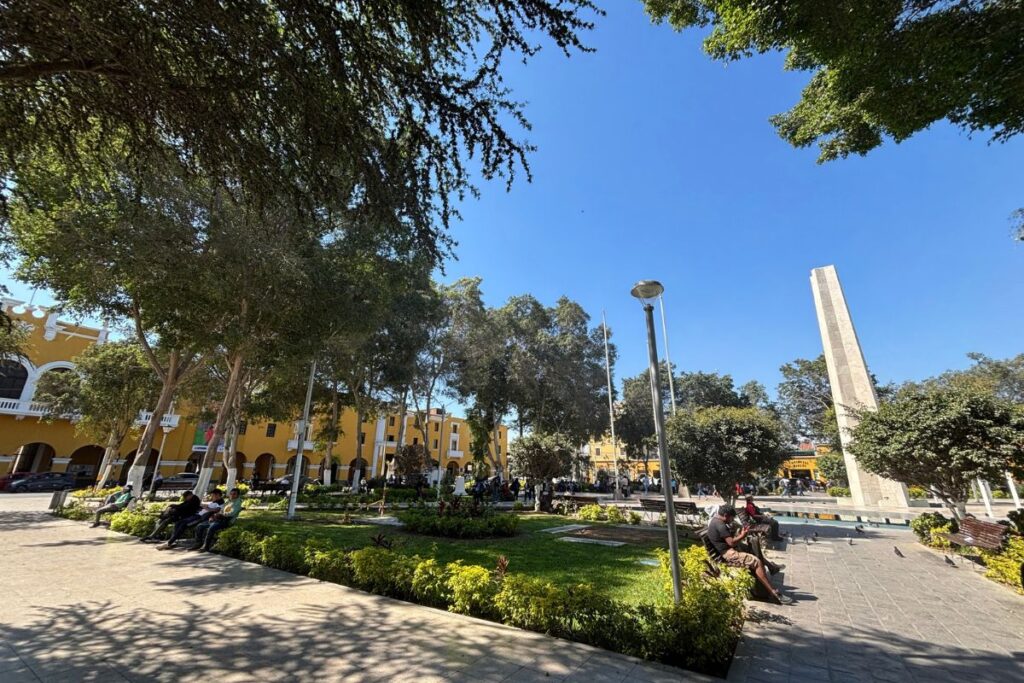
Ica feels much more like an everyday Peruvian city than nearby Huacachina, and its compact Plaza de Armas is worth a walk while you’re here.
What Is Ica Actually Like?
Ica itself isn’t somewhere I’d tell an international traveler to visit for the city sights alone.
It felt like a smaller version of Lima to me: busy roads, traffic, shops, restaurants, and people going about their everyday lives. That’s part of what makes the enormous dunes appearing just outside the city feel so bizarre.
But Ica has something much more interesting going for it than conventional city sightseeing.
This is wine and pisco country.
The Ica Valley is one of Peru’s major wine and pisco-producing regions, with wineries and distilleries scattered around the surrounding countryside. Combine that with Huacachina practically next door, and there are enough worthwhile experiences to build a relaxed day around without inventing a long sightseeing checklist.
What to Do in Ica
Museo Regional de Ica: Worth a Quick Visit
If you have a little time in central Ica, I’d stop at the regional museum.
It’s small, and we spent roughly 30 minutes inside, but its collection gives you useful context for the civilizations that lived throughout this part of Peru, including the Paracas and Nazca cultures.
You’ll see archaeological pieces, ceramics, textiles, and human remains spanning different eras of the region’s history. It helps connect the places you’re traveling through with the cultures that lived in this part of Peru long before modern Ica existed.
One practical warning: most of the displays were in Spanish during our visit. If you don’t read Spanish comfortably, have Google Translate ready on your phone.
I wouldn’t allocate hours to the museum, but for half an hour, I thought it was worthwhile.
The Ica City Tour? I’d Skip It
We also technically took an Ica “city tour.”
I wouldn’t do that again.
Part of our transfer package included a stop in Cachiche, an area associated with Ica’s legends of witches. There’s a small plaza with witch statues, and apparently it’s well-known enough that my aunt immediately asked whether we’d visited.
We did. And you are not missing a major Peru experience if you don’t.
The tour also included the familiar “artisan stop” you may have encountered on organized tours elsewhere in Peru: a quick explanation, a few products to sample, and then time to browse.
Our Ica version was Nietto, a local distillery. The property was actually very cute, and we sampled around five wines and piscos before being shown the bottles available for purchase.
We didn’t buy anything, partly because I still have bottles of pisco from my last Peru trip that have essentially become keepsakes. The entire stop probably took no more than 30 minutes. Because we had a private driver rather than a large tour group, we simply got back into the car when we were finished and continued our day.
It wasn’t a bad experience. It just wasn’t the wine-and-pisco experience I’d specifically come to Ica for.
More than anything, the city tour reinforced something I increasingly believe about travel: you don’t need to fill time simply because you have it. If I had another free afternoon in Ica, I’d rather spend it slowly over lunch at a winery than assemble a list of minor attractions just to say I’d seen them.
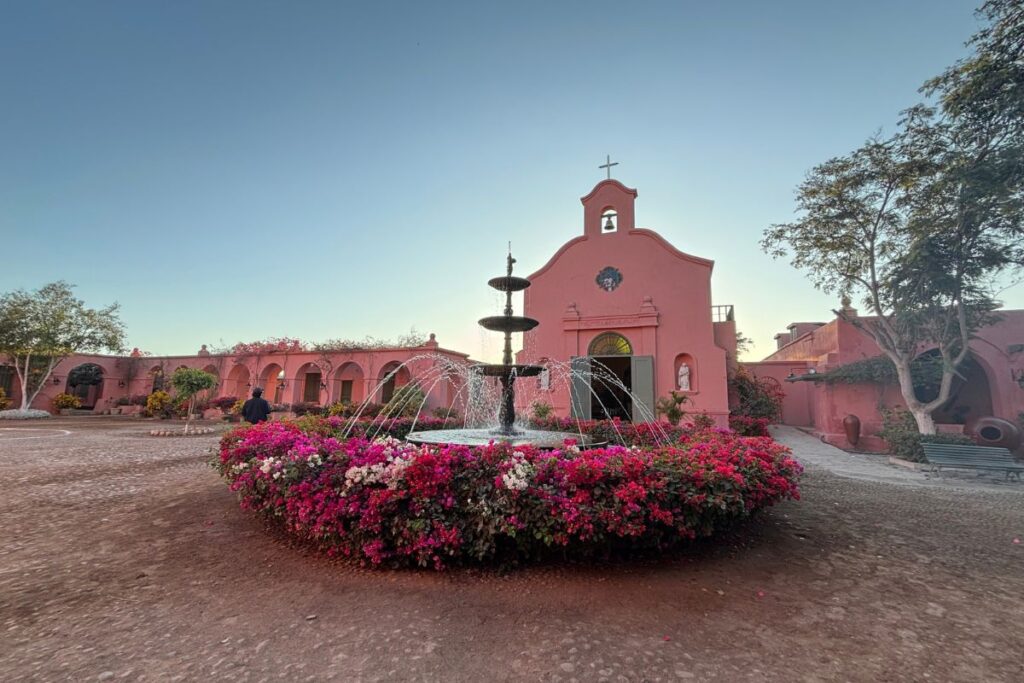
Tacama is much more than a quick wine tasting, the historic hacienda and grounds are part of what makes it worth setting aside a few hours in Ica.
Tacama Was the Ica Experience I Wouldn’t Skip
If I had one full day in Ica again, this is where I’d make time.
Tacama isn’t just somewhere you stop for a quick wine tasting. Between the winery, historic hacienda, vineyards, restaurant, and tours, you can easily spend several hours here without stretching the visit.
On our final day, we had a slow morning, visited the Museo Regional de Ica, and then headed to Tacama. We arrived around 3:00 PM and started with a late lunch.
The restaurant is a proper sit-down restaurant rather than simply somewhere to grab a snack before a tour. The food was very good, we ordered a bottle of wine for the table, and I loved being able to settle in and enjoy the property without immediately rushing into another activity.
By the time we finished eating, it was almost time for our tour.
What Is the Tacama Winery Tour Like?
Tacama offers several different tour experiences, so you can choose based on how much time you have and how deeply you want to get into the wine and pisco production.
We chose one of the more traditional tours, which cost S/45 per person during our visit and lasted about an hour and a half. There are shorter options if you mainly want an introduction to the property, along with more in-depth experiences if you want to spend more time learning about the wines and piscos.
Our tour took us through the production facilities, where we learned more about how Tacama makes its wines and piscos. During this portion, we also sat down for a tasting of three wines and one pisco, before continuing through the grounds and historic parts of the property.
The tasting was probably the one part of the tour I would have slowed down. We had enough time to taste everything and hear about what we were drinking, but I would have happily spent a little longer enjoying each one before moving on.
That’s probably why the tour somehow felt both a little long and a little rushed at the same time. There was plenty of information packed into the hour and a half, but I would have traded a little of the tour time for a more leisurely tasting.
Still, I really enjoyed the experience.
Visit Tacama in the Late Afternoon
One thing we got absolutely right, mostly by accident, was the timing.
Because we arrived for lunch around 3:00 PM and joined the 4:30 PM tour, the later part of our visit coincided with sunset.
My favorite stop was climbing the property’s small bell tower and looking out across the surrounding land toward the distant foothills. In the late-afternoon light, it was gorgeous.
We visited in August, which is winter in Peru and after the main grape harvest, so the vines weren’t lush or full of grapes. Even so, the vineyards and distant foothills made a beautiful backdrop, especially in the late-afternoon light.
Walking around Tacama as the sun began to set was beautiful, and between the leisurely lunch, wine, tour, tasting, and grounds, it felt like a much more complete introduction to Ica’s wine culture than a quick tasting stop.
Even if you’re not someone who wants to spend an entire vacation visiting wineries, I’d make room for Tacama while you’re in Ica.
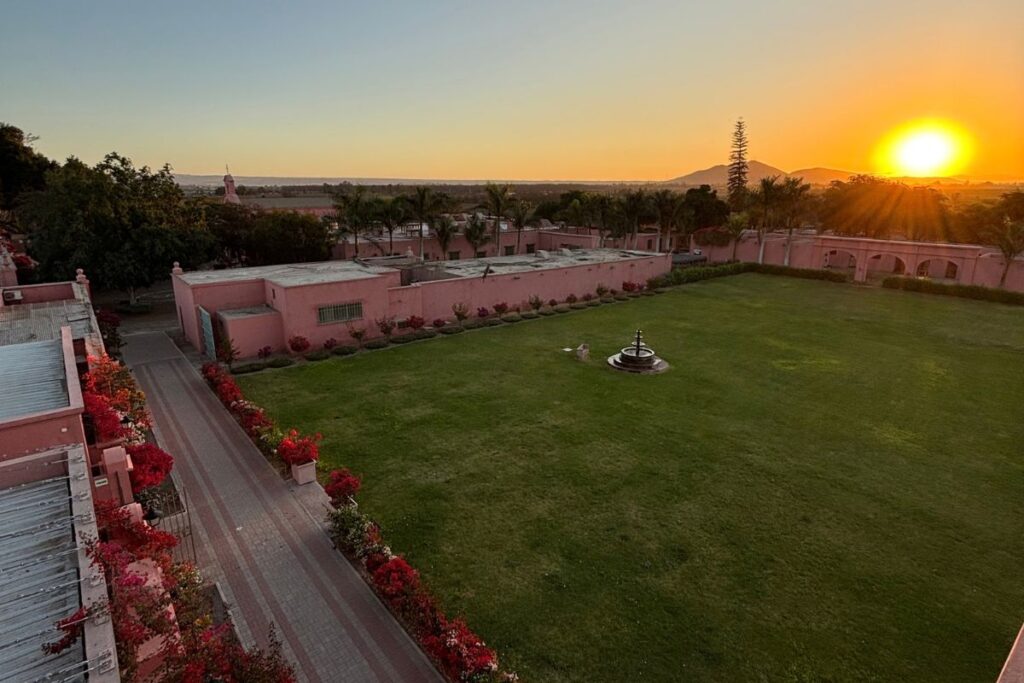
Ending a slow afternoon at Tacama as the sun set over the Ica Valley.
A Slow Day in Ica Was Exactly What We Needed
Looking back, our final day was remarkably simple.
We slept in, spent about half an hour at the museum, and then headed to Tacama for the rest of the afternoon.
That was essentially our entire day.
And it was a great last day in Ica.
Earlier in the trip, we’d taken the city tour partly because we had time and figured we should see the sights. By our final day, we’d stopped trying to fill every hour, and I think the second approach was much better.
Ica doesn’t need an enormous sightseeing checklist. A slow morning, a little history, and an afternoon enjoying the region’s wine and pisco culture felt like plenty.
So, Is Huacachina Worth Visiting?
Absolutely.
Before visiting, I thought there was a real possibility that Huacachina would turn out to be one of those destinations that photographs better than it feels in person.
Instead, the opposite happened.
That first glimpse of the lagoon surrounded by palms and enormous dunes really did make me think, wow, it’s real. The dune buggy and sandboarding were more fun than I expected, and coming back for sunset gave us a completely different experience of the oasis.
What changed was my understanding of how Huacachina fits into a trip through this part of Peru.
You don’t need an entire day packed with Huacachina attractions. Go flying around the dunes. Slide down one even if you make your dad test it first. Walk around the lagoon. Come back for sunset and dinner if you have the chance.
Then give yourself time for Ica, too.
An afternoon of wine and pisco ended up being just as memorable for me as the dunes, and together they made this part of the trip feel much more complete than if we’d treated Ica as nothing more than the city next to Huacachina.
And once I started thinking about Ica and Huacachina together, it also changed the way I looked at our time in Paracas.
We had split this portion of the trip between two nights in Paracas and two nights in Ica. After actually experiencing all three places, I realized just how close everything was—and started questioning whether we really needed to move at all.
That doesn’t change how I feel about Huacachina itself.
It’s absolutely worth visiting. I just wouldn’t plan this part of Peru around Huacachina alone.
Continue Exploring Peru
- Is Paracas Worth Visiting? — Compare the desert oasis with a coastal stop you could include on the same route.
- How Many Days Do You Need in Paracas, Ica, and Huacachina? — Give each stop enough time without turning the route into a rush.
- Why I Used a Local Agency for Machu Picchu—Twice — See how I approached planning a very different Peru experience.
- Peru Is More Than Machu Picchu — Discover where the desert fits into the country’s wider range of landscapes.